Hanifaru Bay Dive Site
Baa Atoll, Maldives · Near Dharavandhoo
Overview
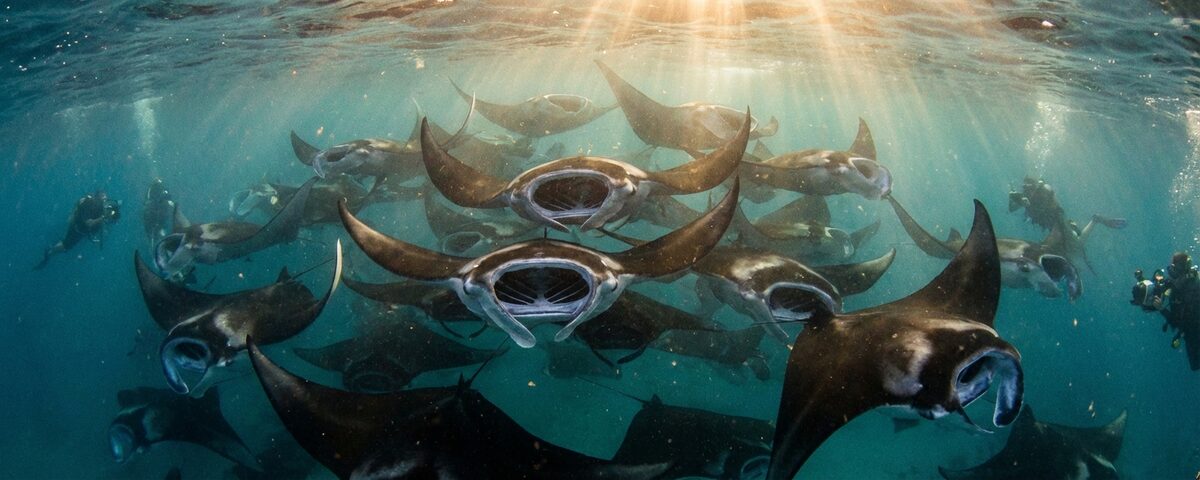
Hanifaru Bay is where the largest known aggregation of reef manta rays on Earth gathers to feed. That is not marketing copy. During peak season, up to 200 manta rays pack into a bay barely 200 metres across, barrel rolling through plankton-thick water in one of the most extraordinary wildlife spectacles available anywhere in the ocean. Whale sharks frequently join them. The whole event happens in water shallow enough for snorkellers to watch from the surface.
The bay sits inside Baa Atoll, on the eastern side of Hanifaru Island, protected as part of a UNESCO Biosphere Reserve since 2011. The geography is the key to everything. Hanifaru is a small, uninhabited island with a curved bay that acts as a natural funnel. When the southwest monsoon pushes plankton-rich water across the atoll, tidal currents concentrate that plankton into the bay like a net. The mantas follow the food.
On a good day, the water turns soupy with zooplankton and the mantas arrive in waves. They start with a few individuals cruising the bay entrance, mouths open in the characteristic feeding position. Within an hour, dozens more appear. When conditions peak, the bay fills with mantas stacked three or four deep, rolling over each other in feeding chains, their wingspans of three to four metres filling every available space. Whale sharks, sometimes four or five at once, weave through the mantas, their massive bodies dwarfing everything else in the water.
The Maldivian government recognised what they had and locked it down. Scuba diving was banned in Hanifaru Bay in 2009 after concerns about bubble disturbance affecting the feeding aggregation. The site is now snorkel only, with strict permit limits and ranger supervision. Only a limited number of snorkellers are allowed in the bay at any time, and tour operators must follow specific approach and behaviour guidelines. The restrictions work. The aggregation has been consistent since monitoring began, and the mantas show no signs of abandoning the bay.
Hanifaru Bay is not a normal dive site. It is a wildlife event, closer in character to East Africa's Great Migration or a whale calving ground than to a typical reef dive. You do not visit Hanifaru Bay for coral or for the fish life. You visit because on the right day, you will float above more manta rays than most divers see in a lifetime.
Scuba diving is available at nearby sites around Baa Atoll, and many operators combine a morning snorkel at Hanifaru with afternoon dives on surrounding reefs. The atoll itself has excellent diving independent of the bay, but Hanifaru is the headliner. Everything else is the support act.
Marine Life at Hanifaru Bay
Manta rays dominate Hanifaru Bay so completely that everything else becomes background. The species here is the reef manta ray (Mobula alfredi), smaller than its oceanic cousin but still reaching wingspans of four metres or more. Individual mantas have been identified and catalogued by their unique belly markings, and researchers at the Manta Trust have documented over 5,000 individual mantas visiting Hanifaru since monitoring began. Some return year after year, with records stretching back over a decade.
The feeding behaviour is what sets Hanifaru apart from every other manta site on Earth. At most locations, you see mantas cruising cleaning stations or doing the occasional somersault through a plankton patch. At Hanifaru, the feeding is industrial. Barrel rolling is the signature move: a manta turns onto its back, opens its mouth wide, and spirals through the densest plankton concentration, straining water through its gill plates. When multiple mantas barrel roll simultaneously, which happens regularly during peak events, the effect is mesmerising. Cyclone feeding, where mantas form rotating chains nose to tail, occurs during the densest aggregations. A cyclone of twenty or thirty mantas circling in formation is something that stays with you.
Whale sharks appear regularly between August and November. They feed on the same plankton concentrations that attract the mantas, and seeing both species feeding side by side in the same bay is a combination that exists almost nowhere else. The whale sharks at Hanifaru are typically juveniles, three to six metres long, though larger individuals have been recorded.
Beyond the megafauna, the bay holds reef fish populations typical of Maldivian waters. Fusilier schools stream past, and the reef edges host parrotfish, surgeonfish, and the occasional Napoleon wrasse. Blacktip reef sharks patrol the bay entrance. But nobody comes to Hanifaru for the reef fish.
Outside the bay, the surrounding reefs of Baa Atoll support healthy coral formations, hawksbill turtles, and the cleaning stations where mantas go when they are not feeding. Dhonfanu Thila and Nelivaru Haa are nearby dive sites where you can encounter mantas in a more traditional diving context, gliding over cleaning stations while cleaner wrasse pick parasites from their gills.
Dive Conditions
Hanifaru Bay operates under a unique set of conditions that you need to understand before visiting. This is not a site where you rock up and jump in whenever you fancy.
Scuba diving is prohibited inside the bay itself. The Maldivian Environmental Protection Agency banned tanks in 2009 to prevent bubble disturbance during feeding events. All in-water activity at Hanifaru is snorkelling only, supervised by park rangers. This is not optional, and operators who attempt to circumvent the rule face serious penalties including licence revocation.
The bay is shallow, with depths of one to fifteen metres across most of the area. The feeding activity typically happens in the top five metres, making it perfect for snorkelling and frustrating for anyone who thinks they need scuba gear. You do not. The mantas feed at the surface, often close enough to touch (though touching is absolutely prohibited). Floating quietly at the surface while a four-metre manta rolls beneath you is a more intimate experience than most scuba encounters.
Water conditions vary dramatically depending on the feeding event. On calm days without a major aggregation, visibility can reach 25 metres and the bay is a pleasant, easy snorkel. When a feeding event kicks off, the water turns green with plankton and visibility drops to five metres or less. This is actually what you want. Poor visibility means dense plankton, which means the mantas are feeding hard. The mantas materialise out of the murk right in front of you, which is far more dramatic than watching them from a distance in clear water.
Currents can be significant, particularly at the bay entrance during tidal changes. The same tidal flows that concentrate plankton also create currents that can sweep snorkellers into or out of the bay. Rangers and boat crew monitor conditions constantly and will pull snorkellers out if the current becomes dangerous. Wearing fins and maintaining reasonable fitness are both necessary.
Water temperature is a comfortable 27 to 30 degrees Celsius year-round, typical for the Maldives. A rash guard or thin wetsuit is sufficient for thermal protection. Some snorkellers prefer a shorty wetsuit for the buoyancy assistance.
The feeding season runs from June to November, with peak activity in August and September. Outside these months, the bay is quiet and there is little reason to visit. The aggregation depends on the southwest monsoon driving plankton into the bay, and without that weather pattern, the mantas disperse across the atoll to feed elsewhere.
Permit numbers are limited. Each operator receives a set number of permits per day, and when they are gone, they are gone. During peak season, operators may visit the bay in the morning and find the permits already allocated. Booking with a resort or liveaboard based in Baa Atoll gives you the best chance of securing permits on good days, as local operators have priority access.
⚓ Divemaster Notes
Hanifaru Bay is a snorkel site, and the ranger briefing is mandatory for all visitors regardless of experience. Listen to it, follow it, and enforce the rules with your group. The rangers take infractions seriously and will ban operators who allow their guests to touch mantas, freedive aggressively, or block feeding paths.
Brief your group before leaving the boat. The rules are simple but people forget them in the excitement: no touching any marine life, maintain a three-metre distance from mantas and whale sharks, no freediving directly into feeding groups, no flash photography, and stay horizontal at the surface. Vertical snorkellers with dangling legs are the most common source of manta interference.
Watch the current before putting people in the water. The bay entrance can run hard during tidal shifts, and weaker swimmers will struggle. Position your boat so the current carries snorkellers into the bay rather than out of it. Post a crew member on the boat watching the group at all times.
During a major feeding event, the temptation to get as close as possible is overwhelming. Resist it. The mantas are so focused on feeding that they will approach you anyway. Floating still at the surface produces better encounters than chasing, because the mantas do not alter course for a stationary snorkeller but will veer away from someone swimming at them. Tell your group this repeatedly. The people who float quietly and wait will have mantas pass within a metre of their mask. The ones who swim frantically towards every manta will spend the session watching them bank away.
Photography guidance: wide-angle or GoPro type cameras are best. The proximity of the mantas means telephoto is pointless. Shoot upward to silhouette the mantas against the surface light for the most dramatic images. Barrel rolling mantas photographed from below with light streaming past their wings produce the iconic Hanifaru shots.
After the session, log the encounter. Note approximate manta count, whether whale sharks were present, water conditions, and any identifiable individuals (melanistic mantas are easy to spot). This data is valuable to the Manta Trust researchers who work in the atoll.
How to Get to Hanifaru Bay
Hanifaru Bay is in Baa Atoll, roughly 120 kilometres north of Malé, the Maldivian capital. The nearest inhabited island is Dharavandhoo, which has a domestic airport.
From Malé, there are two main routes. The fastest is a domestic flight to Dharavandhoo Airport (Ifuru), operated by Maldivian Airlines and FlyMe. Flight time is about 25 minutes. From Dharavandhoo, your resort or liveaboard arranges a speedboat transfer to the accommodation, which takes anywhere from 10 minutes to an hour depending on where in the atoll you are staying.
The alternative is a seaplane transfer directly to your resort, which most of the premium resorts in Baa Atoll offer. Seaplane transfers from Malé take about 30 minutes and land on the water near the resort. They run during daylight hours only and cost significantly more than the domestic flight, but the aerial views of the atolls are worth it if your budget allows.
Public speedboats run from Malé to various islands in Baa Atoll, but schedules are irregular and journey times are long (3 to 4 hours). This option works for budget travellers but is not practical if your primary goal is maximising time at Hanifaru.
From Dharavandhoo or your resort, Hanifaru Bay is a 10 to 30 minute boat ride depending on your starting point. Operators typically check conditions at the bay before committing to a trip, watching for reports from rangers about manta activity. On days when the aggregation is happening, boats converge quickly.
International flights arrive at Velana International Airport in Malé. Most airlines serving the Maldives operate through Malé, including Emirates, Qatar Airways, Singapore Airlines, Sri Lankan Airlines, and Turkish Airlines. Allow time for the domestic connection; if your international flight arrives late, you will need an overnight in Malé before continuing to Baa Atoll.
Gear Recommendations
This is a snorkel site, so gear requirements are straightforward compared to a scuba dive.
A well-fitting mask and snorkel are essential. Bring your own if you are particular about fit. Resort and operator rental masks range from excellent to appalling, and a leaking mask during a once-in-a-lifetime manta encounter is the kind of frustration you can prevent with a 50-dollar investment. Anti-fog treatment applied before entering the water makes a real difference when you are face-down for an extended period.
Fins are mandatory, not optional. The currents in and around the bay can require sustained swimming, and attempting Hanifaru Bay without fins risks exhaustion and drift. Full-foot fins work for warm water, but open-heel fins with booties offer better propulsion if you are swimming against current.
A rash guard provides sun protection and light thermal insulation. Water temperature rarely drops below 27 degrees, so a full wetsuit is unnecessary for most people. Those who get cold easily might prefer a 1mm or 2mm shorty. The buoyancy from neoprene also helps you float effortlessly at the surface, which is where you want to be.
For photography, a GoPro or similar action camera with a wide-angle lens is the practical choice. The close proximity of the mantas means you do not need a big camera rig, and the variable visibility makes autofocus and wide framing more useful than manual controls. If you are bringing a proper underwater camera, a fisheye or ultra-wide rectilinear lens is the right choice. Strobes are permitted but use them sensibly; continuous firing into a manta's face at close range is poor etiquette.
A flotation vest or noodle is worth considering for weaker swimmers or anyone who wants to conserve energy during long surface watches. Some operators provide them as standard. There is no shame in using one, and it frees your attention from staying afloat to watching the spectacle below you.
Sunscreen should be reef-safe (mineral based, no oxybenzone or octinoxate). You are swimming in a protected marine area alongside the largest manta aggregation on Earth. Chemical sunscreens washing off into the feeding water is exactly the kind of contamination the UNESCO protection exists to prevent.
Recommended Dive Operators
Soneva Fushi is the flagship luxury resort in Baa Atoll, located on Kunfunadhoo Island. Their marine biology team runs dedicated Hanifaru Bay excursions during the season, and their in-house manta biologist provides briefings that add real educational value to the experience. The resort has strong permit access and will adjust daily schedules around feeding events. It is expensive, properly expensive, but the marine programme is outstanding.
Amilla Maldives is another high-end option in Baa Atoll with excellent Hanifaru access. Their dive centre partners with the Manta Trust for research and identification work. Guests can participate in citizen science during snorkel trips, photographing manta belly patterns for the identification database.
The Nautilus Maldives offers a boutique luxury experience on Thiladhoo Island with a strong focus on marine encounters. Their house reef is one of the best in the atoll, and they run Hanifaru trips with small group sizes.
For mid-range budgets, local guesthouses on Dharavandhoo offer Hanifaru Bay trips at a fraction of resort prices. Dharavandhoo Divers and Atoll Transfer operate regular snorkel excursions during the season. The experience in the water is identical. You are in the same bay, seeing the same mantas. What differs is the comfort of your accommodation and the quality of the briefing.
Liveaboard safaris passing through Baa Atoll during the season include Hanifaru Bay on their itineraries. The advantage of a liveaboard is flexibility, as the boat can reposition to be near Hanifaru when conditions look promising rather than committing to a single departure time. Carpe Diem Fleet and Explorer Ventures both run Baa Atoll itineraries during the monsoon season.
Liveaboard Options
Liveaboard safaris that include Baa Atoll during the southwest monsoon season (June to November) offer one of the best ways to experience Hanifaru Bay without committing to a single resort.
The main advantage of a liveaboard for Hanifaru is scheduling flexibility. When the feeding aggregation depends on tidal conditions and plankton density, both of which change daily, a liveaboard can reposition to be near Hanifaru Bay on the best days and dive other Baa Atoll sites on quieter ones. Resort guests are more locked into their operator's schedule.
Carpe Diem Maldives operates dedicated Baa Atoll itineraries during the manta season. Their route typically covers Hanifaru Bay for snorkelling alongside dive sites throughout Baa Atoll and neighbouring Raa Atoll. The crew have years of experience reading the conditions and timing Hanifaru visits for maximum manta activity.
Explorer Ventures runs seasonal Maldives itineraries that swing through Baa Atoll during the monsoon months. Their boats carry dive and snorkel gear, so you can scuba dive surrounding reefs in the morning and snorkel Hanifaru in the afternoon (or vice versa, depending on conditions).
Scubaspa is a hybrid dive-liveaboard-spa vessel that offers Baa Atoll routes. If the idea of a spa treatment between manta encounters appeals, this is your boat.
Most Maldives liveaboard itineraries during June to November include at least one or two days in Baa Atoll with Hanifaru Bay access. Confirm the specific itinerary when booking, as some routes spend more time in the central atolls and only pass through Baa briefly.
Pricing for a week-long liveaboard in the Maldives starts from around 1,500 USD for budget boats and runs to 5,000 USD or more for premium vessels. The monsoon season is not peak tourist season for the Maldives (that is December to April), so liveaboard rates during Hanifaru season are often lower than the dry season premium. This works in your favour.
Book well in advance for August and September departures. These peak manta months attract dedicated manta enthusiasts who plan a year ahead. July and October offer good aggregation chances with slightly easier booking availability.