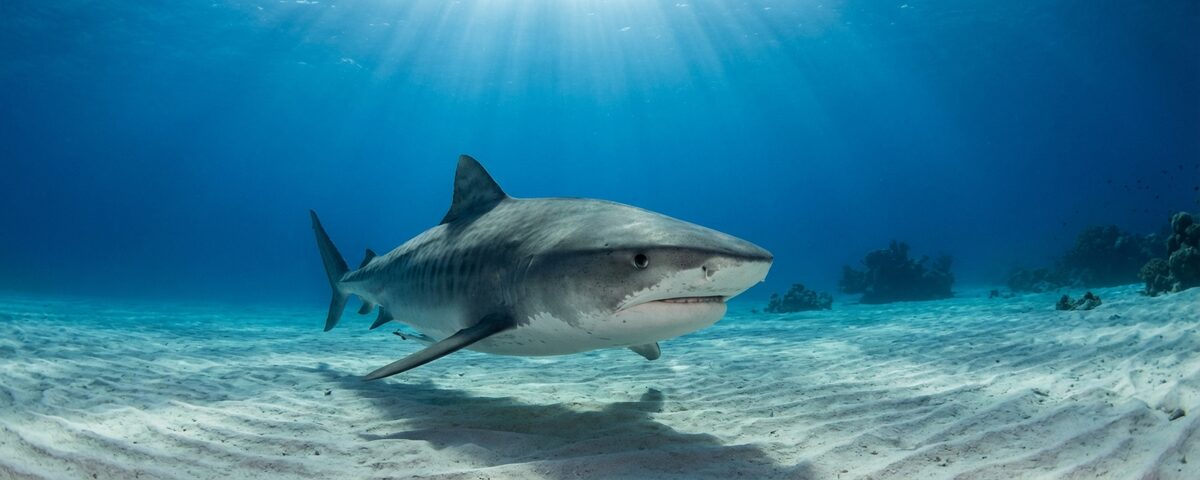
Fuvahmulah Dive Site
Gnaviyani Atoll, Maldives · Near Fuvahmulah
Overview
Fuvahmulah sits alone in the equatorial Indian Ocean, 500 kilometres south of Malé, and it has quietly become one of the most remarkable shark diving destinations on the planet. This single-island atoll in Gnaviyani Atoll is the only place in the Maldives (and one of very few places worldwide) where tiger sharks are encountered on virtually every dive, year-round. Not seasonally. Not occasionally. Reliably, consistently, and at close range.
The island's isolation is the key to everything. Unlike the classic Maldivian atolls with their sheltered lagoons and channel dives, Fuvahmulah drops straight into deep ocean on all sides. The reef shelf extends perhaps 20 to 30 metres from shore before plunging into open blue. This geography means pelagic species that would normally pass through channels here simply live at the reef's edge. Tiger sharks patrol the harbour and southern tip. Thresher sharks appear at cleaning stations in the early morning. Oceanic manta rays cruise past in the blue. Whale sharks turn up with startling regularity during the northeast monsoon.
The diving here feels fundamentally different from anywhere else in the Maldives. There are no soft coral-draped overhangs, no channels funnelling current, no protected thila pinnacles to circle. Instead, you drop into the blue off a harbour wall or reef edge and wait for the ocean to come to you. The sharks are not baited, not fed, and not aggregated artificially. They're simply present because the island's position on deep oceanic currents puts it at a natural crossroads for large marine life.
Fuvahmulah remained virtually unknown to the dive world until around 2017, when local operators began offering dedicated shark diving trips. Word spread fast once the first tiger shark videos hit social media, and the island now draws a growing number of experienced divers who've exhausted the Maldives' more traditional offerings and want something raw. The infrastructure remains small-scale: a handful of guesthouses, two or three dive operators, and no resort hotels. This isn't polished luxury diving. It's frontier pelagic diving with big-animal encounters that rival the Galápagos or Socorro.
For divers who care about sharks, Fuvahmulah is non-negotiable. The tiger shark encounters alone justify the trip. Everything else that shows up is a bonus, and the bonus list is genuinely extraordinary.
Marine Life at Fuvahmulah
Tiger sharks are the reason people come, and they deliver. The resident population around Fuvahmulah's southern tip and harbour area numbers somewhere between 10 and 30 individuals at any given time, with some sharks identified across multiple years of photo-ID records. They range from 2.5 to over 4 metres in length, and they're not distant silhouettes in the blue. On a typical dive, tigers cruise within 3 to 8 metres of divers, sometimes closer. They move slowly, deliberately, making wide passes with unmistakable confidence. First-timers often comment on how calm the sharks are. Not indifferent exactly, but unhurried. They've seen divers before and they're not bothered.
Thresher sharks are the early-morning draw. They come to cleaning stations on the reef edge at depths of 25 to 35 metres, arriving in the half-light before sunrise. The encounters are typically brief (2 to 5 minutes before the shark moves off), but watching a thresher hover at a cleaning station, tail streaming behind like a scythe, is genuinely mesmerising. Fuvahmulah is one of only three or four reliable thresher shark sites in the world, alongside Malapascua in the Philippines.
Oceanic manta rays pass through regularly, particularly between November and April. These are not the smaller reef mantas common at Lankan and Hanifaru; these are Mobula birostris, the giants, with wingspans reaching 5 metres or more. They appear in the blue water column, often cruising at 15 to 20 metres, and sometimes make several slow passes if divers hold still.
Whale sharks visit during the northeast monsoon, roughly December to March. Sightings are not guaranteed on every dive, but Fuvahmulah has one of the highest encounter rates in the Maldives during this window. The sharks tend to swim along the reef edge at the surface or just below, feeding on plankton concentrated by the island's current shadow.
Hammerhead sharks (scalloped) appear on deeper dives below 30 metres, usually in the morning. Singles and small groups are more common than the large schools found at sites like Rasdhoo, but the encounters happen close and in good visibility.
Silver-tip sharks patrol the deeper sections of the reef drop-off, typically at 25 to 35 metres. Grey reef sharks are present in smaller numbers than at classic Maldivian channel dives, but they show up regularly. Whitetip reef sharks rest on the sandy patches near the harbour.
Beyond sharks, Fuvahmulah delivers schooling tuna (dogtooth and yellowfin), barracuda in loose aggregations, Napoleon wrasse, and occasional sailfish sightings. The reef itself supports decent hard coral coverage, though the diving here is not about the reef. It's about what lives beyond it.
Dive Conditions
Fuvahmulah's conditions are shaped by its equatorial position and open-ocean exposure. There is no sheltered lagoon to hide in, no protected channel to duck into if conditions turn rough. When the ocean cooperates, the diving is spectacular. When it doesn't, you sit on shore and watch the swell.
Visibility is typically excellent, ranging from 20 to 40 metres on good days. The deep oceanic water surrounding the island carries less particulate than the atoll lagoon water of northern Maldives sites. During plankton blooms (often coinciding with whale shark season), visibility can drop to 15 metres, but the trade-off is usually worth it because the plankton brings the big filter feeders in.
Current varies from negligible to genuinely strong, and it can change direction during a single dive. The equatorial position means tidal patterns are less predictable than in the central atolls, and ocean currents from the Indian Ocean's deep circulation add an extra variable. Dive operators monitor conditions closely and will cancel dives without hesitation when currents or swell make entries unsafe.
The main dive sites sit along the island's southern coastline and around the harbour. Entries are typically from small dhonis (local boats) with backward rolls into the water. The harbour dive involves a descent along the harbour wall to around 20 metres, then drifting south along the reef edge where tigers patrol. The southern point dives start in open blue water and require comfort with mid-water descents where there's no reef reference below you.
Surface conditions matter here more than at most Maldivian sites. Southwest monsoon (May to October) can bring significant swell to the southern dive sites, limiting access. Northeast monsoon (November to April) generally produces calmer seas on the south side, though northerly sites can become exposed instead. Wind shifts can shut down diving for a day or two at a time, so building contingency days into your trip is wise.
Water temperature sits between 27 and 30 degrees year-round. A 3mm full wetsuit is standard; some divers add a hood for early morning thresher dives when water temperature at depth drops slightly.
Advanced Open Water is the minimum certification, but that really is the minimum. Operators look for a genuine logbook showing 50 or more dives, including open water and current experience. This is not the place to discover you're uncomfortable in blue water. The sharks are large, the water is deep, and the nearest reef wall is sometimes 10 metres behind you. Comfort with these conditions is essential, not optional.
⚓ Divemaster Notes
I've been guiding here since 2019, and Fuvahmulah still surprises me. Nowhere else in my career have I been able to tell guests with confidence: you will see tiger sharks today. Not might. Will. The encounter rate is above 95% on harbour dives during settled conditions, and the sharks behave with a calm that makes the whole experience workable even for divers who are nervous about being in the water with a 4-metre predator.
The harbour dive is where I take first-timers. We descend along the wall to 15 to 20 metres and settle on the sand at the base. The tigers tend to appear within 5 to 10 minutes, cruising in from the south or emerging from the deeper water off the wall's edge. I position the group in a loose semicircle facing outward, everyone on their knees in the sand. The sharks make passes at a comfortable distance, and over the course of a 45-minute dive, they often come progressively closer as they habituate to the group's presence.
Body position matters enormously with tigers. Horizontal in the water column is the worst possible orientation because it presents a large silhouette from below. I keep everyone on the bottom, kneeling or prone, which reduces the group's visual profile and keeps divers below the sharks' cruising depth. This isn't just a comfort thing; it changes the encounter dynamic completely.
For thresher shark dives, I insist on a 5:45am departure. We need to be on the cleaning station by 6:15, before full daylight. Threshers are crepuscular; once the sun is properly up, they drop to depth and the show is over. I've had guests complain about the early start exactly once each. After the dive, never.
The southern point is my favourite dive on the island, but it's also the most demanding. It's an open-ocean drift with no reef reference for the first part of the descent. I do a thorough buddy check on the surface and we descend together as a tight group. Down at 20 to 25 metres, the reef edge appears below and the parade starts: tigers, oceanic mantas (in season), hammerheads on lucky days. The key is staying relaxed and burning as little air as possible, because you want every minute you can get.
One thing I tell every group: respect the sharks' space and they'll reward you with closer passes than you'd get by chasing them. The divers who stay still and control their breathing are the ones the tigers approach most closely. The ones who swim toward the sharks get nothing but tail views.
How to Get to Fuvahmulah
Fuvahmulah has a domestic airport with daily flights from Malé operated by Maldivian (the national carrier). Flight time is approximately 75 minutes. The airport sits on the island itself, and transfers to guesthouses and dive centres take 10 to 15 minutes by road.
From Malé, Velana International Airport connects to Fuvahmulah's domestic terminal. You'll need to transit between the international and domestic terminals (a short walk or shuttle). Booking domestic flights through Maldivian's website works, though availability during peak season (December to March) fills quickly. Book domestic legs as soon as you confirm international flights.
There are no speedboat or ferry services to Fuvahmulah from Malé. The 500-kilometre distance makes sea travel impractical for most visitors. Occasional cargo vessels and the national ferry do make the journey, but schedules are irregular and the trip takes over a day.
The island is small enough to navigate on foot or by motorbike. Guesthouses and dive operators are concentrated around the harbour area on the island's eastern side. Most dive operators offer accommodation packages that include airport transfers, accommodation, and diving.
Fuvahmulah has limited tourist infrastructure compared to established Maldives dive destinations. There are no resort hotels, no spa complexes, and no overwater villas. Accommodation is in local guesthouses, which are clean and comfortable but basic. The island is a conservative Muslim community, so bikinis are restricted to designated beach areas and alcohol is not available. Pack accordingly.
For international arrivals, Malé connects to most major Asian and Middle Eastern hubs. Singapore, Colombo, Dubai, Doha, and Istanbul all offer frequent services. European carriers run seasonal direct flights during the winter peak. Budget 24 to 48 hours of travel from Europe or the Americas, including the domestic connection.
Gear Recommendations
Wide-angle lens is the only correct choice here. The subjects are large (2 to 5 metre animals) and they pass at distances of 3 to 10 metres. Fisheye or rectilinear ultra-wide with dome port. Strobes help fill shadows on tiger sharks' patterned skin, though available light shooting works on high-visibility days. Camera housing with reliable autofocus tracking is important because the sharks rarely hold still for a considered composition.
3mm full wetsuit is standard for daytime dives. Add a 3mm hood for pre-dawn thresher dives when the combination of early morning air and depth can make the first 10 minutes uncomfortable. Gloves are useful for kneeling on sand and coral rubble during harbour dives.
SMB and reel are mandatory. Open ocean drift dives at the southern point can carry you away from the boat if current picks up, and surface visibility for a lone head bobbing in ocean swell is poor. Deploy SMB at 5 metres during safety stop, every dive, no exceptions.
Dive computer with conservative settings. The combination of depth (30 metres plus on some dives), multiple daily dives, and the temptation to push no-deco limits when a tiger shark appears at 35 metres means you need a computer you trust to keep you honest.
Nitrox is available from all operators and strongly recommended. Tiger shark dives at 15 to 25 metres are comfortable on air, but thresher dives at 30 to 35 metres benefit significantly from EAN32 for extended bottom time and faster nitrogen off-gassing between dives.
Reef hook not typically needed here. Unlike channel dives in the central atolls, Fuvahmulah dives are mostly stationary or gentle drift. The sharks come to you.
Recommended Dive Operators
Fuvahmulah Dive is the longest-established operator on the island and the team largely responsible for putting the destination on the map. Their guides know the tiger shark population individually and can often predict which animals will appear on a given day based on tide, time, and recent sighting patterns. Group sizes are small (maximum 6 divers per guide) and their safety protocols for big-animal diving are thorough. They run morning thresher dives and two daytime dives as standard, with flexibility to add afternoon sessions when conditions allow.
Pelagic Divers Fuvahmulah offers a similar operation with a strong focus on underwater photography support. Their guides position groups well for camera angles on tiger shark passes and will adjust dive plans to favour photography when conditions suit. They operate from a comfortable dhoni with rinse tanks and camera staging areas.
Dive Fuvahmulah runs smaller operations from the harbour, offering personalised service with guides who have deep local knowledge. Their flexibility on dive timing (adjusting to weather windows and shark activity patterns) makes them a solid choice for divers on longer stays who want to maximise encounters.
All operators on Fuvahmulah follow a voluntary code of conduct for tiger shark diving: no feeding, no chumming, minimum approach distances, and maximum diver numbers per site. This self-regulation has kept the sharks' behaviour natural and the encounters genuine, which is ultimately what makes the destination work.
Liveaboard Options
Fuvahmulah is not a standard liveaboard destination. The vast majority of Maldivian liveaboard itineraries cover the central atolls (North Malé to Ari to Vaavu) and don't venture this far south. A small number of expedition-style liveaboards do include Fuvahmulah on extended southern routes, typically 10 to 14-night itineraries that cover the deep south from Huvadhoo to Addu to Fuvahmulah.
The Four Seasons Explorer occasionally runs southern itineraries that reach Fuvahmulah, though these are scheduled seasonally and sell out well in advance. Emperor Maldives offers dedicated southern routes on the Emperor Serenity during the northeast monsoon season.
For most divers, the land-based approach is more practical and more flexible. Guesthouse plus dive operator packages run USD 150 to 250 per day including two dives, accommodation, and meals. Staying 5 to 7 nights gives enough buffer for weather days while ensuring multiple tiger shark and thresher encounters. The land-based setup also means you're not paying for transit days sailing to and from Malé.