British Loyalty (Wreck) Dive Site
Addu Atoll, Maldives · Near Addu City (Hithadhoo)
Overview
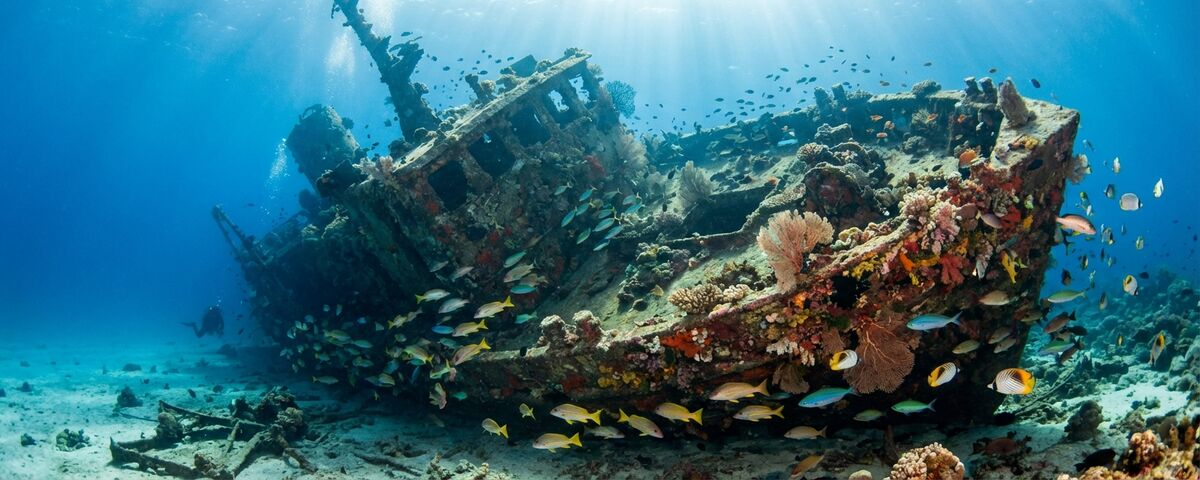
The British Loyalty is the largest diveable shipwreck in the Maldives, a 134-metre oil tanker resting on her port side between the islands of Maradhoo and Hithadhoo in Addu Atoll. She sits at 33 metres on the sand, with her starboard railings visible from around 15 metres. The wreck has been down there since January 1946, and eight decades of Indian Ocean growth have turned her into something between an artificial reef and a war memorial.
The story behind the wreck is worth knowing before you get in the water. Built in 1928 by Palmers Shipbuilding in Newcastle, the British Loyalty spent her early years hauling oil. During World War II, she was torpedoed by a Japanese midget submarine while anchored at Diego Suarez in Madagascar (May 1942). She survived. Towed to Addu Atoll, she became a floating fuel depot for the Royal Navy's secret base on Gan Island. Then in March 1944, a German U-boat (U-183) slipped through the anti-submarine nets guarding Gan Kandu and put another torpedo into her. She survived again, but this time the damage was too severe for repair.
When the British withdrew from the Maldives after the war ended, they towed the battered tanker to her current position and scuttled her with naval gunfire. A ship called British Loyalty, sunk by the British. The irony wasn't lost on anyone.
Today she's covered in hard and soft corals, colonised by everything from nudibranchs to Napoleon wrasses, and visited by the pelagics that patrol Addu's channels. It's not just a wreck dive. It's a history lesson you experience at 30 metres.
Marine Life at British Loyalty (Wreck)
The wreck herself dominates everything. At 134 metres bow to stern, you won't see all of her in a single dive unless you're on a scooter or running a very aggressive air plan. The hull is encrusted with hard corals and soft coral gardens, particularly along the exposed starboard side. Large gorgonian fans have established themselves on the upper sections, and sponge growth fills every sheltered nook.
Schools of bluefin trevally work the water column around the wreck, and batfish congregate in the sheltered areas near the superstructure. Green and hawksbill turtles are regulars, often resting on the hull or swimming lazily over the deck. Grey reef sharks patrol the deeper sections, and nurse sharks tuck themselves into gaps in the structure. Barracuda form loose schools above the stern.
The two torpedo impact points are still clearly visible. The Japanese torpedo hole on the deck and the German torpedo damage along the keel tell their own story. The propeller sits at 23 to 28 metres, originally four blades, each roughly two metres long. Parts of the internal structure are accessible, though penetration requires proper training and equipment.
Manta rays pass through the area, particularly during monsoon transitions when plankton blooms pull them into the atoll. This isn't a guaranteed manta dive, but they're a genuine bonus when they show up. Macro life on the hull itself is solid: nudibranchs, flatworms, and small crustaceans have colonised every surface.
Dive Conditions
The wreck lies in the channel between Maradhoo and Hithadhoo, which means current is the primary variable. Most dives happen on slack tide or mild current, but the channel can move when conditions shift. Your operator will time the dive around tidal movement.
Visibility is the wreck's biggest wildcard. On good days from January to March, you'll get 20 to 30 metres and can see the full profile of the ship from the descent line. On bad days, particularly during monsoon transitions or after rain, visibility drops to 5 metres or worse. The wreck is still worth diving in reduced vis (the scale means you're always close to something), but photography suffers.
Water temperature holds steady at 27 to 30 degrees year round. The depth profile means you're spending time at 25 to 33 metres, so air consumption matters and bottom time is limited on single tank recreational profiles. A typical dive plan puts you at the stern or midships at 30 metres, working your way up the hull to exit around 15 metres on the starboard side.
Surface conditions are generally calm inside the atoll. Boat access is straightforward from any of the connected islands. Entry is by giant stride from the dive dhoni, with a descent line to the wreck.
⚓ Divemaster Notes
Brief your divers thoroughly on the history before the dive. Knowing what you're looking at transforms this from a coral-covered hull into something genuinely affecting. Point out the torpedo damage specifically.
Plan your route before descent. The wreck is too large to cover in one dive. Most operators run either a stern dive (propeller, engine room exterior, aft superstructure) or a midships to bow dive. The stern section tends to have better marine life aggregations. The bow is more photogenic for wide-angle wreck shots.
Watch depth. The seabed sits at 33 metres and it's easy to drop below the hull chasing something interesting in the sand. On a single tank, you'll have roughly 20 to 25 minutes at maximum depth before decompression limits start pressing. Start deep, finish shallow on the hull.
The wreck is not officially prepared for penetration diving and some internal areas are unstable. Overhead environments inside the hull should only be entered by divers with proper wreck penetration training, redundant air, and a continuous guideline. External exploration of the superstructure and open holds is fine for advanced open water divers.
Tidal timing matters. Slack tide gives you the best conditions. A gentle current can actually help, pushing you along the hull so you cover more ground. Strong current makes the dive uncomfortable and limits what you can see. Check with your operator for the day's tide schedule.
How to Get to British Loyalty (Wreck)
Addu Atoll sits at the very bottom of the Maldives, roughly 540 kilometres south of Malé and just below the equator. Gan International Airport receives domestic flights from Velana International Airport (Malé) via Maldivian Airlines, with multiple daily departures. Flight time is about 70 minutes. Some international routes operate into Gan directly from Colombo, Sri Lanka.
Five of Addu's islands are connected by causeways and a road called The Link, so once you're on the ground you can reach dive operators by road. Most operators are based around Hithadhoo or Maradhoo, a short drive from the airport on Gan. The wreck site itself is a 10 to 15 minute boat ride from the nearest departure points.
Addu is genuinely off the beaten path by Maldives standards. Most diving tourists never make it past the central atolls, which means the wreck and surrounding sites see a fraction of the traffic. No resort island experience here. It's a local island destination with guesthouses and small hotels, which keeps costs significantly lower than the resort atolls.
Gear Recommendations
Bring a torch. The wreck has overhangs, holds, and shaded areas where a good light reveals colour and critter life you'd miss otherwise. Even external exploration benefits from a primary light.
A 3mm wetsuit or shorty is sufficient for water temperature, but if you run cold at depth, a 5mm gives you an extra margin of comfort at 30 metres for 20 plus minutes. Reef hook not needed here.
Computer with clear depth and NDL display is important. You're managing a depth-limited dive, and losing track of your no-decompression limit at 30 metres is how unplanned deco stops happen. SMB and reel are standard safety kit for any Maldives dive.
For photography, wide-angle is the only sensible choice for the wreck itself. The scale demands it. A fisheye or rectilinear wide-angle with strobes will capture the profile shots that make this dive memorable. Macro shooters can work the hull growth on a separate, shallower dive focused on the upper sections.
Recommended Dive Operators
Aquaventure Dive Centre on Hithadhoo is the most established local operator, running regular trips to the wreck and other Addu sites. They know the tidal patterns and will time your dive well. Diverland Maldives in Addu City is another solid option with experienced guides who know the wreck intimately.
Liveaboard operators including Blue Force Fleet and Explorer Ventures run southern Maldives itineraries from January to March that include the British Loyalty as a headline dive. These trips typically combine Addu with Huvadhoo Atoll and Fuvahmulah, giving you the wreck plus pelagic action further north.
Liveaboard Options
Southern Maldives liveaboard routes are seasonal, typically running January to March or April when weather conditions favour the southern atolls. Blue Force Fleet, Emperor Maldives, and Carpe Diem operate itineraries that include Addu Atoll, with the British Loyalty as a signature dive stop. These trips usually run 7 to 10 days and cover the southern atolls from Malé or Gan, combining wreck diving with channel dives, manta encounters, and the whale sharks of Fuvahmulah. Booking early is recommended as southern routes have limited departures per season.