Monad Shoal Dive Site
Malapascua, Philippines · Near Malapascua Island
Overview
Monad Shoal is the only place on earth where you can reliably see pelagic thresher sharks on a recreational dive. These extraordinary animals, with their scythe-like tails sometimes exceeding their body length, visit the cleaning stations on this submerged island every morning at dawn. The sharks ascend from deep water in the darkness, arrive at the shoal as the first light filters down, and spend 20 to 40 minutes hovering at the cleaning stations while small wrasse remove parasites. Then they descend back to the depths, and the show is over until tomorrow.
Monad Shoal sits about 8 kilometres off the northern tip of Cebu, a flat-topped seamount rising from deep water to about 15 metres below the surface. The cleaning stations are located on the southern edge of the plateau, at depths of 18 to 25 metres. The dive is straightforward: descend before dawn, position yourself near a cleaning station, settle on the sand, and wait.
The encounter dynamic is unlike any other shark dive. Thresher sharks are notoriously shy, and the cleaning station visits are the only time they come into shallow enough water for recreational divers to observe them. The combination of early morning light, the anticipation of waiting, and the sudden appearance of a 3-metre shark with a tail as long as its body creates a dive experience that stays with you permanently.
The catch is the early start. Boats leave Malapascua's harbour at 5:00 AM, sometimes earlier, and you're in the water before sunrise. Some mornings the sharks appear immediately. Some mornings you wait 30 minutes in the grey dawn light. Some mornings they don't show at all, though no-show days are relatively rare during the peak season.
The thresher shark population at Monad Shoal has been the subject of scientific study for over a decade. Researchers from the Thresher Shark Research and Conservation Project monitor the population using photo-identification and acoustic tagging, tracking individual animals' movements and cleaning station usage patterns. The data contributes to conservation management decisions that protect the shoal and the species it supports.
Marine Life at Monad Shoal
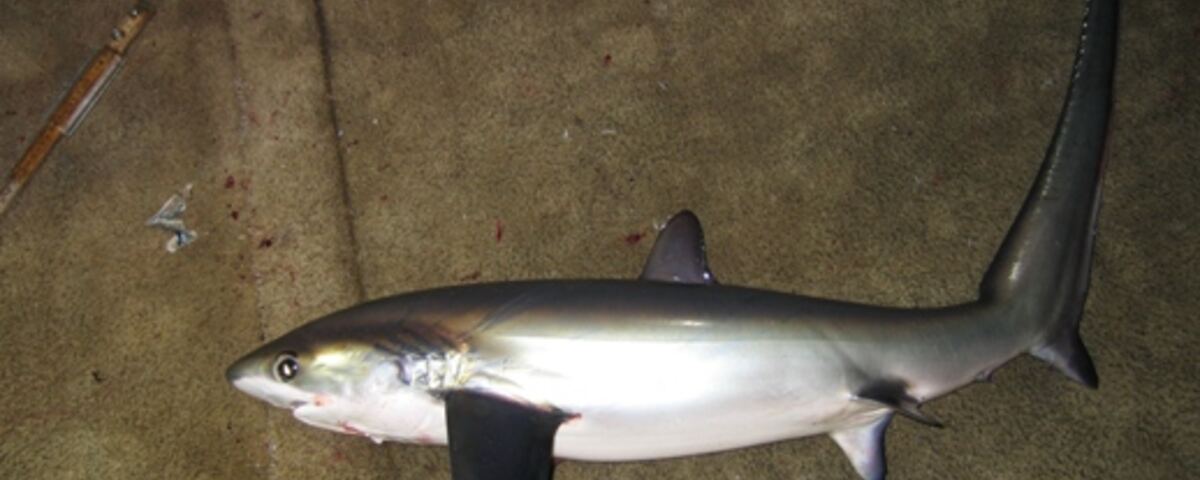
Pelagic thresher sharks (Alopias pelagicus) are the target species, with typical sightings of 1 to 3 individuals per dawn dive. The sharks are striking animals: grey or blue-grey above, white below, with an upper tail lobe that extends to match or exceed the shark's body length. At the cleaning station, they slow down to an almost stationary hover, presenting themselves sideways to the cleaner wrasse that work along their gills and skin.
The tail is the defining feature, and seeing it in person recalibrates your understanding of shark morphology. These tails are not vestigial or decorative; thresher sharks use them as hunting weapons, stunning prey fish with whip-like tail strikes. Observing the tail up close, at a cleaning station where the shark is calm and cooperative, is a rare privilege.
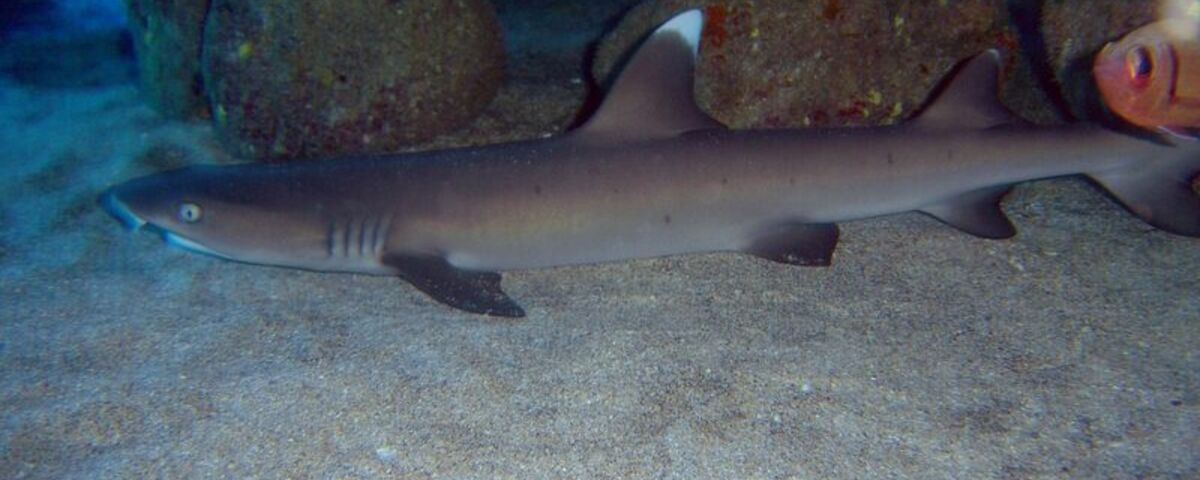
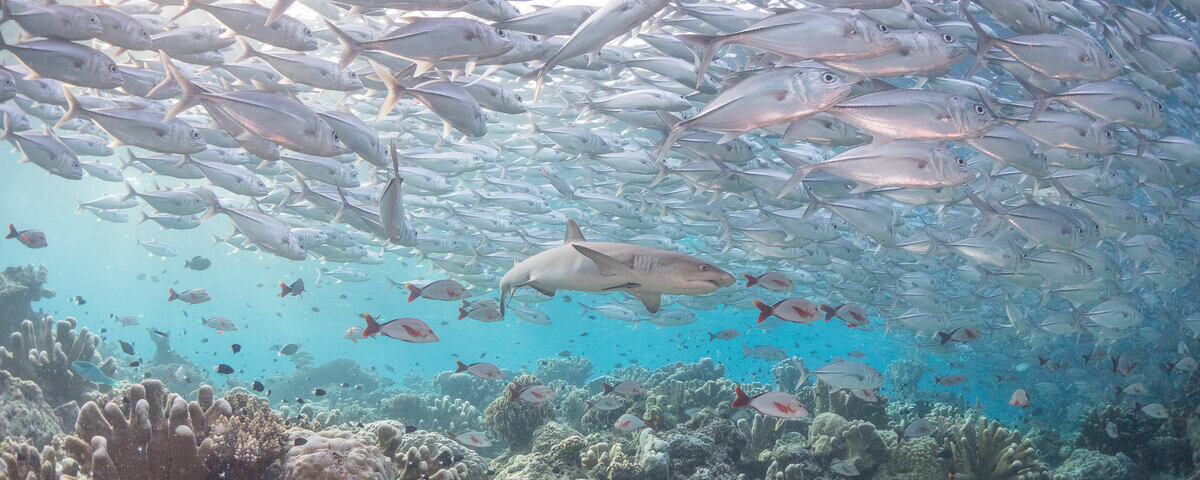
Beyond the threshers, Monad Shoal supports a healthy reef community. Devil rays occasionally visit the shoal, sometimes in small groups. White-tip reef sharks rest on the sandy sections of the plateau. Barracuda school in the mid-water. The cleaning station bommies host the expected complement of reef fish: wrasse, butterflyfish, anthias, and the cleaner wrasse themselves.
Manta rays have been sighted at Monad Shoal, though these appearances are irregular and should be treated as bonuses rather than expectations. Hammerhead sharks are also reported occasionally, usually at the edge of the plateau in deeper water.
The thresher shark's tail is a hunting weapon that has been filmed in slow motion by BBC crews at this very site. The sharks use the whip-like upper tail lobe to stun prey fish, striking with accelerations that exceed those of any other shark species. Seeing the tail up close at a cleaning station, understanding its function, and appreciating the evolutionary engineering that produced it adds an intellectual dimension to what is already a visually stunning encounter.
Dive Conditions
Monad Shoal dives start before dawn. Boats depart Malapascua at 5:00 AM, and you'll be in the water between 5:30 and 6:00 AM, descending in near-darkness or dim pre-dawn light. The descent is to 18 to 25 metres on the shoal's plateau, where you settle near a known cleaning station and wait.
Current ranges from mild to moderate. When running, it can push across the plateau, making position maintenance require some effort. A reef hook is useful for anchoring yourself near the cleaning station without kicking up sand.
Visibility is typically 10 to 25 metres, though the pre-dawn darkness reduces effective visibility in the early minutes. As light increases, the visibility improves and the full scene becomes visible. Water temperature ranges from 26 to 29 degrees, with cooler water possible at depth during upwelling events.
The dive profile is typically 40 to 60 minutes, with most of the time spent at 20 to 25 metres near the cleaning stations. Nitrox is recommended to extend no-decompression limits at this sustained depth.
The site is suitable for Advanced Open Water divers comfortable with early morning deep diving in variable visibility. The sharks are wild animals and the encounter is not guaranteed, though success rates during peak season (roughly November to May) exceed 80 percent on most operators' records.
The shoal's flat-topped shape creates a natural amphitheatre for the cleaning station encounters. The edges of the plateau drop into deep water on all sides, and the sharks ascend from these depths to reach the cleaning stations on top. The transition from deep blue water to the sandy plateau is where the sharks first become visible, materialising from below like grey ghosts at the edge of your visual range.
⚓ Divemaster Notes
I've done the Monad Shoal dawn dive hundreds of times, and the ritual never gets old. The 4:30 AM alarm, the dark boat ride, the descent into grey water, and then the moment when a shape materialises from the murk and you realise it's a thresher shark. That moment is what brings people to Malapascua, and it delivers more often than not.
Patience is everything here. Some mornings the sharks arrive at first light and circle the cleaning station for 30 minutes. Other mornings you wait 20 minutes in the cold and dark before the first one appears. Stay calm, stay still, and trust the process. The sharks have been using these cleaning stations for years and they'll come when they're ready.
Positioning matters. I place my groups about 3 to 5 metres from the cleaning station bommie, slightly downslope so the sharks are at eye level or above. Getting too close pushes the sharks to use alternative cleaning stations further along the plateau, and then nobody gets a good encounter. The guides from different operators coordinate positioning to avoid crowding, which works most of the time.
The number of divers at Monad Shoal during peak season can be frustrating. On busy mornings, 30 to 40 divers line up along the cleaning stations, and the sharks adjust their behaviour accordingly. For the best experience, visit outside the December to February peak, when diver numbers drop but shark attendance remains high. March to May is my preferred window.
Bring the right lens. The sharks come close enough for wide-angle portraits, but the low light conditions mean you need a fast lens and/or powerful strobes. A fisheye or ultra-wide rectilinear lens is ideal. ISO 800 to 1600 is often necessary in the pre-dawn light.
How to Get to Monad Shoal
Malapascua Island is located off the northern tip of Cebu. From Cebu City, the journey involves a 3 to 4 hour bus or van ride to Maya port, followed by a 30-minute boat crossing to Malapascua. Some dive resorts arrange direct transfers from Cebu-Mactan International Airport.
From Malapascua, Monad Shoal is approximately 30 minutes by dive boat. All dive operators on the island offer daily dawn thresher shark dives as their primary attraction.
Malapascua is a small island with a relaxed atmosphere. Accommodation ranges from basic beachside rooms to comfortable dive resort packages. The island has no ATMs and limited infrastructure, so bring cash (Philippine pesos) and manage expectations for connectivity.
Gear Recommendations
Full 3mm or 5mm wetsuit for the cool pre-dawn water. Reef hook for positioning at the cleaning station. Torch for the descent (but switch it off near the cleaning station; the sharks prefer dim light). Wide-angle lens with strobes for the low-light conditions. Nitrox strongly recommended for the sustained depth. SMB for the ascent. Dive computer with backlit display readable in low light.
Recommended Dive Operators
Thresher Shark Divers is the original and most experienced operation for Monad Shoal dives, with years of data on shark behaviour and cleaning station activity. Evolution Diving Resort offers comfortable accommodation combined with reliable dawn dive operations. Exotic Island Dive Resort runs well-organised early morning trips with experienced local guides. Bueo Dive Resort combines accommodation and diving with a conservation focus on the thresher shark population.
Liveaboard Options
Malapascua is not a typical liveaboard destination. The thresher shark dives are operated exclusively by island-based dive centres, with the dawn schedule requiring overnight stays on Malapascua. Some Philippine liveaboards include a Malapascua stop on wider Visayan Sea itineraries, but the island-based format is the standard.