Hin Daeng Dive Site
Southern Andaman Sea, Thailand · Near Koh Lanta
Overview
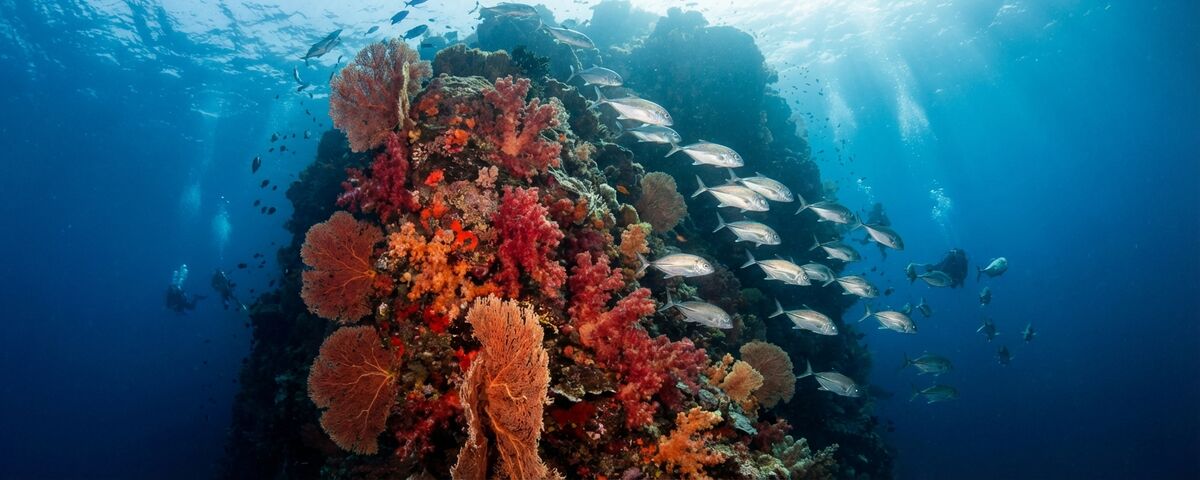
Hin Daeng is one of those dive sites that local professionals in Thailand quietly rank above everything else. Ask a divemaster on Koh Lanta or a liveaboard guide working the Andaman Sea route where they would choose to dive on their day off, and this name keeps coming up. The pinnacle sits roughly 55 kilometres southwest of Koh Lanta in open ocean, a lone rocky formation rising from the deep Andaman seabed with only a few metres of bare rock breaking the surface. Hin Daeng translates to Red Rock in Thai, and the name is entirely literal. Below the waterline, the rock face is smothered in soft corals so thick and red that the whole structure looks like it is on fire when you drop below five metres.
The topography is what makes this site special before you even consider the marine life. The eastern and northern flanks are relatively shallow, sloping gently with coral patches scattered across sandy ground. But the western and southern faces are something else entirely. A vertical wall plunges from near the surface to beyond 60 metres, disappearing into the Andaman blue with no visible bottom. That wall is where the action concentrates. Currents sweep nutrient-rich water along it, soft corals strain into the flow to feed, and everything from reef fish to whale sharks turns up to take advantage.
Hin Daeng lies within the Mu Koh Lanta National Marine Park, and its remote offshore position means it avoided the worst of the reef degradation that hit more accessible Thai sites over the past two decades. The isolation cuts both ways, though. Getting here requires either a dedicated day trip by speedboat (two and a half hours from Koh Lanta) or a liveaboard itinerary that routes through the southern Andaman. You cannot just rock up on a longtail. That barrier to access is part of why the site remains in such good condition, and why the diving feels genuinely wild in a way that busier Thai destinations lost years ago.
Marine Life at Hin Daeng
The headline act at Hin Daeng is manta rays. The pinnacle functions as a cleaning station, and mantas visit regularly between January and April to have parasites removed by cleaner wrasse working the shallower rocks. Seeing a three-metre wingspan manta glide in from the blue, circle overhead, and settle at a cleaning station while you hover at ten metres is the kind of encounter that rewires your expectations of what Thai diving can be. On productive days, multiple mantas work the site simultaneously.
Whale sharks are the other big draw, though calling them reliable would be dishonest. They pass through, particularly during plankton-rich periods in February and March when visibility dips slightly but the water column fills with food. When they do appear, it is usually along the western wall, cruising through midwater with their mouths open. You will not see one on every trip. But you might, and that possibility charges every minute of every dive here.
Beyond the megafauna, the reef life is genuinely outstanding. The red and orange soft corals that give the site its name are some of the healthiest in Thailand, with colonies so dense they overlap and compete for space on every available surface. Gorgonian sea fans extend from the wall at depth, and barrel sponges grow to sizes you rarely see on mainland Thai reefs. Schools of bigeye trevally and giant trevally patrol the wall edges in tight formations. Rainbow runners pass in silver curtains. Great barracuda hang off the deep side, barely moving, their silhouettes appearing and disappearing at the edge of visibility.
Leopard sharks rest on the sandy ledges below the wall, typically at 25 to 35 metres. Whitetip reef sharks cruise the overhangs, and grey reef sharks occasionally show up on the deeper sections, though sightings are not guaranteed. The shallower rocks on the northern side host a different world: moray eels peering from crevices, scorpionfish sitting camouflaged on the coral, crocodile needlefish hunting at the surface, and dense schools of fusiliers moving in coordinated clouds. Nudibranchs and flatworms add splashes of neon colour if you slow down enough to notice them.
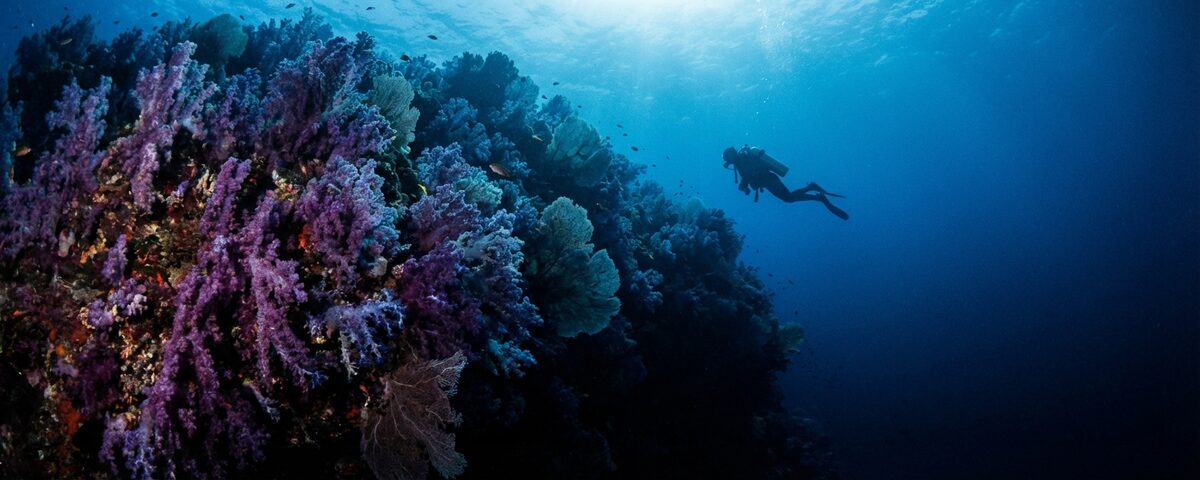
Hin Muang, the companion pinnacle, sits only a few hundred metres away and is connected to Hin Daeng by a ridge at around 40 metres depth. Most dive trips here include both sites, and the contrast is worth experiencing: Hin Muang's purple soft corals versus Hin Daeng's red, with the deeper pinnacle offering an even more dramatic wall profile.
Dive Conditions
Hin Daeng is classified as an advanced dive site, and it earns that classification honestly. The depth range is enormous. Shallow sections on the northern rocks start at just five metres, which is where most divers decompress and make their safety stops. But the western wall drops to 60 metres and beyond, well past recreational limits, and the temptation to chase it deeper is real. Maintaining depth discipline here matters more than at most sites because the wall gives no natural floor to stop your descent.
Currents are the primary challenge. The site sits in open ocean with no island shelter, and tidal flows can push hard along the wall from any direction. On slack tide, conditions are comfortable enough for confident intermediate divers. When the current picks up, it can pin you against the wall or push you off it into blue water. Downcurrents occur occasionally on the deeper sections and can catch divers off guard. Competent guides read the conditions before every dive and adjust the plan accordingly, starting upcurrent and drifting with it rather than fighting.
Visibility ranges from 15 to 40 metres depending on season and conditions. January through March typically delivers the clearest water, with 25 to 35 metres being common. When plankton blooms reduce visibility to 15 or 20 metres, the trade-off is increased chances of manta ray and whale shark encounters, since the plankton is what draws them in. Water temperature holds steady between 27 and 30 degrees Celsius, though thermoclines at depth can drop the temperature noticeably below 25 metres.
Surface conditions can be rough. The open ocean position means swells build without obstruction, and on choppier days, entries and exits require confidence and good timing. Divers prone to seasickness should medicate before the crossing. The site is only accessible during the November to April season (some operators extend to May or June in calmer years), with the Mu Koh Lanta National Marine Park effectively closed for diving during the southwest monsoon from July to October.
⚓ Divemaster Notes
Brief thoroughly and honestly. Hin Daeng in current is not a site for rusty divers or people who scraped through their Advanced course six months ago and have not been in the water since. Check logbooks and air consumption from earlier dives before deciding who joins.
Descent is typically down the mooring line on the northern side, gathering the group at the shallow rocks between 5 and 10 metres before heading to the wall. From there, the dive plan depends on current direction and strength. On slack tide, you can work along the western wall and loop back to the mooring. With current running, commit to a drift along the wall and arrange boat pickup.
The wall is the attraction, but it is also where divers get into trouble. The lack of a visible bottom creates a psychological pull to go deeper, especially when a leopard shark or grey reef appears at 35 metres and the wall keeps going. Set a maximum depth with the group before the dive and enforce it. For recreational groups, 30 metres is a sensible limit that still gives access to the best soft coral coverage and pelagic action.
Watch for downcurrents on the south end where the wall drops beyond 60 metres. If a diver gets pulled down, the correct response is to swim away from the wall into open water where the downcurrent weakens, not to fight it vertically. Brief this before the dive.
Manta encounters are most common in the shallows between 8 and 15 metres, around the cleaning stations on the northern rocks. If mantas are present, get the group settled at a comfortable depth, establish neutral buoyancy, and let the animals come to you. Chasing mantas is the fastest way to end the encounter. Patience pays.
Safety stops are best done on the shallow rocks if the group is near the mooring, or free-hanging with SMBs deployed if you have drifted. Surface conditions can be rough, so SMBs should be deployed at 5 metres to give the boat time to spot and approach.
How to Get to Hin Daeng
Hin Daeng sits approximately 55 kilometres southwest of Koh Lanta and about 100 kilometres southeast of Phuket, in open Andaman Sea. It is not visible from any island, and reaching it requires a dedicated boat trip.
The fastest and most common access point is Koh Lanta, where multiple dive operators run day trips by speedboat. The journey takes roughly two to two and a half hours each way, depending on sea conditions. Day trips typically include two dives (one at Hin Daeng, one at Hin Muang) with surface interval in between. Koh Lanta itself is reached by ferry from Krabi (roughly 90 minutes) or by road from Krabi Airport via the new bridge connections.
From Phuket, liveaboard trips are the standard option. Southern Andaman itineraries departing Phuket typically run three to five nights and include Hin Daeng and Hin Muang alongside Koh Haa, Koh Rok, and sometimes the Trang islands. The crossing from Phuket takes around five hours, making day trips impractical from there. Some operators also depart from Trang.
Getting to the region from Bangkok involves flying to either Krabi Airport or Phuket International Airport, both served by multiple daily flights taking about 90 minutes. From Krabi, the onward journey to Koh Lanta takes roughly two hours by road and ferry. From Phuket, connecting to a liveaboard is straightforward since most depart from Chalong Bay or Rassada Pier.
All visitors diving within the Mu Koh Lanta National Marine Park pay a park entry fee of 400 Thai Baht for foreign nationals (subject to change). This is usually included in your dive trip price. Park regulations require diving with a licensed guide.
Gear Recommendations
A 3mm full wetsuit is standard for the 27 to 30 degree water, though a hooded vest or extra rash guard underneath is worth considering if you plan to spend time below 20 metres where thermoclines can drop the temperature. Some divers on longer liveaboard trips find a 5mm suit more comfortable for multiple deep dives per day.
Nitrox certification is strongly recommended. The depth range at Hin Daeng means recreational air limits become a real constraint on the wall, and EANx32 provides meaningful extra no-decompression time. Most liveaboards and better day trip operators offer Nitrox fills for an additional fee.
Carry a surface marker buoy and reel as standard. The open ocean position and potential for drift means the boat needs to see you on ascent, particularly if current has carried you away from the mooring. A whistle and mirror are worthwhile backup signalling devices given the exposed location.
A dive torch is essential for the wall. The soft corals that define Hin Daeng are a muted brownish grey at depth under ambient light. Hit them with a torch and the reds and oranges explode into colour. The difference is dramatic enough that diving the wall without a light means missing half the visual experience.
For photography, wide-angle is the obvious choice for the wall, soft corals, and pelagic encounters. A fisheye or rectilinear wide-angle lens captures the scale of the wall and the drama of manta passes. Macro shooters will find subjects on the shallow rocks (nudibranchs, flatworms, shrimp), but the limited bottom time on deeper sections makes lens changes impractical mid-dive. If you have to pick one setup, go wide.
Recommended Dive Operators
From Koh Lanta, Dive and Relax is the closest operator to Hin Daeng and runs regular speedboat day trips with small groups and well-maintained equipment. Blue Planet Divers on Koh Lanta also operate dedicated Hin Daeng trips with experienced guides who know the site thoroughly. Scubafish is another established Koh Lanta operator offering day trips with a solid reputation for safety and professionalism.
For liveaboard access, The Junk runs characterful southern Thailand itineraries on a converted traditional sailing vessel, including Hin Daeng on their Phuket departures. MV Giamani operates well-regarded mid-range liveaboards with southern Andaman routes. For premium options, MV Hallelujah runs comfortable trips with smaller diver-to-guide ratios. Genesis Liveaboard offers budget-friendly multi-day trips that include both sites.
All reputable operators provide PADI or SSI certified guides, equipment rental, and handle the national park fee. If diving Hin Daeng from Koh Lanta on a day trip, confirm the departure time and expected journey duration, as sea conditions can affect both. Liveaboard operators have the advantage of flexibility, waiting for optimal conditions before committing to the dive.
Nitrox availability varies by operator. Given the depth profile, EANx32 is worth arranging if you plan to explore the deeper wall sections and want to extend your no-decompression limits.
Liveaboard Options
Hin Daeng is accessible both by day trip from Koh Lanta and by liveaboard, making it more flexible than the Similan Islands sites that require overnight trips. That said, liveaboards offer significant advantages here: the ability to dive the site in optimal conditions (waiting for slack tide or calmer seas), multiple dives across both Hin Daeng and Hin Muang, and the comfort of not doing a five-hour round trip by speedboat.
Southern Andaman liveaboard itineraries typically run three to five nights, departing from Phuket's Chalong Bay. These trips combine Hin Daeng and Hin Muang with other southern sites including Koh Haa (known for its cathedral cave and excellent visibility), Koh Rok (pristine shallow reefs), and sometimes Shark Point near Phuket as a warm-up dive. Some extended itineraries connect the southern sites with the Similan Islands for a comprehensive Andaman Sea experience.
Budget liveaboards for a three-night southern itinerary start from around 15,000 to 20,000 Thai Baht. Mid-range options run 25,000 to 40,000 Baht. Premium vessels charge 45,000 Baht and upward. Prices typically include meals, tanks, weights, guide services, and national park fees. Equipment rental and Nitrox are usually extra.
The southern Andaman liveaboard season runs November to April, with February and March generally offering the best combination of calm seas, good visibility, and peak manta activity. January is also excellent. The shoulder months of November and late April can deliver great diving with fewer boats, though weather is less predictable.
Day trips from Koh Lanta are priced between 4,500 and 7,000 Thai Baht depending on operator and inclusions. These typically depart early morning (around 7:00 to 7:30) and return mid-afternoon. Two dives are standard. The journey is comfortable in good conditions but can be rough on choppier days.