Hin Muang Dive Site
Southern Andaman Sea, Thailand · Near Koh Lanta
Overview
Hin Muang holds the deepest vertical wall in Thailand, and most divers who have been there will tell you it is the single best dive site in the country. That is not hyperbole. Purple Rock, as the name translates from Thai, is an entirely submerged seamount sitting 500 metres north of its sister site Hin Daeng in the open Andaman Sea, roughly 55 kilometres southwest of Koh Lanta. There is nothing above the surface to mark its presence. No rocks breaking the waterline, no navigation buoy visible from distance. Just open ocean, and then you drop in and find one of the most spectacular underwater landscapes in Southeast Asia waiting below.
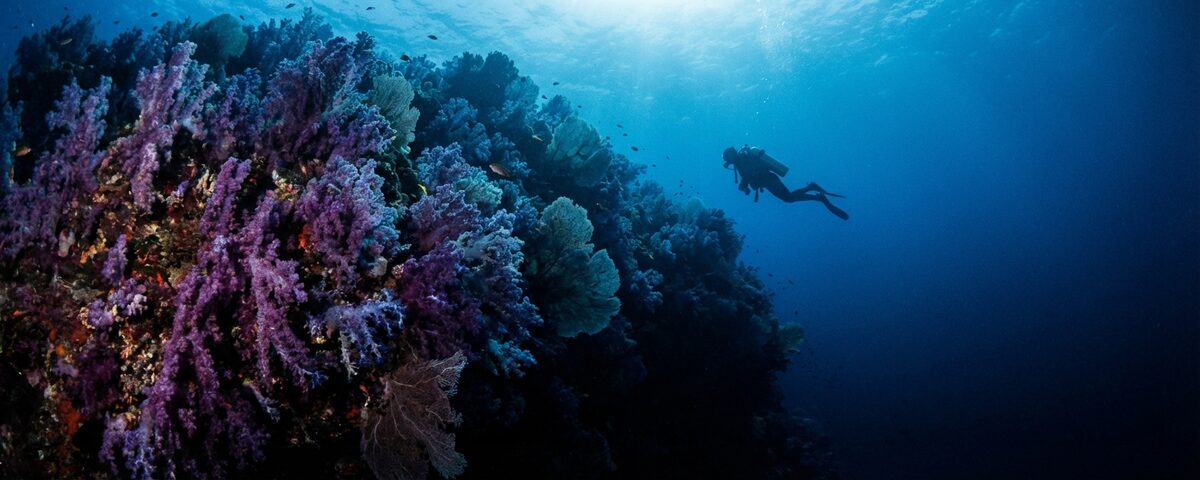
The seamount runs on a roughly east-west axis. The shallowest point sits at around 8 to 9 metres on the western end, a broad rocky ridge covered in anemones and hard coral that slopes gradually deeper toward the east. At about 20 to 25 metres the ridge fractures into smaller pinnacles and outcrops, and from there the walls begin. The southern face drops vertically from around 15 metres to well beyond 60, disappearing into darkness that continues past 70 metres. That wall is what gives Hin Muang its reputation. It is sheer, unbroken, and plastered floor to ceiling in soft coral so dense and so intensely purple that the rock beneath is invisible.
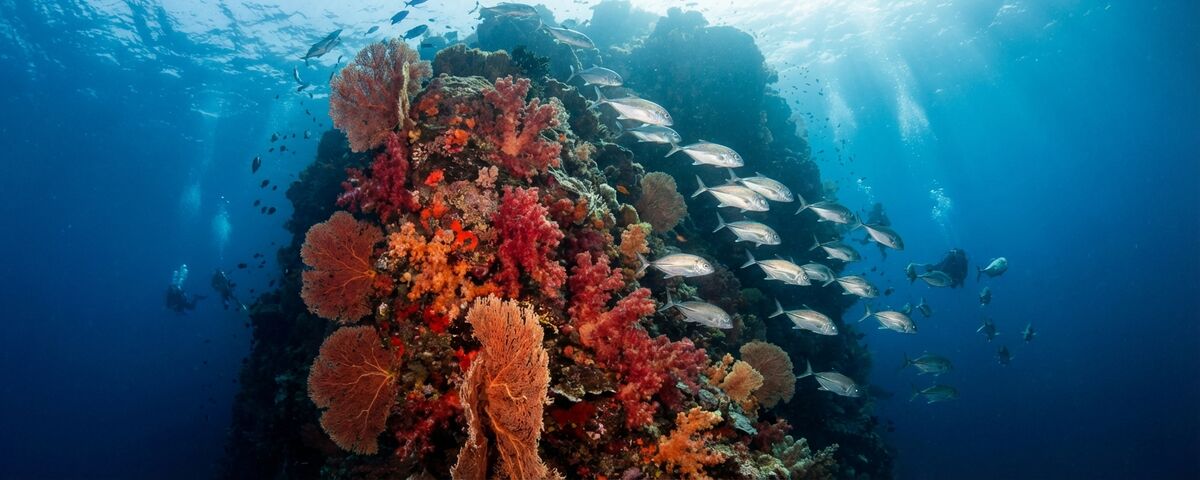
The colour is not subtle. From five metres down, the entire southern face glows in shades of purple, violet, and lilac, punctuated by splashes of red and orange where different soft coral species compete for space. Sea fans the size of dining tables spread across the wall at intervals, their latticed structures filtering current for plankton. The effect in good visibility is overwhelming. You hang in blue water at 20 metres, facing a wall that stretches above and below you in vivid purple for as far as you can see in both directions.
Hin Muang sits within the Mu Koh Lanta National Marine Park, and the site is closed annually from 15 May to 15 October during the southwest monsoon. This enforced rest period, combined with the site's remote open-ocean location and the strong currents that regularly sweep through, has preserved the reef in a condition that more accessible Thai dive sites lost decades ago. The isolation works as a filter. You cannot visit casually. Getting here requires either a dedicated speedboat trip from Koh Lanta lasting about two hours, a day trip that typically pairs Hin Muang with Hin Daeng and sometimes Koh Haa, or a liveaboard itinerary routing through the southern Andaman.
Marine Life at Hin Muang
Manta rays are the headline encounter and the one most divers come hoping for. Hin Muang functions as both a cleaning station and a feeding ground, and mantas visit regularly between January and April. They arrive from the blue with no warning, three-metre wingspans catching the light as they bank and turn over the reef. On good days, groups of two or three work the cleaning stations on the shallower western ridge simultaneously. The encounters are often close. Mantas at Hin Muang are accustomed to divers and will circle overhead at distances of just a few metres if you stay still and let them come to you.
Whale sharks pass through the area throughout the season, though encounters are less predictable. They tend to appear in the blue water off the deeper walls rather than over the reef itself. When one does turn up, the entire dive changes. You will hear tank banging before you see anything, and then a shape materialises from the blue that makes the manta rays look small.
Grey reef sharks patrol the deeper sections of the wall, typically below 25 metres. Leopard sharks rest on sandy patches at the base of the eastern pinnacles. White-tip reef sharks shelter in crevices and under overhangs throughout the site. On the shallower ridge, giant trevally hunt in packs, their silver flanks catching the light as they accelerate through schools of fusilier. Barracuda form loose aggregations off the wall edge.
The soft coral itself is the other star attraction. The purple coverage is genuine and extensive, not a patch here and there but continuous carpets of Dendronephthya and other soft coral species in deep violet, lilac, and magenta. Interspersed among the soft coral are anemone colonies hosting Clark's anemonefish and skunk anemonefish. Sea fans and whip corals extend from the wall face into the current.
For macro enthusiasts, the site delivers more than you might expect from a pelagic-focused location. Porcelain crabs hide in the anemones. Ornate ghost pipefish appear occasionally among the sea fans. Nudibranchs are scattered across the reef, and moray eels occupy crevices throughout the wall. The diversity here runs deeper than the big stuff, though the big stuff is what you will remember.
Dive Conditions
The shallowest point on the western ridge sits at 8 to 9 metres. Most diving happens between 12 and 30 metres along the wall and ridge system. The southern wall drops past 60 metres, and technical divers have explored beyond 70. For recreational diving, the 15 to 25 metre range offers the best combination of wall scenery, marine life, and manageable bottom time.
Current is the defining factor at Hin Muang. The seamount sits in open ocean with nothing to break the flow of the Andaman's tidal currents, and the shape of the ridge accelerates current over its upper surface. Moderate current is the norm; strong current is frequent. On high-current days the surface can run noticeably faster than the deeper water, making descents along the mooring line important. Once you are down, the lee side of the ridge provides shelter, and the walls themselves create eddies where you can hover comfortably.
Visibility ranges from 10 to 30 metres and varies considerably with current and plankton levels. The best visibility typically occurs in February and March. Plankton blooms can reduce visibility to 10 to 15 metres, but those same blooms are what attract the mantas and whale sharks, so reduced viz at Hin Muang often means better marine life encounters.
Water temperature is a consistent 27 to 30 degrees year-round, warmest from February to April. A 3mm wetsuit is standard. The site is closed from mid-May to mid-October for the monsoon season, when sea conditions make the crossing dangerous and diving impossible.
Advanced Open Water certification is the minimum, and most operators want to see a logbook with at least 30 to 50 dives. This is not a site for newly certified divers. The depth, current, and open-ocean location demand solid buoyancy control and comfort in blue water with limited references.
⚓ Divemaster Notes
Hin Muang is where I take experienced divers who tell me they have seen everything Thailand has to offer. It changes their mind every time. The wall on the southern face is the single most impressive piece of underwater topography I have guided in this country, and I have been doing this for over a decade.
I always start the dive on the western ridge at the mooring, where the reef is shallowest. This gives the group a chance to sort out buoyancy and equalisation before we head deeper along the wall. From the mooring at 9 metres, I take the group south and slightly east, dropping to 18 to 20 metres where the wall becomes vertical. That is where the purple soft coral is at its densest, and where the reaction from first-time visitors tends to be an audible gasp through the regulator.
Current management is everything here. I check conditions on descent and choose the direction that keeps us working with the flow rather than against it. If current is running west to east (the most common pattern), I start on the western ridge and drift east along the wall. If it is reversed, I do the opposite. On slack current days, which are rare but magical, I take the group on a full circuit of the ridge at different depths.
The manta cleaning stations are on the western ridge between 10 and 14 metres. If mantas are present, I will adjust the dive plan to spend the last 15 minutes of bottom time hovering near the stations during the safety stop. The trick is patience. Find a spot on the reef where you can kneel or hover without damaging anything, stay low and still, and wait. The mantas come to you. Chasing them guarantees they leave.
One thing I always brief: the depth here is real. The wall disappears below you and the blue water pulls your eyes down. It is easy to drift deeper than planned without realising it. I tell every group to check their computer every 30 seconds on the wall section. Narcosis at 40 metres on this wall, with the purple coral glowing and a manta overhead, is genuinely dangerous because it feels so beautiful that your brain forgets to check the numbers.
How to Get to Hin Muang
Hin Muang is accessed from Koh Lanta, which serves as the primary base for southern Andaman Sea diving in Thailand. From Koh Lanta, speedboats reach the site in approximately two hours. Most dive operators run full-day trips that include two dives at Hin Muang and Hin Daeng (the sites sit just 500 metres apart) with a possible third dive at Koh Haa on the return.
Koh Lanta itself is reached by road from Krabi (about 1.5 hours including the short car ferry crossing) or by minivan transfer from Krabi Airport. Flights from Bangkok to Krabi take roughly 90 minutes, and direct connections from Chiang Mai and Phuket are also available.
Liveaboard itineraries covering the southern Andaman Sea include Hin Muang as a standard stop. These trips typically run from Phuket or Khao Lak and combine the southern sites (Hin Daeng, Hin Muang, Koh Haa, Phi Phi) with the Similan Islands and Richelieu Rock in the north. A 4-night southern route or a full 7-night Andaman circuit both work.
National park fees apply. The Mu Koh Lanta National Marine Park entrance fee is 400 baht for foreign visitors, typically collected by the dive operator and included in the trip price.
Gear Recommendations
3mm wetsuit for the 27 to 30 degree water. A surface marker buoy is mandatory; the site is open ocean with boat traffic and currents that can push you away from the mooring during safety stops. Reef hook useful for the ridge top in strong current, allowing you to clip in and wait for mantas without fighting the flow. Nitrox strongly recommended to extend bottom time on the wall at 20 to 25 metres. Wide-angle lens for the wall shots and manta encounters. A 100mm macro setup works well on the shallower ridge if you are willing to ignore the big stuff. Dive computer with clear depth and NDL display; the depth changes rapidly on the wall and you need to monitor constantly. Torch recommended for illuminating the soft coral colours in the deeper wall sections where ambient light fades.
Recommended Dive Operators
Phoenix Divers Koh Lanta operates fast fibreglass speedboats and keeps group sizes small. Their Hin Daeng and Hin Muang day trip pairs three dives across both sites plus Koh Haa. Dive and Relax on Koh Lanta runs similar itineraries with good surface intervals and experienced guides who know the current patterns. Koh Lanta Divers has been operating the route for years and their divemasters are reliable on site selection based on conditions.
For liveaboards, The Junk (a converted Chinese sailing vessel) includes Hin Muang on its southern Andaman itineraries and is consistently rated among the best Thai liveaboard experiences. Thailand Master and Deep Andaman Queen both run routes covering the full Andaman coast from Similans down to Hin Daeng and Hin Muang. Emperor Fleet operates the MV Emperor Serenity on southern routes during peak season.
Liveaboard Options
Hin Muang features on most southern Andaman liveaboard itineraries running between November and April. The Junk offers a unique experience on a traditional sailing vessel, with southern routes that spend a full day at Hin Daeng and Hin Muang including a possible sunset dive. Thailand Master and the Smiling Seahorse run 4 to 7-night circuits combining the Similans and Surin Islands in the north with the southern sites. Deep Andaman Queen operates a dedicated southern route that maximises time at Hin Muang, Hin Daeng, and Koh Haa. Expect to pay 6,000 to 12,000 baht per day depending on the vessel and cabin class. Book 2 to 4 months ahead for January to March, which is peak season for manta encounters.