Banana Reef Dive Site
North Malé Atoll, Maldives · Near Malé
Overview
Banana Reef holds a particular distinction in Maldivian diving history: it was the first dive site officially opened to tourism in the country, back in 1972 when the Maldives' dive industry consisted of a single operator and a handful of curious Europeans. Half a century later, it remains one of the best reef dives in North Male Atoll and a testament to what long-term marine protection can achieve.
The reef is a long, curved structure (the shape gives it its name) that runs roughly north to south, with a reef top at about 5 metres and walls dropping to 30 metres. The eastern side features dramatic overhangs and caves that shelter dense fish populations, while the western side slopes more gradually with excellent coral coverage. The reef's position on the atoll's outer edge means it receives current that drives productivity and marine life diversity.
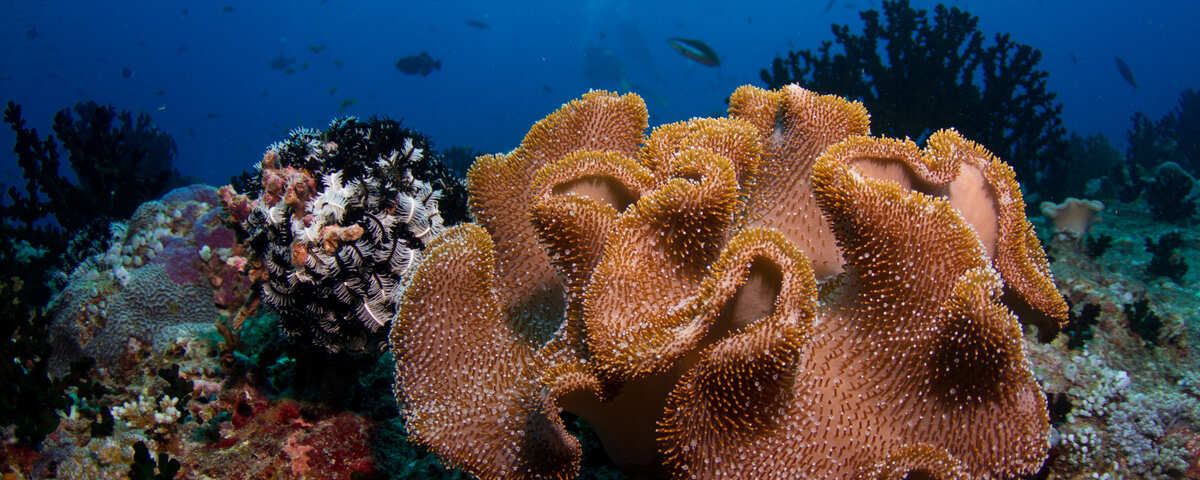
Banana Reef is colourful in a way that exemplifies the Maldivian reef aesthetic. Soft corals in vivid oranges, purples, and reds drape the overhangs. Hard coral tables line the reef top. Sea fans spread across the current-swept walls. The overall impression is of a reef at peak health, which at this point is what five decades of dive tourism management has produced.
The fish life is diverse and dense. Schools of banner fish, oriental sweetlips, and blue-stripe snapper cluster under the overhangs. Napoleon wrasse patrol the reef edge. White-tip reef sharks rest in the caves. Eagle rays sweep past the wall. The biodiversity reflects the reef's position at the intersection of Indian Ocean currents that bring species from both the Arabian Sea and the Bay of Bengal.
Banana Reef works for a wide range of experience levels. The sheltered western side suits intermediate divers, while the eastern overhangs and deeper wall sections reward experienced exploration. The mild to moderate current is manageable for competent divers, and the reef's proximity to Male makes it one of the most convenient quality dives in the Maldives.
The historical significance of Banana Reef extends beyond the Maldives. It was here that the viability of dive tourism in the Indian Ocean was first demonstrated. The early visitors in the 1970s were guinea pigs for what would become a multi-billion-dollar industry. The reef they explored has been continuously dived for over 50 years, and the fact that it remains in excellent condition speaks to both the reef's resilience and the Maldives' management of dive tourism.
The reef's curved shape creates natural current dynamics that vary along its length. The convex side catches the current first, creating zones of high energy where pelagic fish concentrate. The concave side is sheltered, with calmer water that favours coral growth and macro life. This variation within a single site means different experiences depending on where on the reef you dive.
Marine Life at Banana Reef
The overhangs on the eastern side shelter impressive fish aggregations. Oriental sweetlips in groups of 20 or more hang motionless in the shade. Blue-stripe snapper school tightly under the overhangs. Moray eels of several species (giant, honeycomb, and white-mouth) occupy the crevices.
Napoleon wrasse are regularly sighted, often approaching divers with the curiosity characteristic of the species. White-tip reef sharks rest in the caves and under overhangs during the day. Eagle rays cruise past the wall, particularly on incoming current.
The soft coral coverage is exceptional, with Dendronephthya soft corals in orange and red cascading from the overhang ceilings. Sea fans spread across the current-facing surfaces. Hard coral tables on the reef top provide habitat for damselfish, butterflyfish, and wrasse.
Schools of banner fish (longfin bannerfish) are a visual signature of Banana Reef, forming groups along the wall that photograph beautifully against the blue water. Moorish idols appear in pairs and small groups. The reef is one of the better sites in North Male for finding leaf scorpionfish, which shelter against the wall in well-camouflaged positions.
The reef's curved shape creates different conditions along its length: the current-exposed sections have the densest fish aggregations and the healthiest gorgonian fans, while the sheltered sections offer the best soft coral and macro opportunities.
Occasional pelagic visitors include grey reef sharks on the outer wall and schools of big-eye trevally during current. Turtles rest on the reef but are less abundant than at Sipadan-level sites.
At the reef's deepest sections (25 to 30 metres), gorgonian fans spread in impressive displays. These deeper sections are less visited and often have more marine life per square metre than the popular upper sections.
Schools of oriental sweetlips in the overhangs are particularly photogenic, their spotted patterns creating a striking composition against the dark overhang background. The sweetlips hold position with remarkable stability, allowing careful photographers to compose detailed portraits.
Dive Conditions
The reef top sits at about 5 metres, with walls dropping to 30 metres. The overhangs on the eastern side are the most dramatic features, with some extending several metres outward from the wall face. The dive profile follows the wall at 10 to 20 metres for the best fish and coral, with optional deeper excursions to the base.
Current is mild to moderate, typically running north or south along the reef's length. The curve of the reef creates sheltered areas that provide rest from the flow. The reef is diveable year-round, with conditions varying between the northeast (December to April, generally clearer water) and southwest (May to November, more plankton and current) monsoons.
Visibility ranges from 15 to 30 metres, with the best clarity during the northeast monsoon. Water temperature is a consistent 27 to 30 degrees. A 3mm wetsuit is standard.
Intermediate certification is recommended due to the current and depth profile, though the sheltered sections are accessible to confident Open Water divers.
The reef structure is large enough for multiple groups to dive simultaneously without congestion. Different operators typically use different sections of the reef, and the curve provides natural separation between groups.
⚓ Divemaster Notes
Banana Reef is the dive I use to introduce guests to Maldivian reef diving. It has everything the Maldives is known for (colour, fish density, sharks, overhangs) in a manageable package. The current is rarely strong enough to cause problems, the depth range is comfortable, and the visual impact is immediate.
The eastern overhang section is the highlight, and I spend most of the dive time there. I approach from the reef top, descend to 15 metres along the wall, and work southward along the overhang line. Each overhang has its own character: some are deep and dark, requiring torches; others are shallow and light-filled, with soft coral draping from the ceiling like curtains.
The Napoleon wrasse at Banana Reef are unusually bold. I can often attract them by hovering still at the reef edge and making eye contact. They approach to investigate, sometimes hovering a metre in front of a diver for extended observation. For photographers, the Napoleon wrasse portraits at Banana Reef are among the most natural and relaxed available anywhere in the Maldives.
I finish the dive on the reef top at 5 metres, where the table corals provide an excellent safety stop environment. The shallow section is bright, colourful, and alive with reef fish. It is the best possible ending to what is consistently one of my most enjoyed guided dives.
One practical note: Banana Reef's popularity means it can be busy, particularly in peak season (December to March). I schedule morning dives to avoid the midday crowd of boats, though the reef is large enough that diver congestion rarely becomes a problem underwater.
Banana Reef is a forgiving site for new arrivals adjusting to Maldivian conditions. The current is manageable, the depth is comfortable, and the visual rewards are immediate. I use it as a first-dive to calibrate guests' equipment, buoyancy, and comfort levels before moving to more demanding sites.
The reef's history as the Maldives' first tourist dive site gives it a narrative weight that adds depth to the experience. Knowing that you are diving the same reef that pioneers explored in 1972, and that it looks as good (or better) than it did then, provides a hopeful counterpoint to the global narrative of reef decline.
How to Get to Banana Reef
Banana Reef is in North Male Atoll, approximately 20 to 40 minutes by speedboat from Male. Most North Male Atoll resorts and dive centres include it on their regular dive schedules.
Male is the Maldives' international gateway with direct flights from Asia, the Middle East, and Europe. North Male Atoll resorts offer airport speedboat transfers ranging from 15 to 60 minutes.
Gear Recommendations
3mm wetsuit. Wide-angle lens for the overhangs, reef scenes, and Napoleon wrasse. Torch for illuminating the darker overhangs and bringing out soft coral colours. SMB for safety stops. Nitrox useful for extended wall time.
Recommended Dive Operators
Bandos Maldives dive centre includes Banana Reef on their standard rotation. Baros Maldives runs small-group dives with experienced guides. Full Moon Resort has a well-established dive operation with Banana Reef as a regular site. Male-based dive safari operators use Banana Reef as a convenient departure dive.
Liveaboard Options
Banana Reef is primarily accessed from North Male Atoll resorts on day trips. Liveaboards starting from Male often include Banana Reef on their first or last dive day. Most Maldives liveaboard itineraries begin with a North Male Atoll dive day before heading to more remote atolls.