Guraidhoo Kandu Dive Site
South Malé Atoll, Maldives · Near Guraidhoo
Overview
Guraidhoo Kandu is a marine protected channel system on the south-eastern edge of South Malé Atoll, and it belongs to that small category of Maldivian dive sites that safari operators will happily spend half a day on. The reason is simple: this is not one dive site but three, packed into a stretch of reef barely a kilometre across. Two parallel channels, Guraidhoo Kandu proper and Lhosfushi Kandu, are split down the middle by Medhu Faru, a long reef formation that acts as a natural divider and drift dive in its own right. The result is a complex underwater geography that rewards repeated visits and punishes complacency in equal measure.
The channel sits south of Guraidhoo island, roughly 32 kilometres from Malé. It earned protected status from the Maldivian government for good reason: the reef structure here is unusually intricate, with walls, overhangs, coral heads and sandy slopes all compressed into a relatively compact area. Incoming tidal currents funnel through the channels from the open ocean, dragging nutrients, plankton and everything that feeds on them into the atoll's interior. That current is the engine driving the site's marine life, and it is also the thing that makes Guraidhoo Kandu a site for experienced divers only.
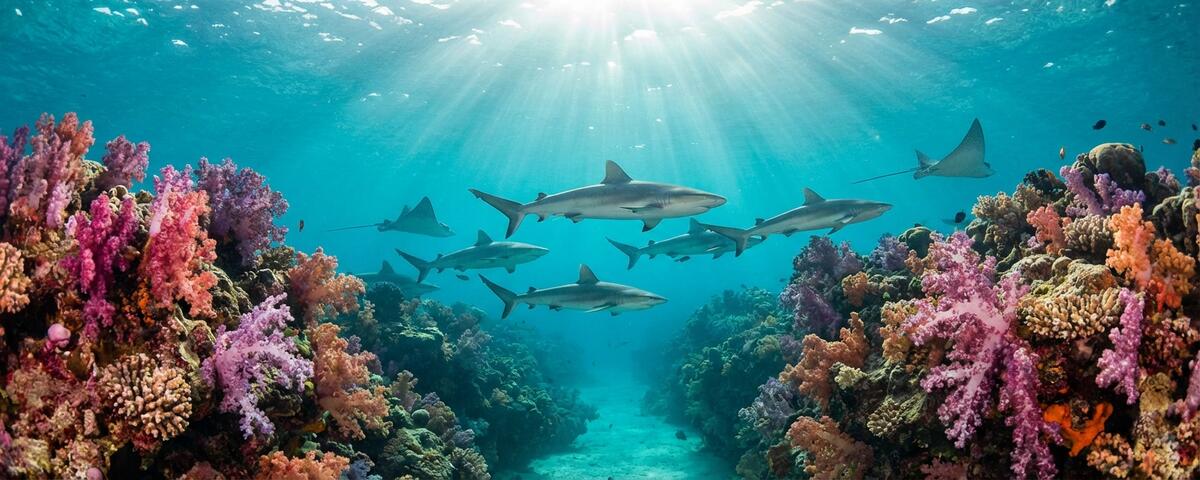
Grey reef sharks patrol the deeper sections with the confidence of animals that have never been hunted here. Eagle rays cruise through mid-water, their wingspan spanning well over a metre, riding the current with barely a flick of their wings. Napoleon wrasse, the slow-moving giants of the reef, turn up with such regularity that dive guides barely remark on them any more. Schooling fish fill the channels in staggering numbers: fusiliers, bannerfish, snappers and trevally forming dense clouds that shift and reform as predators move through.
What separates Guraidhoo Kandu from the more famous channel dives further north in North Malé is its complexity. You cannot simply drop in, drift through, and surface at the other end. The twin-channel layout and central reef create eddies, upwellings and localised current reversals that demand attention. The best dive guides read the water before committing to a route, and they will change plan mid-dive if the current shifts. For divers who find straightforward drift dives a bit passive, this is the antidote.
The site also benefits from its proximity to Guraidhoo island, one of the Maldives' inhabited local islands with a growing guesthouse scene. Budget-conscious divers who cannot justify a resort or liveaboard can base themselves on Guraidhoo and dive this channel repeatedly for a fraction of the cost. Maafushi, the backpacker hub of South Malé, is close enough that operators from there run regular trips too.
Marine Life at Guraidhoo Kandu
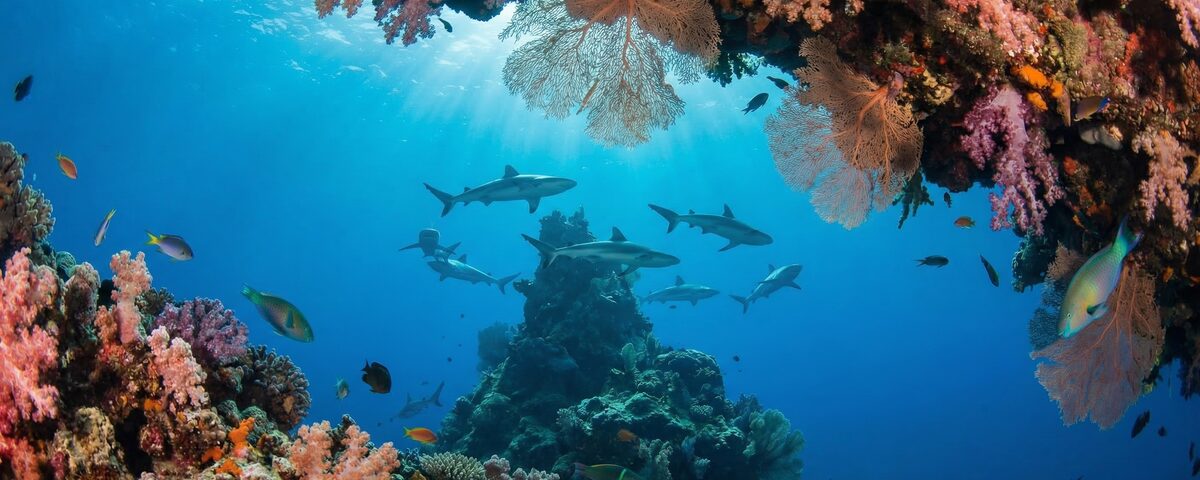
Grey reef sharks are the headliners. They congregate at depth along the channel walls, particularly on the outer edge where the reef drops away into open ocean. During incoming current, they position themselves in the flow, facing into it with mouths slightly open, riding the oxygen-rich water. Groups of 5 to 15 sharks are normal. Occasionally the count climbs higher, especially during the northeast monsoon season when current strength peaks.
Eagle rays are the second consistent draw. Spotted eagle rays pass through the channels individually and in small groups, usually at mid-depth between 12 and 20 metres. They tend to appear from the blue side of the channel, make a pass along the reef wall, and disappear back into open water. Their wing-like pectoral fins and spotted pattern make them unmistakable even in reduced visibility.
Napoleon wrasse are resident here, not visitors. These fish can exceed a metre in length and weigh over 100 kilograms, and they have a curious habit of approaching divers head-on before turning away at the last moment. The younger ones, still sporting their juvenile green colouration, shelter in the coral heads on Medhu Faru.
The schooling fish are what fill the frame between the big-ticket sightings. Dense clouds of bluestripe fusiliers stream through the channels in ribbons. Longfin bannerfish hold station above the reef in neat formation. Red snappers cluster under overhangs. Oriental sweetlips, with their distinctive spotted pattern, hang in small groups at cleaning stations where wrasse pick parasites from their gills.
Tuna and trevally work the edges of the channel, picking off stragglers from the fusilier schools. Giant trevally are present but less common than at the more exposed outer atoll sites. Barracuda patrol in loose groups rather than the tight tornados you see at places like Barracuda Point. Whitetip reef sharks rest on sandy patches at the channel base during the day, becoming more active at dusk.
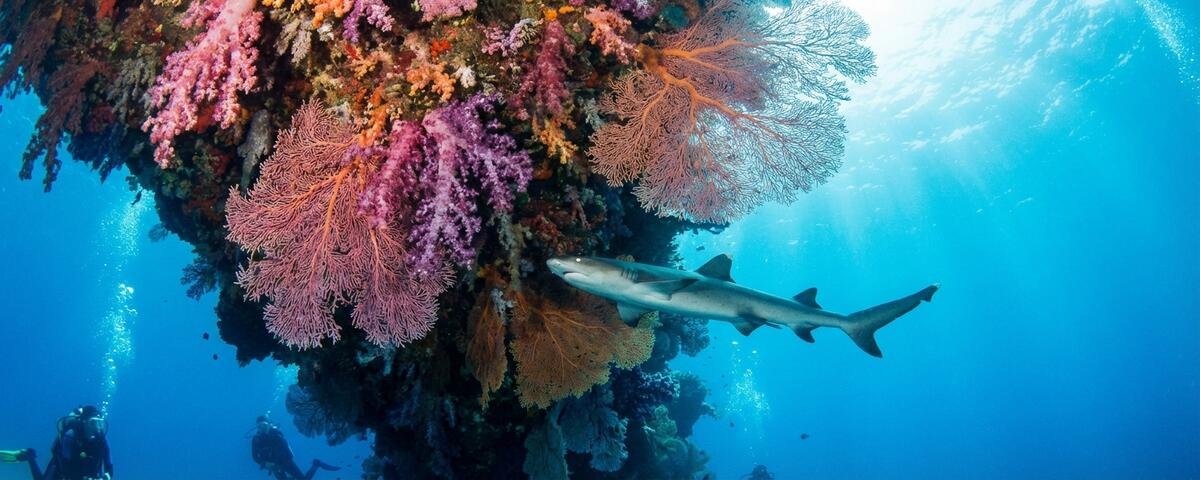
The reef itself is covered in soft corals, particularly on the Medhu Faru drift where gorgonian sea fans reach impressive sizes. Sponges in oranges and purples coat the overhangs. Hard coral coverage is solid on the shallower sections, with table corals and staghorn formations providing habitat for damselfish, anthias and butterflyfish in numbers that would be unremarkable anywhere else but somehow feel abundant here because the water is so clear.
Turtles pass through regularly. Green turtles are more common than hawksbills, and they seem particularly relaxed around divers in the protected area. Moray eels occupy holes throughout the reef structure: giant morays on the deeper walls, honeycomb morays in the shallows.
During plankton blooms, which typically coincide with the southwest monsoon season from May to November, manta rays visit the channel. These encounters are less reliable than at dedicated manta sites like Manta Point at Lankanfinolhu, but when they happen, the combination of mantas and sharks in the same dive makes for a memorable day.
Dive Conditions
Guraidhoo Kandu's defining characteristic is current. The channel funnels tidal flow between the open Indian Ocean and the atoll's interior lagoon, and the resulting currents range from gentle drift to genuinely powerful. Incoming current (from ocean to atoll) brings the best visibility and the most marine life, as nutrient-rich water from the deep ocean pushes through the channel. Outgoing current can be equally strong but tends to carry more suspended particulate, reducing visibility.
Depth across the three sub-sites varies considerably. Medhu Faru, the central reef, has its top at around 5 metres and slopes to 25 metres on either side. The main Guraidhoo Kandu channel drops to 30 to 35 metres along its outer wall. Lhosfushi Kandu, the northern channel, is shallower overall with a sandy bottom at 12 to 24 metres and is the more accessible of the two for intermediate divers, though current can still catch out the unprepared.
Visibility ranges from 10 to 30 metres depending on current direction and season. The northeast monsoon (December to April) generally delivers the clearest water, with 20 to 30 metres being typical. The southwest monsoon (May to November) brings more plankton and reduced visibility, often 10 to 20 metres, but also brings the mantas. Both seasons are diveable.
Water temperature sits between 27 and 30 degrees Celsius year-round. Most divers are comfortable in a 3mm shorty or full 3mm suit. The deeper sections of the outer channel can feel cooler when thermoclines push through, and a hooded vest is not excessive for divers spending extended time below 25 metres.
The site produces localised effects that make it more complex than a standard channel drift. Where the two channels meet Medhu Faru, current can split, creating eddies and what local guides call washing machines: circular current patterns that can disorient and spin a diver. These are manageable with good buoyancy and awareness, but they catch people off guard. Vertical ascents are the standard response if you find yourself caught in one.
Surface conditions at the channel mouth can be choppy when current opposes wind, making entries and exits more challenging than at sheltered lagoon sites. Dive boats typically position on the outer reef for negative entry descents during incoming current dives.
⚓ Divemaster Notes
I treat Guraidhoo Kandu as three separate dives, and which one I run depends entirely on what the current is doing when we arrive. There is no single dive plan that works here because the twin-channel layout means the current can be doing completely different things on either side of Medhu Faru.
My preferred dive in incoming current is Guraidhoo Corner. We drop on the outer reef at 25 to 30 metres, position on the channel lip where the reef meets the drop-off, and wait. This is where the grey reef sharks stack up. They face into the current and hold station, and if you settle in behind a coral head and stay still, they genuinely stop caring about you. I have had sharks cruise within two metres while my guests held their breath and tried not to fumble their cameras. The trick is getting to the corner before the current pushes you past it. I time the drop precisely and descend fast.
When the current is gentler or my group is less experienced with drift diving, I run Medhu Faru instead. This is the scenic dive. You drop on the southern end of the central reef at about 15 metres and drift north along the wall, letting the current carry you past the sea fans and soft coral gardens. The reef here is genuinely beautiful, and you pick up eagle rays crossing between the two channels, Napoleon wrasse cruising along the wall, and schools of sweetlips at their cleaning stations. It is a more relaxed dive than the corner, but still requires decent buoyancy because the reef is close and fragile.
Lhosfushi Kandu, the northern channel, I save for groups that want a channel experience but cannot handle the intensity of the main channel. It is shallower, the current is usually milder, and the sandy bottom at 12 to 24 metres gives a reassuring reference point. You still get whitetip sharks, turtles and good reef fish here, and the narrower channel entrance concentrates the marine life nicely.
The washing machine effect at the junction between Medhu Faru and the main channel has caught me out exactly once, early in my career. A sudden shift in current direction spun three of my divers sideways and pushed one down 5 metres before he could react. Now I brief every group on the vertical ascent response: if you feel the circular pull, inflate your BCD slightly and ascend to shallower water where the effect weakens. Do not fight it laterally.
For photography, Guraidhoo Corner in incoming current with good visibility is spectacular. Wide-angle with strobes for the sharks. But the Medhu Faru drift produces the best ambient light shots because the reef is shallower and the colours pop without artificial light. Macro shooters can spend an entire dive on the soft coral gardens and never look up.
One thing I always tell visiting divers: this site rewards patience more than swimming. Park yourself, control your breathing, and let the channel bring the show to you. The divers who kick around trying to chase sharks see far less than the ones who pick a spot and wait.
How to Get to Guraidhoo Kandu
Guraidhoo Kandu is accessed from Guraidhoo island or from nearby Maafushi, both in South Malé Atoll. From Malé's Velana International Airport, Guraidhoo is reachable by public ferry (roughly 2 hours, departures from Villingili ferry terminal) or private speedboat (30 to 40 minutes). The ferry runs daily and costs a few dollars. Speedboat transfers cost between 35 and 50 USD per person depending on the operator and can be arranged through guesthouses.
Maafushi, the more developed local island roughly 8 kilometres north of Guraidhoo, has more frequent ferry connections to Malé and a larger selection of budget accommodation. Dive operators on Maafushi run trips to Guraidhoo Kandu regularly, with the boat ride taking 15 to 20 minutes.
For resort guests, several properties in South Malé Atoll include Guraidhoo Kandu in their dive excursion programmes. Anantara Dhigu, Naladhu, and Holiday Inn Kandooma all operate dive centres with access to the site. The channel is also a standard stop on South Malé liveaboard itineraries, typically dived on the first or last day of a safari departing from Malé.
Velana International Airport receives direct flights from most major Asian hubs (Colombo, Singapore, Kuala Lumpur, Bangkok, Dubai) and European connections via Middle Eastern carriers. No visa is required for stays under 30 days for most nationalities. The airport is on Hulhulé island, connected to Malé by a bridge.
Gear Recommendations
3mm full wetsuit recommended over a shorty for the deeper channel sections where thermoclines can drop temperatures noticeably. Reef hook essential for the outer corner during strong incoming current, allowing you to clip in at depth and watch sharks without burning air fighting the flow. SMB and reel mandatory for all dives here as surfaces can be choppy and boats need to track drifting divers. Wide-angle camera setup for shark encounters and reef scenery. Torch useful for illuminating overhangs and soft coral detail on Medhu Faru. Nitrox strongly recommended to extend bottom time at the 25 to 30 metre depths where sharks concentrate on the outer corner. Carry a backup mask in your BCD pocket as surface conditions at the channel mouth can be rough during boat entries.
Recommended Dive Operators
Ocean Pro Divers, based on Guraidhoo island, specialises in the local channel dives and knows the current patterns intimately. Their guides have logged thousands of dives across the three sub-sites and will adjust the dive plan based on real-time conditions rather than running a fixed route. Guraidhoo Dive Centre is another island-based operation with strong local knowledge.
From Maafushi, Maafushi Dive and Water Sports runs regular trips to Guraidhoo Kandu and offers the site as part of multi-dive day packages that pair it with Kandooma Thila or Kuda Giri wreck. Dive Club Maldives and Sea Rovers Diving, both Maafushi-based, also cover the site with experienced guides.
For liveaboard visitors, most safari operators departing from Malé include Guraidhoo Kandu on their South Malé itinerary. Emperor Maldives and Carpe Diem are well-established operators whose guides know the site thoroughly. Soleil 2, a mid-range safari vessel, includes South Malé on its central atolls route and often schedules two dives at Guraidhoo to cover both channels.
Dive pricing on local islands runs significantly lower than resort rates. Expect to pay 50 to 70 USD per dive from Guraidhoo or Maafushi, compared to 80 to 120 USD from resort dive centres. Multi-dive packages reduce the per-dive cost further.
Liveaboard Options
Guraidhoo Kandu features on most South Malé Atoll liveaboard itineraries. Emperor Maldives runs the Emperor Serenity and Emperor Voyager on central atoll routes that include South Malé as standard, with Guraidhoo Kandu typically dived alongside Kandooma Thila and Cocoa Corner. Carpe Diem Maldives operates several vessels on flexible routes through the central atolls, and their guides frequently schedule multiple dives at Guraidhoo to cover different sub-sites. MV Soleil 2 includes the channel on its 7-night central atolls safari. Budget-conscious liveaboard options include the Maldives Aggressor and Explorer Ventures vessels that pass through South Malé on their longer atoll-hopping routes. Most safari itineraries departing from Malé reach Guraidhoo Kandu within the first day of sailing, making it either the opening or closing highlight of a trip. Week-long central atolls safaris typically cost 1,500 to 4,000 USD per person including diving, depending on vessel class and season.