Kandooma Thila Dive Site
South Malé Atoll, Maldives · Near Guraidhoo
Overview
Kandooma Thila is one of South Malé Atoll's standout dives, a submerged pinnacle rising from 35 metres to within 12 metres of the surface inside the Kandooma channel. The thila sits in the channel between Kandooma Island and the outer reef, positioned perfectly to intercept the currents that sweep nutrients and pelagic predators through the gap. Grey reef sharks are the main attraction, and they show up with a reliability that few Maldivian sites can match.
The pinnacle itself is roughly oval, perhaps 80 metres long and 40 metres across at its widest point. The top is a broad plateau of hard coral at 12 to 15 metres, dropping away on all sides through a series of overhangs and ledges before reaching the sandy channel floor at around 35 metres. The northern and eastern faces take the brunt of the incoming current, and these walls are where the action concentrates.
What makes Kandooma Thila compelling is its accessibility relative to its quality. South Malé Atoll sits just south of the capital, reachable by speedboat from Malé airport in under an hour. Most liveaboard itineraries through the central atolls include it, and the growing number of guesthouses on nearby Guraidhoo and Maafushi means day-trip access is straightforward. You don't need a week-long safari to dive here, though it certainly rewards repeat visits.
The thila's position inside the channel creates a natural concentration effect. Current flowing through the gap accelerates around the pinnacle, creating eddies on the downstream side where sharks and rays gather with minimal effort. On a strong incoming tide, the eastern face becomes a wall of movement: sharks quartering back and forth, fusiliers streaming past in dense schools, and eagle rays gliding through the mid-water with that unhurried wingbeat that makes them look like they own the place. They probably do.
Protected Marine Area status means no fishing within the channel, and the difference in fish biomass compared to unprotected sites in the same atoll is immediately obvious. Schools here are thicker, predators bolder, and the overall impression is of a reef operating at something close to full capacity. The soft coral coverage on the overhangs, particularly on the northern face, reflects this health. Dense clusters of Dendronephthya in reds and oranges cling to every overhang ceiling, fed by the consistent current that brings them a steady supply of plankton.
Marine Life at Kandooma Thila
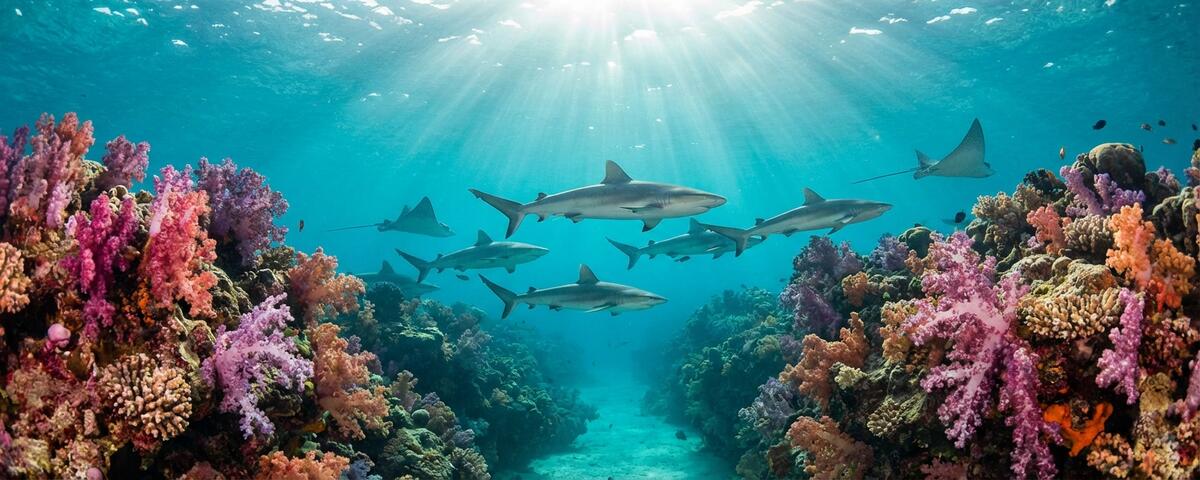
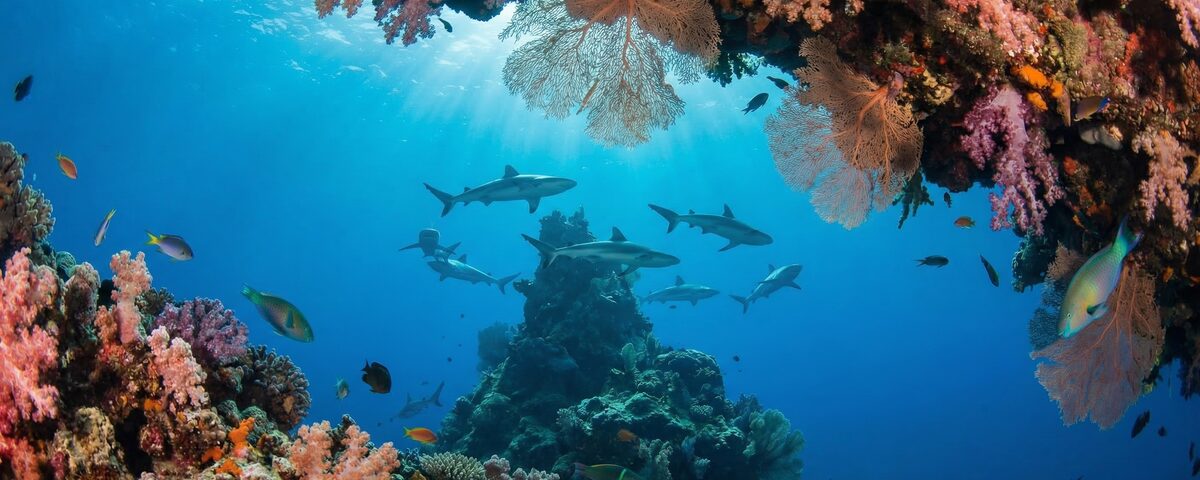
Grey reef sharks dominate the scene at Kandooma Thila, and their numbers are consistently impressive. Schools of 15 to 30 grey reefs patrol the channel side of the pinnacle during incoming current, holding station in the flow at 20 to 28 metres. They're not just passing through. These sharks use the thila as a regular patrol route, and the same individuals have been identified across multiple seasons by researchers studying Maldivian shark populations. On strong current days, the school tightens into a wall of sharks that makes the hair on your neck stand up, even through a 3mm wetsuit.
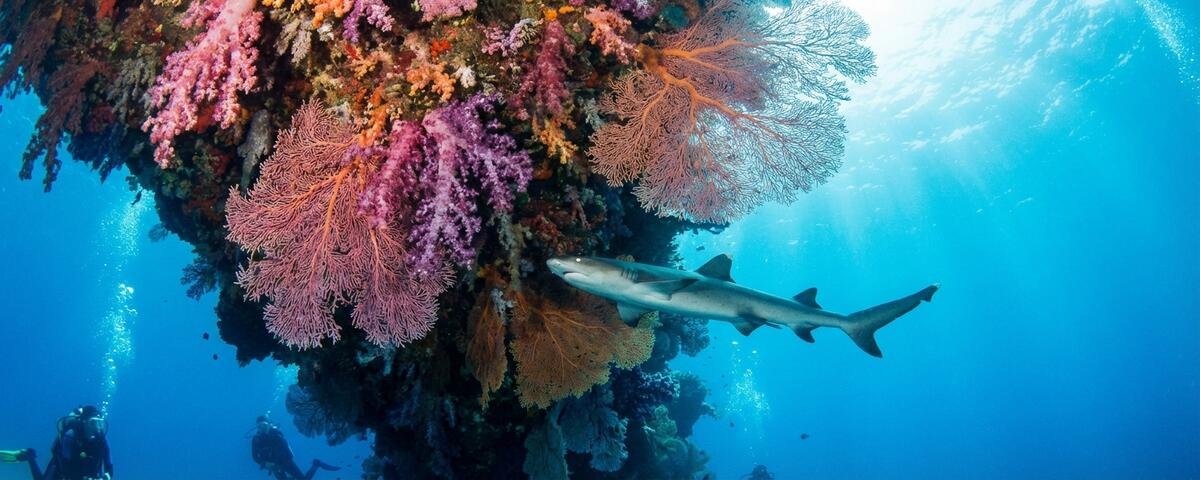
White-tip reef sharks tuck themselves under the overhangs during daylight hours, resting on sandy ledges at 18 to 25 metres. Counts of 5 to 8 per dive are standard. They're docile and approachable, barely registering your presence unless you get within a metre.
Eagle rays are the other reliable big-ticket encounter. Spotted eagle rays cruise through the channel in groups of 2 to 6, usually at 15 to 22 metres, their spotted dorsal surfaces catching the light as they bank and turn. The channel funnels them past the thila, and patient divers holding position on the downstream side often get repeated passes as the rays work the current.
Napoleon wrasse of serious size patrol the upper reaches of the pinnacle. Males exceeding a metre in length are common, and they've grown accustomed to divers. They'll approach within arm's reach, turning one eye towards you with that characteristically knowing expression before gliding off along the reef edge.
The soft coral on the overhangs deserves its own paragraph because it genuinely warrants the trip on its own merit. The northern face between 15 and 25 metres is carpeted in Dendronephthya soft corals, predominantly red and orange but with scattered patches of yellow and purple. The density is remarkable. Overhang ceilings disappear entirely under the growth, creating vivid canopies that photograph brilliantly with a wide-angle lens and strobes.
Schooling fish fill the water column above the thila top. Blue-lined snapper congregate in groups of several hundred, forming shifting clouds of yellow that part and reform as you fin through them. Yellowback fusiliers stream past in the current, and banner fish hover in loose aggregations around the coral heads. Trevally hunt through these schools in fast-moving packs, their attacks sending cascades of silver in every direction.
Oriental sweetlips shelter under the larger overhangs in groups of 10 to 20, their spotted flanks pressed close together. Nearby, you'll find lionfish drifting over the reef, and moray eels (both giant and whitemouth) occupying crevices along the wall.
Turtle sightings are frequent. Hawksbills feed on the sponges growing between the soft coral colonies, and green turtles rest on the pinnacle top. Neither species is particularly bothered by divers at this site.
On the macro front (if you can tear your attention away from the sharks), nudibranchs are scattered across the reef walls, and cleaning stations on the pinnacle top attract groupers and sweetlips queuing for service from cleaner wrasse. The caves and crevices shelter glass fish in shimmering clouds, and longnose hawkfish perch on the gorgonian fans that sprout from the wall at depth.
Dive Conditions
Current is the defining factor at Kandooma Thila and it's not something to take lightly. The site sits in a channel that funnels tidal flow between the open ocean and the atoll interior, and current strength ranges from gentle drift to genuinely challenging. Incoming current (flowing from the ocean into the atoll lagoon) produces the best diving conditions: cleaner water, better visibility, and more shark activity on the exposed eastern face. Outgoing current reverses the flow and tends to bring murkier lagoon water through the channel, dropping visibility to 15 metres or below.
Most operators time their dives for incoming current, typically using a negative entry to descend quickly to the thila top and avoid being swept past. In strong flow, holding position on the exposed face requires reef hooking. Reef hooks are standard equipment here and not optional. Without one, you'll burn through your air fighting the current and miss the sharks entirely.
Visibility ranges from 15 metres on outgoing or slack tide to 30 metres on a clean incoming current. The difference is dramatic enough that the same site can feel like two completely different dives depending on timing.
Water temperature sits between 27 and 30 degrees Celsius year round. A 3mm shorty is adequate for most divers, though those prone to feeling the cold should consider a full 3mm suit, particularly for dives below 20 metres where the thermocline occasionally drops things by a degree or two.
The best season runs from January to April during the northeast monsoon. This period brings calmer seas, better visibility, and more consistent incoming currents through the channel. The southwest monsoon (May to November) delivers rougher surface conditions and less predictable currents, though the site remains diveable throughout the year. June and July are the weakest months for visibility.
Depth ranges from the thila top at 12 metres to the channel floor at 35 metres. Most of the shark action occurs between 20 and 30 metres, so the dive profile tends towards the deeper end. Air management matters. Recreational bottom time at these depths is limited, and the temptation to stay deep watching sharks can lead to shorter dives than planned if you're not monitoring your SPG.
Surface conditions in the channel can include chop and swell, particularly during the southwest monsoon. Boat pickup after the dive is normally on the downstream side of the thila, where current creates a calmer zone. Delayed SMBs are standard practice.
⚓ Divemaster Notes
Kandooma Thila rewards good planning and punishes lazy diving. The single biggest factor in dive quality here is current timing, and getting this right separates a world-class shark dive from a mediocre reef drift.
Check the tide tables before committing to the dive. You want incoming current, ideally about an hour into the flood tide when flow has established but hasn't reached peak strength. Peak incoming current can exceed what's comfortable even with a reef hook, particularly on spring tides around the full and new moon.
Entry technique matters. Negative entries are the way to go. Brief the boat captain on your drop point (upstream of the thila on the current-facing side), kit up fully, and descend immediately on entry. The channel current at the surface can be different in direction from the current at depth, so don't waste time floating on top trying to orient yourself.
Once on the thila, head for the current-facing edge at around 20 to 25 metres. This is where the sharks concentrate. Hook into the reef (there are natural hooking points in the dead coral areas, and please use those rather than hooking into live coral) and settle in. The sharks will come to you. Chasing them burns air and achieves nothing except pushing them further away.
For photography, wide-angle is the obvious choice here. A 10-17mm or equivalent fisheye covers the shark schools and soft coral overhangs beautifully. Strobes help under the overhangs where the soft coral colours are their most vivid, but for the open-water shark passes, ambient light often produces more natural results. The best shots come from holding position at the reef edge with sharks passing between you and the blue water behind them.
Air management: plan for 45 to 50 minutes maximum. Most of the action is at 20 to 28 metres, which eats through air faster than a shallow reef dive. If you're hitting 80 bar at the 30-minute mark, start thinking about moving to the thila top for your safety stop rather than pushing for one more shark pass at depth.
The safety stop on the thila top at 12 to 15 metres is pleasant in its own right. Hard coral coverage is good, turtles cruise through, and the schooling snapper provide entertainment while you off-gas. On calm days, the thila top catches enough light to feel almost Mediterranean.
Watch for down-currents on the exposed corners of the thila, particularly the northeast corner. These can push you deeper than intended without obvious warning. If you feel yourself being pulled down despite finning up, move laterally along the wall rather than fighting the column of water.
How to Get to Kandooma Thila
Kandooma Thila sits in South Malé Atoll, immediately south of North Malé where the international airport is located. Getting there is straightforward compared to more remote Maldivian dive sites, and that's part of its appeal.
From Velana International Airport (Malé), the nearest guesthouse islands are Guraidhoo and Maafushi, both in South Malé Atoll. Public ferries run from Villingili ferry terminal (a short taxi boat from the airport) to both islands, though schedules are limited and journey times run 2 to 3 hours. Private speedboat transfers from the airport to Guraidhoo take about 45 minutes and cost $150 to $250 per person depending on the operator and group size.
Maafushi has become the budget diving hub of the Maldives, with dozens of guesthouses and multiple dive centres offering daily trips to Kandooma Thila when conditions allow. The boat ride from Maafushi to the site takes 30 to 40 minutes. Guraidhoo is closer still, roughly 20 minutes by dhoni.
Liveaboard itineraries covering the central atolls routinely include Kandooma Thila. Most central Maldives routes start from Malé and work south through South Malé before continuing to Vaavu and Meemu Atolls. The thila is typically dived on day one or two of these trips.
Resort-based diving is another option. Several resorts in South Malé Atoll list Kandooma Thila among their dive site offerings, including properties on Kandooma Island itself (now a Holiday Inn Resort) and nearby islands. Resort dive centres run trips to the site weather and current permitting, usually as two-tank morning excursions.
Visa-wise, the Maldives grants 30-day free tourist visas on arrival for most nationalities. No advance visa application required.
Gear Recommendations
Reef hooks are essential, not optional. Bring your own if you're not confident your operator provides quality ones. A 1.5-metre line with a stainless steel hook on one end and a sturdy clip for your BCD on the other is the standard setup. Some divers prefer longer lines (2 metres) for more freedom of movement when hooked in. Practice deploying and stowing your hook before the dive if you haven't used one recently.
A delayed surface marker buoy (DSMB) and reel are required kit. Channel dives mean you may surface away from the boat, and the boat needs to spot you quickly in potentially choppy conditions. Bright orange or yellow, minimum 1.2 metres inflated length. Carry a backup whistle and mirror as well.
Exposure protection: a 3mm full suit or shorty handles the 27 to 30 degree water comfortably. If you run cold or plan dives below 25 metres where a slight thermocline exists, a full 3mm suit is the better choice. Gloves are useful for reef hooking but check local regulations as some operators prohibit them to prevent coral contact.
For cameras, wide-angle is the setup for Kandooma Thila. A rectilinear wide-angle (10-17mm on crop, or 16-35mm on full frame) handles both the shark encounters and the soft coral overhangs. Strobes are valuable for the overhangs and macro work on the thila top, but many shark photographers shoot ambient light only to reduce drag in the current. If you're bringing strobes into the current, make sure your arms are securely clamped. Losing a strobe arm at 25 metres in a channel current is an expensive lesson.
A dive computer with a clear display is important here because you'll be managing depth actively. Nitrox (EANx32) extends your bottom time meaningfully at the 20 to 28 metre depths where the best action occurs. Most operators in South Malé offer Nitrox fills for an additional charge.
Torch: carry a small backup torch for peering into overhangs and caves. Not essential, but the soft coral colours under overhangs absolutely come alive when you add artificial light, even if you're not photographing them.
Recommended Dive Operators
South Malé Atoll has a solid selection of dive operators with regular access to Kandooma Thila. Quality varies, and the operators worth using are those who time their dives around the current rather than running a fixed schedule regardless of conditions.
Maafushi-based centres dominate the budget end. Several PADI 5-Star operations run daily boat trips to the thila and surrounding sites. Look for centres whose divemasters carry reef hooks as standard equipment and who check current conditions before committing to the site. A centre that always goes to Kandooma regardless of the tide is one that doesn't know what they're doing.
Guraidhoo has fewer operators but benefits from proximity. The shorter boat ride means more flexibility to time the dive correctly. Local operators here tend to have years of experience reading the channel currents and will adjust departure times to hit the sweet spot.
Liveaboard operators on central Maldives routes typically have the most experienced guides for this site. The better liveaboards employ Maldivian divemasters who've been diving these channels for decades and read the current by watching the surface water. Their site knowledge is noticeably superior to resort or guesthouse guides who rotate between dozens of sites.
Pricing from guesthouses runs $60 to $90 per dive including equipment, with multi-dive packages bringing the per-dive cost down to $50 to $70. Liveaboard pricing is bundled into the overall trip cost. Resort diving is the most expensive option at $100 to $150 per dive.
Whatever operator you choose, confirm they provide reef hooks and that their guides use them. This isn't a nice-to-have at Kandooma Thila. Also confirm they carry delayed SMBs and that dive briefings cover current-specific entry and exit procedures for the channel.
Liveaboard Options
Central Maldives liveaboard routes are the most popular itineraries in the country, and Kandooma Thila features on nearly all of them. These routes typically run 7 to 10 nights, departing from Malé and covering North Malé, South Malé, Vaavu, and sometimes Meemu Atolls before returning.
Budget liveaboards in the Maldives start around $150 to $200 per night, offering basic but functional cabins, three daily dives, and full board. Mid-range vessels run $200 to $350 per night with better cabins, Nitrox included, and more personalised guiding. Premium boats push past $400 per night and add luxuries like individual dive guides, photography facilities, and spa services.
The advantage of a liveaboard for Kandooma Thila specifically is timing flexibility. A liveaboard can anchor near the site and wait for optimal current conditions, diving it at the perfect moment rather than being committed to a fixed departure from a guesthouse island. The best liveaboard operators will dive Kandooma twice if conditions are exceptional, something a day-trip operator can rarely offer.
Several well-regarded operators run the central atolls route. Look for boats with Maldivian divemasters who know the channels intimately. The local knowledge advantage on a channel dive like this is substantial. A guide who's dived Kandooma Thila 200 times reads the current from the surface and positions the group perfectly. A guide who's dived it twice is guessing.
Booking timing matters. January to April is peak season and the best boats fill months in advance. Budget liveaboards have shorter booking windows, but mid-range and premium vessels for peak season should be booked 6 to 12 months ahead. Off-season (May to November) is significantly cheaper and still diveable, though conditions are less consistent.
Most liveaboards include airport transfers, all meals, drinking water, and 2 to 3 dives per day in their rate. Extras typically include alcohol, Nitrox, equipment rental, and tips for the crew. Budget $100 to $150 per day for extras on a mid-range boat.