Wainilu Dive Site
Komodo, Indonesia · Near Labuan Bajo
Overview
Wainilu is the dive site in Komodo that nobody talks about at the bar afterwards, and that is precisely why the photographers love it. While the rest of the park trades in adrenaline and pelagics, big currents and bigger fish counts, Wainilu works on an entirely different frequency. It is Komodo's muck diving site, its answer to Lembeh Strait, and the place where the smallest creatures in the national park put on the best show.
The site sits on the central coast near Rinca Island, tucked into a sheltered bay where the currents that define most Komodo diving barely register. Drop in and your first impression will be underwhelming. A sloping field of broken coral rubble and dark sand stretches out below you, punctuated by sea urchins and patches of algae. No dramatic walls. No pinnacles disappearing into blue water. If you surfaced after thirty seconds, you would wonder what the fuss was about.
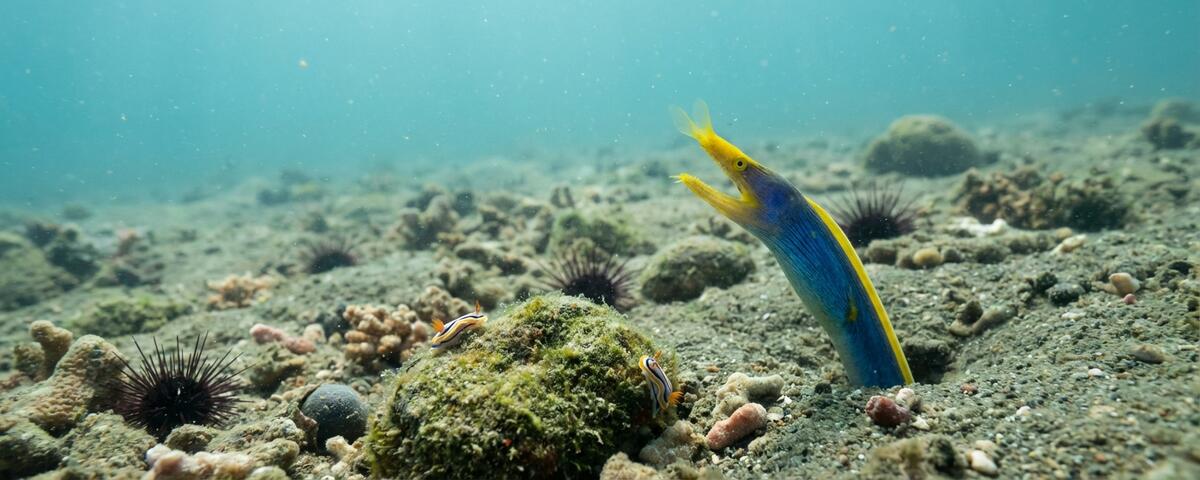
Give it two minutes. Let your eyes adjust. The rubble starts moving. A frogfish the size of your fist sits motionless against a sponge, its lure twitching. A ribbon eel pokes its electric blue head from a burrow, jaws gaping in that permanently startled expression they wear. A pair of mandarin fish shuffle through the coral fragments in the shallows, their psychedelic patterns almost offensively bright against the drab substrate.
This is what Wainilu does. It takes the divers who arrive expecting nothing and sends them back to the boat having seen creatures they did not know existed. Every guide in Labuan Bajo has a story about the sceptical diver who came here reluctantly between the 'real' Komodo sites, then spent the entire surface interval scrolling through 200 macro photographs and asking when they could go back down.
The site works best as a contrast piece within a broader Komodo itinerary. After a morning getting battered by current at Batu Bolong or Castle Rock, an afternoon at Wainilu feels like stepping into a different country. The pace drops. The focus narrows. You stop scanning the blue for sharks and start scanning the sand for something the size of a thumbnail. It is a fundamentally different style of diving, and it rounds out a Komodo trip in a way that another current-swept pinnacle simply cannot.
Marine Life at Wainilu
The species list at Wainilu reads like a macro photographer's wish list, the kind of inventory that would take months of dedicated diving to compile at most sites but turns up casually on a single 55-minute dive here.
Ribbon eels are the poster species. These slender, impossibly coloured morays live in burrows across the sandy slope, poking their heads out to filter-feed on passing plankton. Juveniles are jet black with a yellow dorsal fin. Adults shift to brilliant blue with yellow jaws. The colour transformation takes years, and Wainilu is one of the few sites in Komodo where you can reliably find both colour phases on a single dive.
Frogfish are the other headline act. Painted frogfish in red, orange, yellow, and brown sit motionless on sponges and rubble, relying on camouflage so effective that guides routinely point directly at one while divers stare past it. Giant frogfish occasionally show up in the shallower sections, their warty skin blending with the encrusted substrate. Hairy frogfish are rarer but recorded here, their filamentous appendages making them look like clumps of algae.
The octopus diversity is remarkable for a single site. Blue-ringed octopus, small enough to sit on a coin, hide in shells and crevices across the rubble field. Wunderpus and mimic octopus both appear here, though neither is guaranteed on any given dive. The mimic's shape-shifting displays, imitating flatfish, lionfish, and sea snakes depending on the threat, are genuinely bizarre to witness. Guides who know their specific burrow locations dramatically improve your chances.
Mandarin fish are the sunset attraction. These tiny dragonets live in the shallow coral rubble at 3 to 5 metres depth, emerging at dusk to perform their mating dance. Watching a pair spiral upward together, releasing eggs and sperm simultaneously before darting back into cover, is one of those underwater moments that stays with you. Sunset dives timed for this behaviour are popular with operators who know the site well.
Ghost pipefish drift vertically among crinoids and soft coral patches, their leaf-like bodies swaying with the surge. Ornate ghost pipefish and robust ghost pipefish have both been documented here. Coleman shrimp pair up on fire urchins, their tiny bodies nestled between the venomous spines. Harlequin shrimp, those painted crustaceans that feed exclusively on starfish, appear occasionally in the rubble.
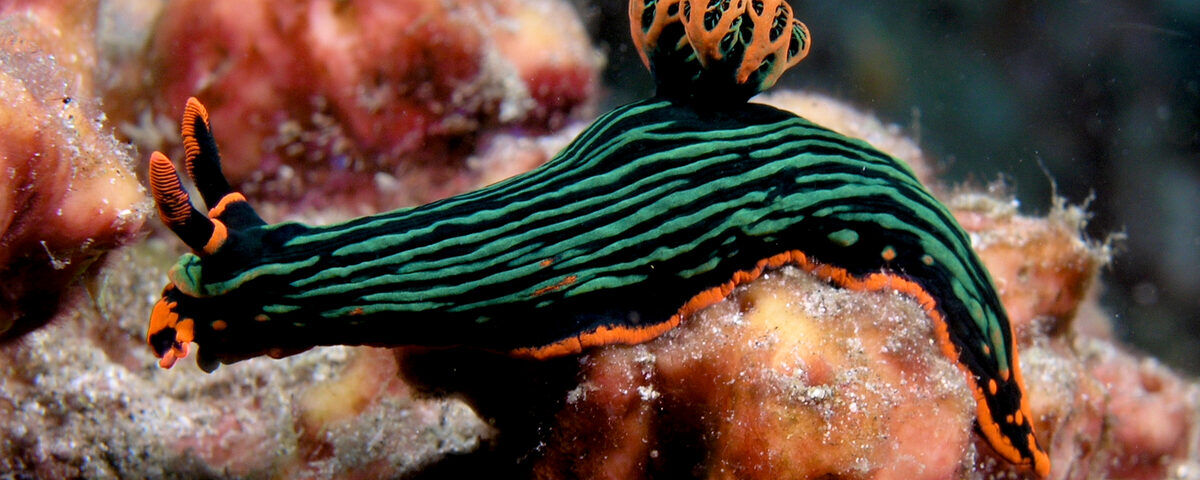
Nudibranchs are everywhere. The site regularly produces 20 or more species on a single dive if you are looking carefully. Chromodoris, Glossodoris, Nembrotha, and Phyllidiidae species are common. The Pikachu nudibranch (Thecacera pacifica), named for its obvious resemblance to the cartoon character, draws particular excitement from photographers.
Scorpionfish lie on the substrate in various states of disguise. Devil scorpionfish (also called Indian walkman or sea goblin) walk across the bottom on modified pectoral fins, flashing vivid orange and black warning colours from their inner fins when disturbed. Flying gurnards spread their massive pectoral fins into wing-like displays. Snake eels thread through the sand, their pointed heads surfacing periodically before disappearing again.
The site also produces cowfish, seahorses, zebra crabs on fire urchins, and an assortment of commensal shrimp on anemones and soft corals. Night dives add another layer entirely, bringing out Spanish dancers, bobtail squid, and hunting cuttlefish.
Dive Conditions
Wainilu is among the easiest dive sites in Komodo National Park, and that statement alone makes it unusual. In a park defined by strong, unpredictable currents and advanced diving conditions, Wainilu's sheltered bay and gentle slope feel almost luxuriously calm.
Currents are negligible to mild, rarely exceeding 1 knot even on spring tides. The site's position in a protected bay near Rinca shields it from the powerful tidal exchanges that rip through the strait between Komodo and Rinca. On most dives, you will feel no current at all. This makes Wainilu one of the few Komodo sites genuinely suitable for newer divers, for those completing their Advanced Open Water certification, or for anyone recovering from an exhausting morning on the current-heavy northern sites.
The depth profile slopes gradually from 3 metres in the shallows to roughly 30 metres at the deepest point on the sand. Most of the productive macro hunting happens between 5 and 20 metres, where the rubble field is densest and the critter populations are concentrated. The average dive depth sits around 15 to 19 metres, giving generous no-decompression limits. Air consumption is typically lower than at other Komodo sites because you are moving slowly, hovering rather than fighting current.
Visibility is the variable that divides opinion on Wainilu. On clear days, particularly during the dry season from April through October, visibility can reach 20 to 25 metres and the site looks surprisingly attractive. During plankton-heavy periods or after rain, it can drop to 5 to 10 metres. For macro work, reduced visibility is largely irrelevant since you are shooting subjects 30 centimetres from your lens. For wide-angle photographers hoping to capture the broader rubble landscape, timing matters more.
Water temperature ranges from 22 to 29 degrees depending on season and depth. The site does not experience the brutal thermoclines that characterise southern Komodo sites like Nusa Kode or Cannibal Rock, but deeper sections can still run a few degrees cooler than the surface. A 3mm wetsuit is usually sufficient, though a 5mm provides more comfort on longer dives or during the cooler months of July and August.
The sandy, silty substrate is both the site's attraction and its main challenge. Poor buoyancy control will stir up clouds of silt that ruin visibility and disturb the creatures you are trying to observe. This is why operators with good standards require decent buoyancy skills before bringing divers here. You do not need to be an expert, but you need to be able to hover at a fixed depth without finning the bottom.
⚓ Divemaster Notes
I tell every group the same thing before a Wainilu dive: leave your wide-angle lens on the boat. Seriously. This is not the dive for it. Bring a 60mm or 100mm macro setup, or if you are shooting compact, switch to macro mode and get your dioptre on. Everything worth seeing here is smaller than your hand.
Buoyancy briefing is non-negotiable. The substrate is dark sand and coral rubble that kicks up into suspended clouds at the slightest fin stroke. I have seen entire dives ruined by one diver with poor trim dragging their fins through the silt at the start. If someone cannot hover cleanly at a fixed depth, I will pair them with a guide who can manage their positioning, or I will suggest they dive a different site instead.
The critter stations are fairly consistent between dives, but they shift over weeks and months. Ribbon eels maintain their burrows for extended periods, sometimes months at a time, so I know where the current residents are. Frogfish are more mobile but tend to stay within a patch of reef for days or weeks before relocating. The mandarin fish colony in the shallows has been active in the same rubble patch for years.
I always start deep, around 20 metres, and work gradually shallower. The deeper sand tends to hold the snake eels and the larger frogfish, plus any octopus activity. As we ascend through the 15 to 10 metre zone, we hit the densest rubble where nudibranch counts peak. The final 20 minutes in the shallows at 5 to 8 metres is where the ghost pipefish and mandarin fish live.
For sunset or night dives, I recommend arriving at the site by 5pm. The mandarin fish start their mating dance around 5:30 to 6pm, just as the light drops. You need to be in position beforehand because approaching the colony with torches blazing will send them into hiding. Red filters on torches are ideal. After the mandarin fish display, switching to a proper night dive as darkness falls reveals a completely different cast: Spanish dancers, bobtail squid, and hunting cuttlefish that are invisible during daylight.
One thing worth knowing: the sea urchins here are dense in places, and several of the bottom-dwelling species (devil scorpionfish, stonefish) are genuinely dangerous to touch. I remind everyone to keep hands off the substrate and maintain a hover at all times. This is as much about safety as it is about not stirring up silt.
How to Get to Wainilu
Wainilu sits on the central coast of Komodo National Park near Rinca Island, roughly 2 to 3 hours by boat from Labuan Bajo depending on sea conditions and boat speed. Unlike the distant southern sites, Wainilu falls within comfortable day-trip range for operators based in Labuan Bajo, making it accessible without a liveaboard booking.
Labuan Bajo is the gateway town, reachable by direct flights from Bali on multiple carriers (1 hour 15 minutes, several daily services). Flights from Jakarta are also available. The town's Komodo Airport has expanded considerably to handle growing tourism, and transfer to the harbour takes about 10 minutes.
Most Labuan Bajo dive operators include Wainilu as an option on their daily boat schedules, typically paired with a current-heavy site in the morning (Batu Bolong, Crystal Rock, or Castle Rock) and Wainilu as the afternoon or sunset dive. This pairing works well because the muck dive provides a welcome contrast after a physically demanding morning.
Liveaboard itineraries also stop at Wainilu, usually on the central Komodo circuit days. It fits naturally into schedules that visit the central and northern sites, and most captains anchor overnight in the sheltered waters nearby.
Komodo National Park entrance fees apply. Current rates are IDR 150,000 on weekdays and IDR 350,000 on weekends and holidays, though these change periodically. Most operators include park fees in their diving packages, but it is worth confirming before booking.
Gear Recommendations
Macro lens (60mm or 100mm) strongly recommended for photography. Compact cameras should use macro mode with a dioptre or wet lens. Leave the wide-angle on the boat. Torch essential for spotting critters in crevices and under rubble, and mandatory for sunset or night dives. Red filter for torches helpful during mandarin fish observation to avoid disturbing their mating behaviour. 3mm wetsuit adequate for most conditions; 5mm for cooler months or extended bottom times. Nitrox beneficial for extending dive times at the productive 15 to 20 metre zone. Pointer stick or muck stick useful for stabilising yourself on sand without using your hands (never touch the substrate directly due to scorpionfish and urchin hazards). SMB for surface signalling.
Recommended Dive Operators
Blue Marlin Dive in Labuan Bajo runs daily boats to Wainilu and their guides know the critter locations intimately. They specifically recommend the site for macro enthusiasts and will pair it with a high-energy site in the morning. Scuba Junkie Komodo offers Wainilu on their regular rotation with guides experienced in spotting the more elusive species like wunderpus and mimic octopus. iDive Komodo lists Wainilu as one of their signature macro sites and runs sunset dives timed for mandarin fish mating behaviour. Dragon Dive Komodo includes Wainilu on their central circuit and caters well to underwater photographers. For liveaboard access, Wunderpus Liveaboard runs small-group photography trips that spend extra time at macro sites like Wainilu.
Liveaboard Options
Wainilu falls within day-trip range of Labuan Bajo, so a liveaboard is not required. That said, liveaboard itineraries through central Komodo regularly include Wainilu, and the advantage of a liveaboard is scheduling flexibility for sunset and night dives without the pressure of a return journey. Dive Komodo's liveaboard includes Wainilu on their central circuit days. Wunderpus Liveaboard offers photography-focused trips with extended bottom times at macro sites. The Seven Seas fleet stops at Wainilu on their comprehensive Komodo itineraries. Budget liveaboard options from Labuan Bajo start around USD 250 per day including diving and meals. Day trips including two or three dives with Wainilu on the schedule typically run USD 80 to 120 per person from Labuan Bajo operators.