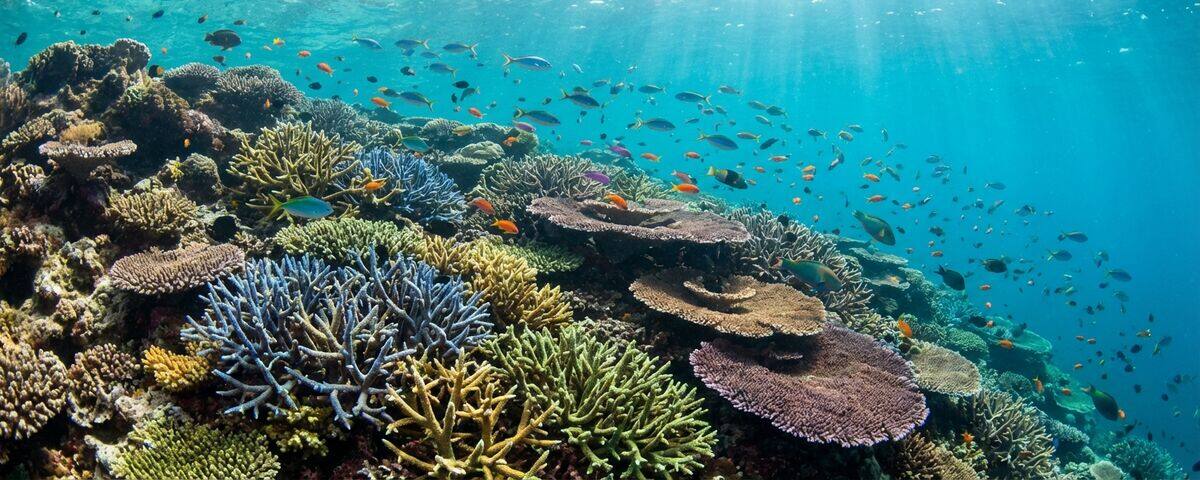
Hanging Gardens Dive Site
Sipadan-Mabul, Malaysia · Near Semporna
Overview
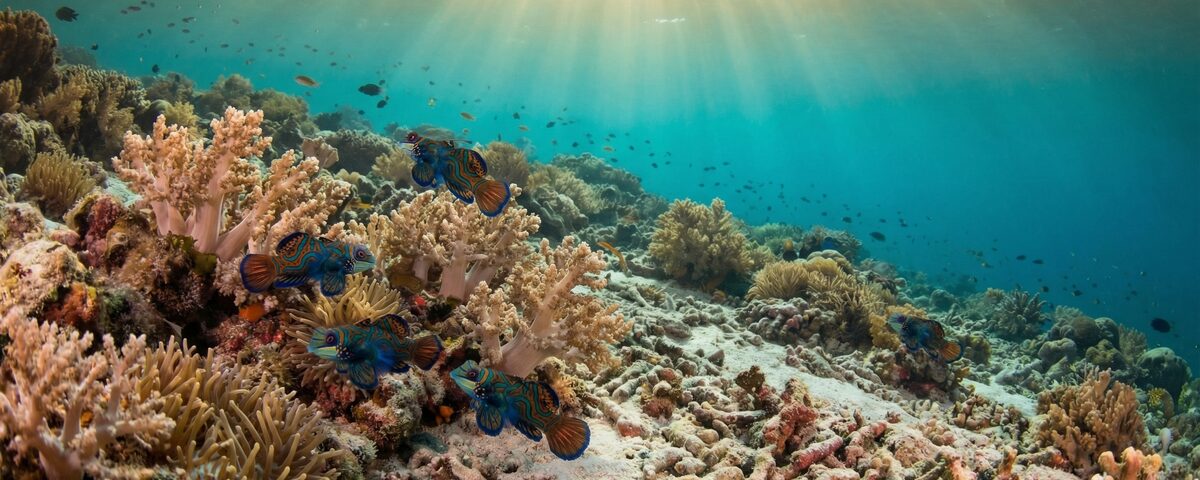
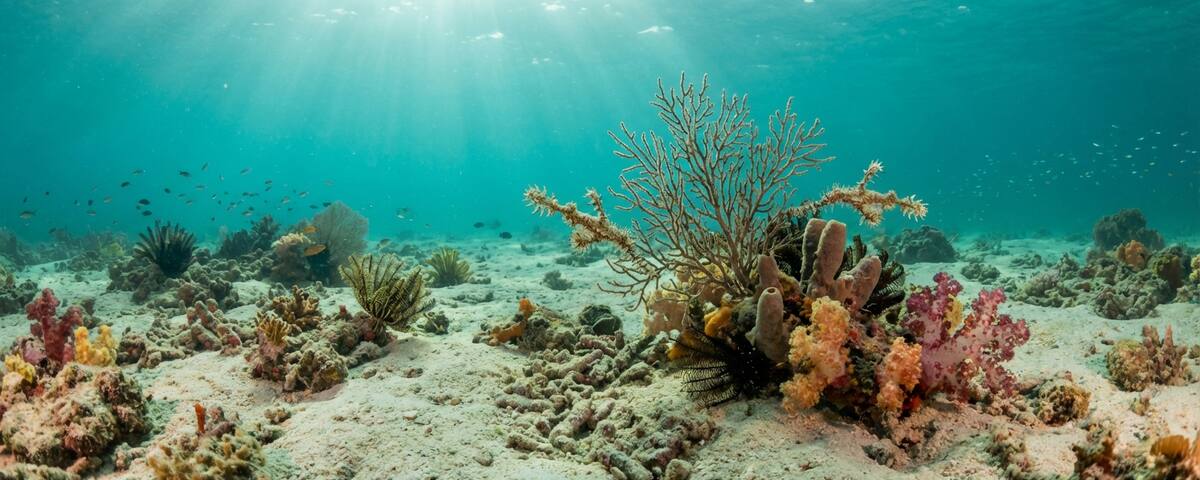
Hanging Gardens is one of Sipadan Island's most visually striking dive sites, named for the dense curtains of soft coral that drape from overhangs and ledges along the reef wall like something from a botanical fever dream. Situated on Sipadan's northern face, the site runs along a section of the island's signature vertical drop-off where the shallow reef flat plunges into deep blue water, and every available surface is colonised by gorgonian fans, dendronephthya soft corals, and wire corals that sway in the gentle current.
The name fits. Other Sipadan sites are known for turtles, for barracuda tornados, for whitetip sharks stacked on ledges. Hanging Gardens earns its reputation through sheer reef architecture. The wall here is not a clean vertical face but a series of stepped overhangs and undercuts, each one hosting a different community of filter feeders that have positioned themselves to catch passing nutrients. The effect, particularly when you drop below 15 metres and look up, is of a vertical garden cascading downward into the abyss.
Sipadan sits on an oceanic pinnacle rising from 600 metres depth in the Celebes Sea, and that geological accident explains why the reef life here is so absurdly dense. Open ocean upwellings deliver nutrients that sustain enormous biomass on a relatively small island. Hanging Gardens catches a fair share of that bounty. The soft corals are the headline act, but the site also supports healthy populations of reef fish, turtles, and the occasional pelagic visitor drifting in from deeper water.
Most divers visiting Sipadan on a standard permit day will dive two or three sites. Hanging Gardens often gets scheduled as a second or third dive, which is a shame because it deserves full air and full attention. If your operator gives you any choice in the matter, request it as a first dive when the morning light angles down through the water column and lights up those soft coral curtains in oranges, reds, and purples that flatten to brown by midday.
Marine Life at Hanging Gardens
The soft corals are what brought you here, so start with those. Dendronephthya clusters in vibrant reds, oranges, pinks, and yellows colonise every overhang and undercut along the wall. They open fully when current is flowing, which is most of the time at Sipadan, and collapse into unrecognisable blobs when the water goes slack. Timing your dive for a period of gentle current means the difference between a wall that looks like an explosion in a paint factory and one that looks like wet tissue paper.
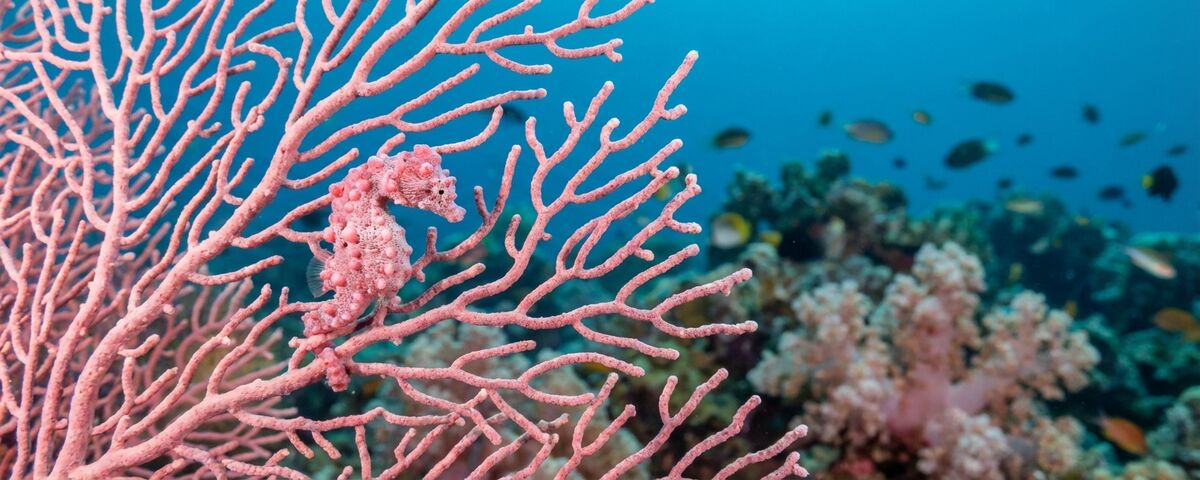
Gorgonian sea fans spread across the wall face in sizes that dwarf most divers. Individual fans reach two metres across, their lattice structures oriented perpendicular to the prevailing current to maximise plankton capture. Pygmy seahorses hide on some of these fans, specifically the Muricella species with their bumpy texture. They are genuinely tiny, smaller than your thumbnail, and finding one without a guide borders on impossible. Ask your divemaster. They know which fans are hosting.
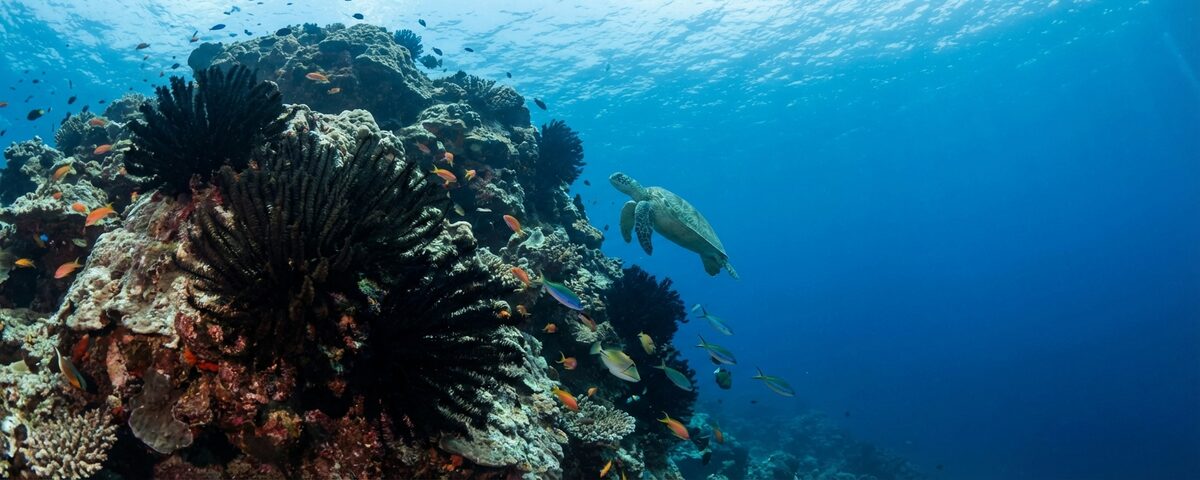
Green and hawksbill turtles are everywhere on Sipadan, and Hanging Gardens is no exception. Hawksbills feed on the sponges growing between soft coral colonies, and greens rest on ledges along the wall. On a single dive you might see five or six turtles without going out of your way to find them. They are remarkably unbothered by divers here, a product of decades of marine park protection.
Schools of pyramid butterflyfish hover along the wall in loose aggregations, picking at plankton. Anthias cloud the shallower sections in pinks and oranges that complement the soft corals behind them. Bigeye trevally patrol the wall edge in formation, occasionally tightening into a baitball when something below catches their attention.
Whitetip reef sharks rest on ledges and in small caves along the lower wall. They are placid during daylight hours, stacked two or three to a ledge, barely acknowledging divers who drift past. Bumphead parrotfish sometimes cruise through in the early morning, a squadron of green-grey bulk that sounds like gravel being chewed, because it is. They bite chunks from the coral, digest the algae, and excrete the calcium carbonate as sand. Much of the beach you walked across to reach the boat was processed through a parrotfish.
Look into the blue occasionally. Sipadan's position in open ocean means anything can appear from the deeper water. Grey reef sharks, eagle rays, and barracuda all pass through Hanging Gardens with enough regularity that ignoring the blue would be a mistake.
Dive Conditions
Hanging Gardens runs along the northern wall of Sipadan Island, starting from the reef flat at around 5 metres and dropping vertically to well beyond recreational limits. Most of the interesting soft coral formations sit between 12 and 30 metres, with the densest overhang sections concentrated between 18 and 25 metres. The wall continues beyond 35 metres into deep blue water, but the best scenery lives in the recreational zone.
Currents range from mild to moderate. The site benefits from its position on the northern face, which is somewhat sheltered compared to exposed points like Barracuda Point or South Point. On most days a gentle drift carries you along the wall from west to east, making this a comfortable one-way dive where the boat picks you up at the far end. Occasionally the current reverses or stalls entirely. Strong currents that require reef hooks are rare here but not unheard of during spring tides.
Visibility is excellent by any standard. Sipadan's oceanic position means the water column is generally free of the suspended sediment that affects nearby Mabul and Kapalai. Expect 20 to 30 metres on an average day, with exceptional days pushing to 40 metres. Reduced visibility below 20 metres typically coincides with plankton blooms, which are actually good news for the soft corals and for any pelagics the plankton attracts.
Water temperature holds steady between 26 and 30 degrees Celsius throughout the year. Thermoclines occasionally appear below 25 metres, dropping temperatures by 2 to 3 degrees in a surprisingly sharp transition. A 3mm full wetsuit handles the conditions for most divers. Those planning to spend time at depth on the lower wall sections may prefer a 5mm suit for the cooler water below the thermocline.
Entry is by boat, with a giant stride into water deep enough that you're immediately on the wall. There is no long swim from shore. Descent is straightforward: drop over the edge of the reef flat and the wall is right there. Most groups descend to their maximum depth first, then work upward along the wall during the dive, finishing with a safety stop on the sunlit reef flat where hard corals and damselfish keep you entertained during the three minutes.
⚓ Divemaster Notes
Brief your group on buoyancy before this dive. The overhangs and soft coral curtains at Hanging Gardens are fragile and positioned exactly where careless fin kicks do the most damage. A diver who drops onto a dendronephthya cluster destroys years of growth in a second. Set expectations clearly: maintain a minimum one-metre gap from all wall surfaces, keep fins above the reef when hovering, and use a horizontal trim throughout.
The standard profile starts with a descent to maximum depth on the deeper wall (25 to 30 metres for advanced groups, 18 to 20 for intermediates) and works upward. The richest overhang sections sit between 18 and 25 metres. Plan to spend the bulk of your bottom time in this zone, ascending gradually as air supply dictates. The reef flat between 5 and 8 metres makes an excellent safety stop area with plenty to see.
For photographers, the soft coral overhangs demand wide-angle glass. A 10 to 17mm rectilinear or a fisheye captures the scale of the gardens with a diver or turtle in the frame for context. Strobe positioning matters here: aim strobes outward and slightly behind to light the soft corals from the side, bringing out their three-dimensional texture. Front-on flash washes the colours flat. Dual strobes on long arms give the best results in the overhang recesses.
Pygmy seahorse hunting on the gorgonian fans requires patience and a macro lens, which means choosing between wide-angle for the gardens or macro for the critters. Recommend photographers pick one per dive rather than switching underwater. The gorgonians hosting pygmies are usually at 20 to 25 metres, and bottom time at that depth evaporates quickly if you are waiting for a two-centimetre seahorse to turn sideways.
Watch the current direction before descent. A westerly drift along the wall is the normal pattern and makes for a comfortable one-way dive. If the current is running east to west (reverse), consider starting at the eastern end of the site and drifting back. In slack conditions, you can swim either direction.
Pair this dive with South Point or West Ridge for a varied permit day. The contrast between Hanging Gardens' soft coral spectacle and the turtle and shark encounters at other Sipadan sites gives divers the full range of what makes this island world-class.
How to Get to Hanging Gardens
Sipadan Island sits in the Celebes Sea off southeastern Sabah, Malaysian Borneo. The gateway town is Semporna, a small fishing port about 90 minutes by road from Tawau.
Fly into Tawau Airport (TWU). Malaysia Airlines and AirAsia operate daily flights from Kota Kinabalu (roughly 50 minutes) and Kuala Lumpur (about 2 hours 45 minutes). From Tawau, road transport to Semporna takes 60 to 90 minutes. Most dive resorts arrange airport transfers as part of their packages, typically 100 to 150 MYR for a private car.
From your resort on Mabul or Kapalai (accommodation on Sipadan itself was removed in 2004 for conservation), speedboats reach Sipadan in 20 to 30 minutes. All Sipadan diving is conducted as day trips from these nearby islands.
Sipadan permits are the critical bottleneck. The Malaysian government limits daily visitors to 176 divers, allocated through licensed operators. Permits are included in resort dive packages but must be booked well in advance during peak season (April to August, school holidays, Chinese New Year). A typical package runs four to five nights and includes two or three Sipadan permit days with remaining days spent on Mabul and Kapalai sites.
Budget 3,500 to 10,000 MYR for a complete package depending on the resort tier, covering accommodation, meals, diving, equipment hire, transfers, and Sipadan permits. Backpacker operations in Semporna offer budget alternatives starting around 2,500 MYR, though permit availability is less guaranteed.
Total travel time from Kuala Lumpur to your first dive at Hanging Gardens runs about 7 to 9 hours: flight to Tawau, road transfer to Semporna, boat to Mabul or Kapalai, then a morning speedboat to Sipadan the next day. International travellers typically connect through KL, Singapore, or Kota Kinabalu.
Gear Recommendations
Wide-angle lens is the right choice for Hanging Gardens. A fisheye or rectilinear wide-angle in the 10 to 17mm range captures the soft coral overhangs in their full cascading glory with deep blue water behind them. The scenes here are about scale and colour, and a macro lens, while useful for pygmy seahorses on the gorgonians, misses the site's defining character.
Dual strobes are important for the overhang work. The soft corals sit in shadows beneath ledges, and ambient light alone renders them in muted browns and greens. Strobes bring back the vivid reds, oranges, and pinks that make these formations so striking. Position strobes wide on long arms to avoid backscatter and to create side-lighting that emphasises texture. A single strobe leaves harsh shadows on one side of the subject.
A 3mm full wetsuit handles Sipadan's warm water on most dives. For multi-dive days or if your dive plan takes you below the thermocline at 25 metres, a 5mm suit keeps you comfortable across three or four dives without the accumulated chill that builds over a full day of diving. Hood and gloves are unnecessary.
Surface marker buoy and reel are mandatory at Sipadan. Currents can shift unexpectedly, and if you surface away from the boat, the SMB is how the captain finds you in open ocean. This is not optional. Every diver in the water should carry their own.
Dive computer with nitrox capability is standard for Sipadan diving. Most operators offer enriched air at 32%, and the multi-dive days with wall profiles benefit significantly from the extended no-decompression limits that nitrox provides. Pay the small surcharge.
Reef-safe mineral sunscreen for surface intervals. Sipadan is a protected marine park, and chemical sunscreens containing oxybenzone and octinoxate are not appropriate here. Rash guard with UV protection reduces sunscreen dependency entirely and is the better option for a full day on a dive boat.
Recommended Dive Operators
Seaventures Dive Rig, the converted oil platform anchored between Mabul and Sipadan, consistently delivers strong Sipadan diving. Their boat captains and divemasters know every metre of Sipadan's wall, and the rig's location means shorter transit times to the island than mainland Semporna operators manage. The accommodation is industrial-chic rather than luxury, but the diving operation is tight and the unlimited Mabul house reef diving between Sipadan days is a genuine bonus.
Sipadan Water Village on Mabul runs a polished operation with overwater chalets and a well-equipped dive centre. Their Sipadan packages are comprehensive, and the guides carry years of site-specific knowledge. Hanging Gardens is a regular feature on their rotation, and their briefings typically include current soft coral conditions and recent wildlife sightings at the site.
Borneo Divers holds the distinction of being the first operator to bring recreational diving to Sipadan, back in the 1980s. Their Mabul resort is comfortable, their equipment well-maintained, and their senior divemasters carry institutional knowledge of these sites that newer operations cannot match. Premium pricing reflects the heritage.
Scuba Junkie offers the most budget-friendly packages without cutting corners on safety or guide quality. Popular with backpackers and younger divers, they run active conservation programmes and coral restoration work around Mabul. Their Sipadan days are well-organised, and the casual atmosphere on their boats keeps the mood light between dives.
For photography-focused trips, consider requesting Hanging Gardens as a first dive on your permit day. Most operators are flexible with site order if conditions allow. Morning light between 8 and 10 AM produces the best colours on the soft corals, and the earlier you dive, the more likely you are to catch bumphead parrotfish cruising the wall.
Liveaboard Options
Sipadan is primarily a resort-based destination, with most divers staying on Mabul or Kapalai and making daily boat trips to the island. However, a small number of liveaboard operators include Sipadan in their Borneo itineraries.
MV Celebes Explorer runs periodic routes through the Celebes Sea that include Sipadan permit days alongside Mabul, Kapalai, and occasionally Layang-Layang Atoll (March to August for hammerheads). Trips typically span 7 to 10 nights with pricing between 8,000 and 15,000 MYR depending on cabin and season. The advantage of a liveaboard is the possibility of combining Sipadan's walls with more remote Celebes Sea sites that resort-based divers never reach.
The main limitation is permit allocation. Liveaboards compete for the same 176 daily permits as resort operators, and their schedule flexibility is constrained by itinerary commitments. A resort stay guarantees two or three Sipadan days per package, while a liveaboard passing through might allocate one or two.
For divers whose primary goal is Sipadan, a resort stay on Mabul gives better value and more dives on the island. For those wanting Sipadan as part of a broader expedition, the liveaboard approach works well, provided you confirm in advance exactly how many Sipadan permit days the itinerary includes.
A sensible combination for serious divers: five nights at a Mabul resort for concentrated Sipadan access, followed by a separate liveaboard trip to Layang-Layang for hammerhead sharks if visiting during season. The two experiences complement each other perfectly.