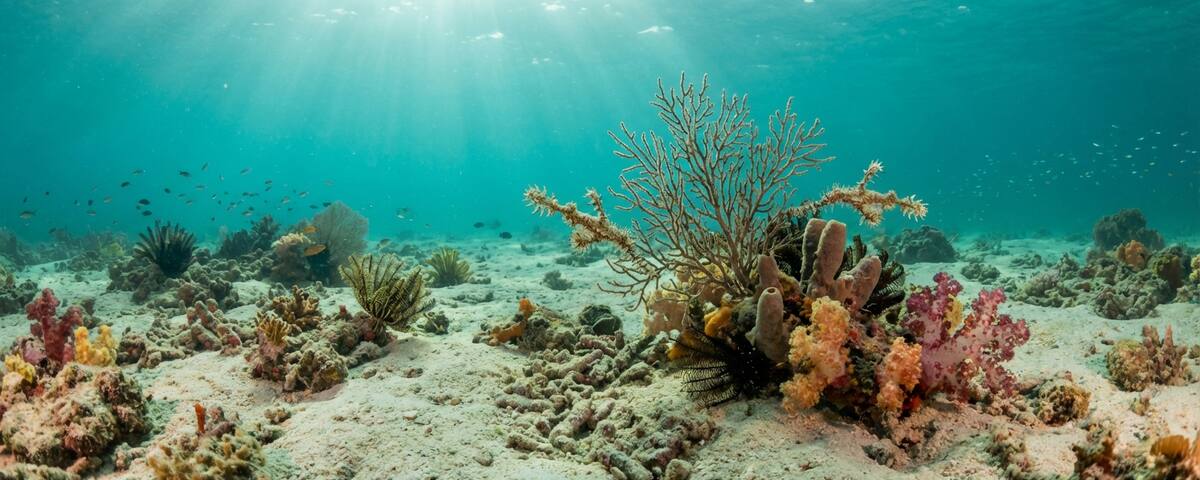
Paradise Dive Site
Sipadan-Mabul, Malaysia · Near Semporna
Overview
Paradise is a muck diving site that most people walk past without realising what sits beneath the surface. Split into two zones, Paradise I and Paradise II, the site serves as the house reef for both Sipadan Water Village and Borneo Divers Mabul Resort on the northern shore of Mabul Island. It is shallow, sheltered, and absolutely loaded with the kind of bizarre marine life that draws macro photographers from around the world.
The name is not ironic. For anyone who gets excited about frogfish tucked into sponges, ghost pipefish mimicking crinoids, or mandarinfish performing their sunset mating dance beneath a wooden jetty, this genuinely is paradise. The site will never win awards for dramatic walls or pelagic encounters. That is not the point. Mabul built its reputation on the small and strange, and Paradise concentrates that reputation into two short stretches of reef that you can dive three times in a day and still find something new on each pass.
Paradise I extends from the Sipadan Water Village jetty northward along a gentle sandy slope dotted with coral rubble, artificial reef structures, and patches of soft coral. Paradise II picks up where the first section leaves off, continuing toward the Borneo Divers property with a similar topography but slightly more hard coral coverage and a couple of deeper sandy channels that attract different species. Together they cover roughly 400 metres of coastline, all of it diveable from shore.
What makes this site genuinely special is the density of critter life packed into a small area at accessible depths. You do not need to go below 15 metres for any of the headline species. Open Water certified divers can access everything the site has to offer, and the absence of current means you can hover in one spot for five minutes watching a single animal without drifting off your target. That patience is rewarded here more than almost anywhere else in the Celebes Sea.
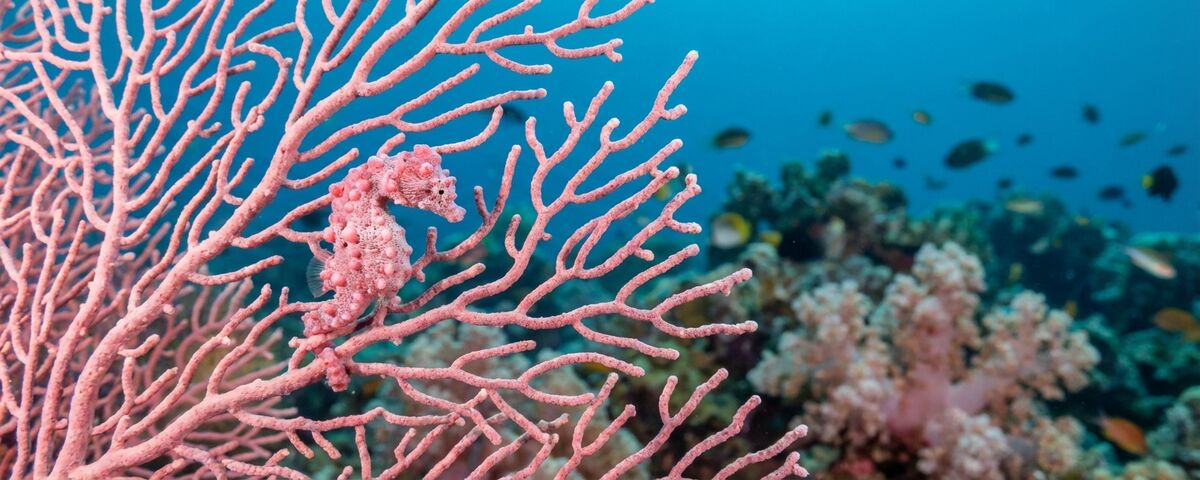
The proximity to two major resorts has an unexpected benefit. Years of artificial reef development, including concrete blocks, old tyres, metal frames, and purpose-built structures, have created a patchwork of micro-habitats that critters colonise eagerly. Frogfish settle onto sponge-covered blocks. Seahorses wrap their tails around wire frames. Nudibranchs carpet the old rubber. It is not pretty in the way a pristine reef is pretty, but the biodiversity per square metre rivals anything at nearby Sipadan.
Marine Life at Paradise
Ghost pipefish are Paradise's calling card. Ornate ghost pipefish, robust ghost pipefish, and the harder-to-spot halimeda ghost pipefish all turn up here with reliable frequency. They hover vertically among crinoids and soft corals, their bodies so perfectly camouflaged that most divers swim straight past them. A good Mabul divemaster will find two or three individuals on a single dive without breaking a sweat.
Frogfish come in multiple species and sizes. Giant frogfish the size of a football sit on sponges in plain sight, their lure twitching occasionally to attract prey. Painted frogfish in orange, yellow, and black variations occupy the artificial reef structures. The occasional warty frogfish shows up wedged between coral rubble at the base of the slope. During good months, you might count five or six individuals across the two zones.
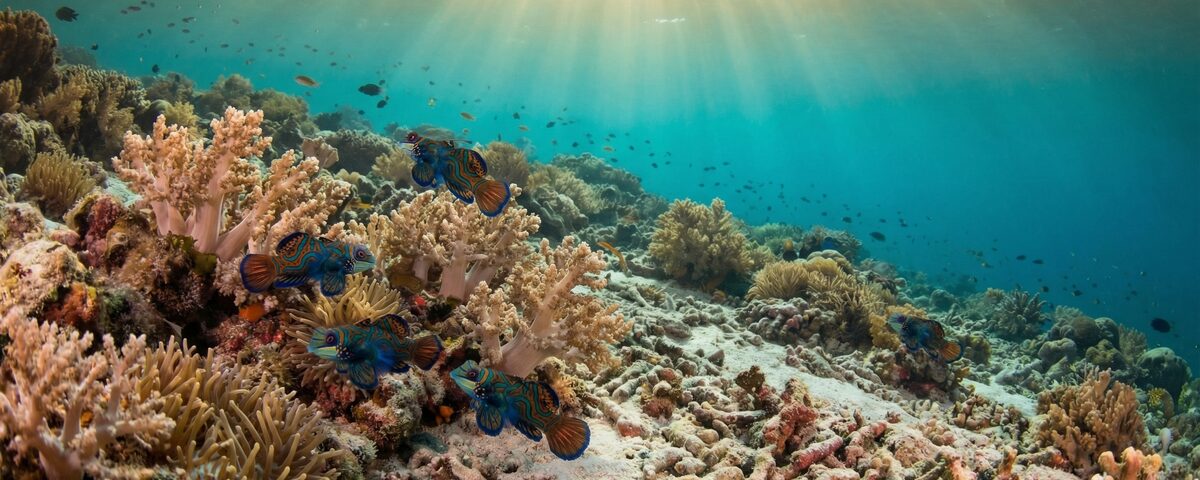
Mandarinfish are the sunset attraction. Below the second jetty at Paradise II, a colony of these impossibly coloured dragonets emerges from coral rubble in the last 20 minutes before dark. The males, with their psychedelic green and orange markings, perform a courtship dance with the smaller females, rising briefly into the water column to spawn before darting back into cover. Timing matters: arrive too early and they stay hidden, arrive too late and you will miss them in the fading light.
Ribbon eels inhabit sandy burrows across both zones. The juveniles are jet black, sub-adults bright blue with a yellow jaw, and mature males fully yellow. All three colour phases have been recorded here. They extend their slender bodies from their holes to feed, retracting instantly if approached too quickly.
Sea moths (short dragonfish) shuffle across the sandy bottom on modified pectoral fins, their flattened bodies and wing-like appendages making them look like something from a different planet entirely. They are uncommon at most dive sites but turn up at Paradise with enough regularity that divemasters know specific patches of sand where they tend to forage.
Spotted-face moray eels peer from crevices throughout the reef. Juvenile cuttlefish, often no larger than a thumb, hover over coral rubble displaying rapid colour changes. Black-saddled tobies and yellow-spotted burrfish potter about the coral blocks. Porcelain crabs filter-feed from anemones. Nudibranchs in dozens of species, from chromodoris to phyllodesmium, cover the substrate.
Night diving elevates the site further. Spanish dancers emerge after dark, their crimson bodies undulating through the water. Bobtail squid bury themselves in the sand with only their eyes visible. Decorator crabs, impossible to spot during the day, walk openly across the reef. Stargazers lie half-buried, waiting for prey. The site transforms after sunset into something entirely different, and many regular Mabul divers consider the night dive at Paradise the single best dive available on the island.
Dive Conditions
Paradise sits on the northern, sheltered side of Mabul Island, facing away from the prevailing currents that sweep through the strait between Mabul and Sipadan. Current at the site ranges from completely absent to gentle, and even that gentle flow rarely exceeds a lazy drift. This makes it one of the easiest sites in the entire Sipadan-Mabul area to dive, and the primary reason it works so well for macro photography: you can park yourself over a subject and stay there.
Depth across both zones runs from 5 metres on the shallow reef flat to 18 metres at the deepest sandy channels on the outer edge of Paradise II. Most of the interesting critter life sits between 8 and 14 metres. There is no wall, no drop-off, just a gradual sandy slope scattered with coral rubble, artificial structures, and patches of living reef.
Visibility is the one variable that can disappoint. Mabul's muck sites do not offer the crystal clarity of Sipadan's walls. On a good day, you will get 12 to 15 metres of vis. On a less good day, after rain or tidal shifts, it drops to 5 metres or less. Macro photographers actually prefer the lower visibility days: the water becomes rich with particles that catch the light from strobes, the backgrounds go dark and moody, and the subjects pop. Wide-angle shooters will find it frustrating.
Water temperature holds between 27 and 30 degrees Celsius year-round. A 3mm shorty is enough for single dives. Divers planning two or three passes at Paradise in a day, which is common, should consider a full 3mm suit to stay comfortable on the third immersion.
Surface conditions are almost always calm. The site is a shore entry from both resorts, with a short wade through waist-deep water before descending on the sandy slope. Boat access is also possible but unnecessary. Entry and exit are as straightforward as diving gets.
Dive times at Paradise are generous. The shallow profile means air consumption is low and no-decompression limits are long. Hour-long dives are routine. Some photographers push past 70 minutes on a single tank at these depths, especially on the evening mandarinfish dive where the action is concentrated in a small area at 8 metres.
⚓ Divemaster Notes
Paradise is where I send my divers when they think muck diving sounds boring. Every single time, they surface converted. The trick is managing expectations before the dive: this is not about swimming long distances or seeing big animals. This is about moving slowly, looking carefully, and trusting your guide.
I brief my groups to stay within two metres of the bottom and to resist the urge to swim forward. At Paradise, progress should be measured in metres, not in distance covered. A good dive here covers maybe 80 metres of ground. A great dive covers 40. The critters are small, camouflaged, and stationary. Swimming past them at normal reef-dive pace means you will see sand and coral rubble and wonder what all the fuss was about.
For the mandarinfish, I bring my group to the second jetty at Paradise II no earlier than 20 minutes before sunset. We descend to about 8 metres, settle onto the sand near the coral rubble patch where the colony lives, and wait. Torches off. Strobes on standby. The fish will not emerge if there is too much light or too many bubbles overhead. I limit the group to four divers maximum for the mandarinfish dive and position everyone around the rubble patch before the action starts.
The best frogfish hunting ground is along the artificial structures between the two jetties, at 10 to 12 metres. The concrete blocks and old tyres have been colonised by sponges in various colours, and the frogfish match their chosen sponge almost perfectly. I look for the texture mismatch: a sponge that seems slightly lumpy or asymmetrical is usually a frogfish that has been sitting there for weeks.
Night diving at Paradise is genuinely world class. I run the night dive starting from Paradise I heading south, staying between 8 and 14 metres. Spanish dancers appear reliably between April and October. The bobtail squid are year-round but you need to scan the sand methodically with your torch set to a narrow beam. They are tiny and their camouflage is exceptional.
One thing that catches people off guard: the jetty pilings are as productive as the reef itself. Frogfish, scorpionfish, and nudibranchs all colonise the wooden and concrete supports. I always include a five-minute piling check on my way back to the exit point. Some of my best finds have been within three metres of the surface, stuck to a jetty post that hundreds of divers swim past every day.
How to Get to Paradise
Paradise is a shore-entry house reef on Mabul Island, accessible directly from Sipadan Water Village or Borneo Divers Mabul Resort on the island's northern coast.
Mabul Island sits in the Celebes Sea off the southeast coast of Sabah, Malaysian Borneo. The nearest mainland town is Semporna, connected to Mabul by a 45-minute speedboat transfer that all dive resorts arrange as part of their packages.
Tawau Airport (TWU) is the gateway. AirAsia and Malaysia Airlines operate daily flights from Kota Kinabalu (50 minutes) and Kuala Lumpur (2 hours 40 minutes). From Tawau, it is a 90-minute road transfer to Semporna, typically arranged through your resort or by private taxi.
International connections route through Kota Kinabalu (BKI), which receives flights from Singapore, Hong Kong, Seoul, Manila, and other regional hubs. Budget carriers including AirAsia and Scoot serve the route from Singapore multiple times weekly.
Accommodation on Mabul ranges from budget backpacker rooms at Uncle Chang's in Semporna (with day-trip boat access) to the overwater bungalows at Sipadan Water Village. Borneo Divers runs beach chalets with their own jetty. Scuba Junkie's Mabul Beach Resort offers solid mid-range rooms. Seaventures Dive Rig, the converted oil platform 300 metres offshore, provides arguably the most unusual dive accommodation in Southeast Asia.
No Sipadan permit is required to dive Paradise. The site is on Mabul's own reef, outside the Sipadan marine park permit system. This makes it available every day of your stay, unlike Sipadan sites which are limited by the 176 daily permit allocation. Most dive packages include unlimited Mabul house reef diving between scheduled boat dives.
Gear Recommendations
Macro lens is non-negotiable for photography at Paradise. A 60mm or 100mm macro with a diopter is the standard setup. Wide-angle gear is nearly useless here given the visibility and the size of the subjects. Dual strobes with diffusers produce the best results on the artificial reef structures, where backscatter from particles can be an issue. A snoot attachment helps isolate subjects against cluttered backgrounds. Torch with variable beam for night diving and for illuminating crevices during day dives. Red filter option useful for the mandarinfish dive to observe without disturbing. 3mm wetsuit or shorty for single dives, full 3mm for multiple immersions. Muck stick (pointer) is standard practice at Mabul for stabilising yourself on the sandy bottom without damaging coral, though check with your resort as some operators discourage their use. No SMB required for the house reef dives as you surface near the jetty. Nitrox useful if planning three or more dives at Paradise in a single day to extend your no-decompression limits.
Recommended Dive Operators
Borneo Divers Mabul Resort has Paradise II literally in front of their jetty. They have been operating since the 1980s and their divemasters know every critter hotspot on this reef intimately. Nightly mandarinfish dives are a standard offering. Sipadan Water Village sits directly above Paradise I with overwater bungalows and a dedicated photo room for camera setup. Their guides specialise in macro life identification and positioning photographers for the best angles. Scuba Junkie Mabul Beach Resort runs guided muck dives at Paradise as part of their standard Mabul dive schedule, with a strong reputation for finding ghost pipefish and frogfish. Their rates represent good value compared to the water village resorts. Seaventures Dive Rig includes Paradise in their daily dive boat rotations and also offers unlimited house reef diving beneath the rig itself. SMART (Sipadan Mabul Resort) operates from the eastern end of the island with experienced guides who cover all Mabul sites including Paradise.
Liveaboard Options
Paradise is a shore-based dive site and not accessible from liveaboards. The site's value lies in repeated visits, night dives, and the mandarinfish sunset dive, all of which require being based on Mabul Island. Liveaboards operating in the Celebes Sea focus on Sipadan and the surrounding reefs rather than Mabul's house reef sites. The most practical approach is a resort-based stay on Mabul with boat dives to Sipadan on permit days and unlimited Paradise access on the days between. A typical package runs 4 to 5 nights on Mabul with 2 to 3 Sipadan permit days included, leaving plenty of time for multiple Paradise dives including the sunset mandarinfish session and a night dive. The Celebes Explorer and similar liveaboards that pass through the area occasionally offer Mabul stops, but the time constraints of a liveaboard schedule do not suit this site. Paradise rewards those who can dive it at their own pace, multiple times, across different times of day.