Lion's Head Dive Site
North Malé Atoll, Maldives · Near Malé
Overview
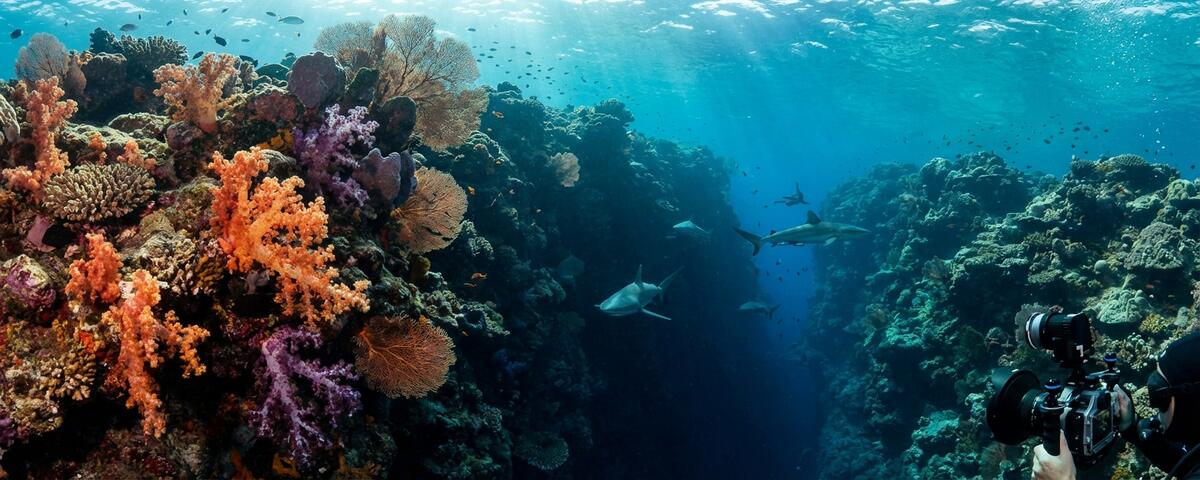
Lion's Head is one of the oldest and most celebrated shark points in the Maldives, sitting south of Thilafushi reef in a natural channel break about 45 minutes by dhoni from Malé. The site earned its name from a distinctive rock overhang at around 15 metres that, viewed from a certain angle, resembles the profile of a lion's mane and jaw. It is a protected marine area under Maldivian law, which tells you everything you need to know about what the government thinks of this reef's ecological value.
The topography is what makes this dive site exceptional. A reef top sits at roughly 3 metres, then the wall drops away steeply to 40 metres before plunging into genuinely deep water beyond recreational limits. Within the first 25 metres, the wall is broken up by caves, overhangs, and projections that interrupt the tidal flow and create upwellings. These structural features do two things simultaneously: they provide shelter for an enormous density of invertebrate life, and they concentrate nutrients in the water column that draw pelagic predators into the area.
Before the Maldivian government designated it a marine reserve, dive operators used Lion's Head as a shark feeding station. The practice ended years ago, but the sharks never left. Grey reef sharks patrol the point in numbers that would have seemed unremarkable thirty years ago but now qualify as genuinely impressive given the state of shark populations across the Indian Ocean. The site sits in a channel, which means tidal currents carry nutrients and plankton past the reef wall twice daily. Sharks, tuna, and other open-water predators exploit these currents, congregating at the point where the reef breaks the flow.
North Malé Atoll was the first area in the Maldives to develop dive tourism back in the 1970s, and Lion's Head has been a fixture on dive itineraries ever since. The reef shows its age in the best possible way. Decades of protection have allowed soft coral colonies to grow to sizes you rarely see on more heavily trafficked sites. The gorgonian fans on the deeper overhangs are massive, some exceeding a metre across, and the density of filter feeders along the wall tells you the current delivers a reliable food supply.
The channel position means this is fundamentally a current-driven dive. On a slack tide day, Lion's Head is pleasant but unremarkable. When the current is running, the wall comes alive. Schools of fusiliers stream past in dense formations, jacks hunt the edges, and the sharks appear from the blue to work the point. The transformation between slack and flowing water is dramatic enough that experienced guides in North Malé will time their visits around the tidal cycle rather than running the site on a fixed schedule.
Lion's Head works for intermediate divers comfortable with moderate current and wall diving, but the best of what the site offers requires advanced skills and a willingness to drop below 20 metres. The caves and overhangs between 15 and 25 metres hold the most spectacular soft coral growth and the greatest concentration of marine life. Above 15 metres, the reef is healthy and attractive but lacks the structural complexity that defines the site's character.
Marine Life at Lion's Head
Grey reef sharks are the headline act. They patrol the point where the reef breaks the channel current, typically at 15 to 25 metres depth. On a good current day, a dozen or more grey reefs work the area, cruising back and forth along the reef edge in a pattern that becomes predictable after a few minutes of watching. They are not aggressive toward divers but neither are they particularly shy. Hold a steady position on the wall and they will pass within comfortable photography range on their regular patrol routes.
Whitetip reef sharks share the deeper sections, usually closer to the wall than the grey reefs. They rest under overhangs during slack periods and become active as the current picks up. Nurse sharks tuck themselves into the caves at 20 to 25 metres, stacked two or three deep in the larger recesses. A good torch reveals them in the shadows, lying motionless on the sand floor of the cave.
Hawksbill turtles are genuinely common here. The protected status of the site means the turtle population has recovered well, and you can expect to see at least one or two on any given dive. They feed on sponges growing under the overhangs and are largely unbothered by diver presence. Green turtles pass through less frequently but regularly enough to keep your eyes scanning the blue.
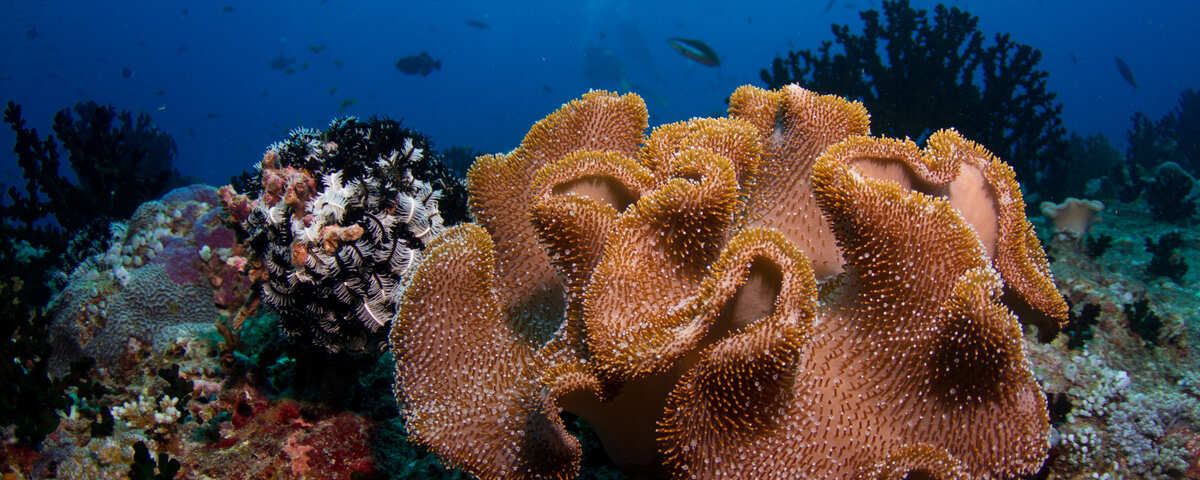
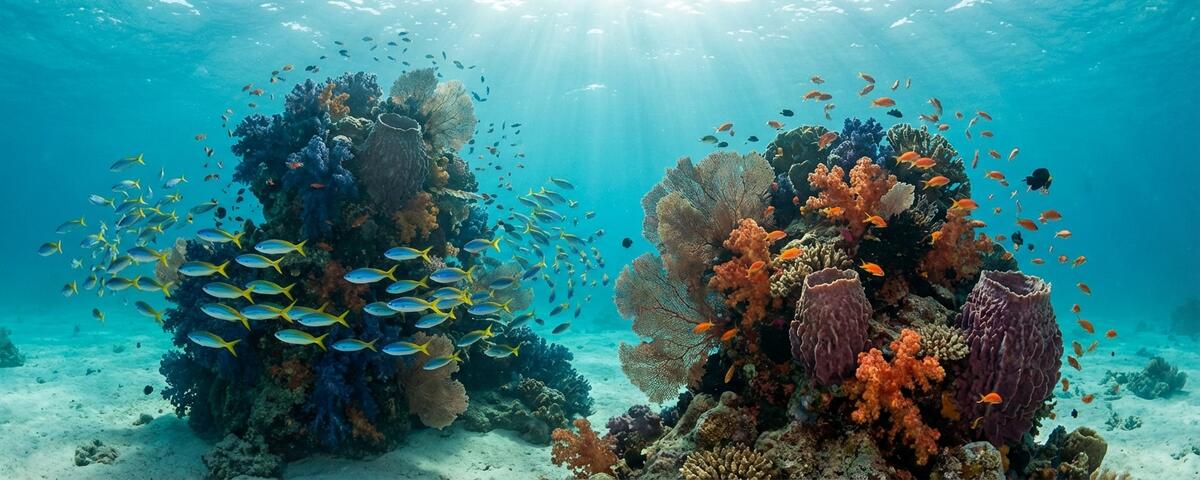
The wall itself is covered in an extraordinary diversity of invertebrate life. Soft corals in orange, red, and purple cluster on every available surface below 12 metres. Gorgonian sea fans spread across the current-facing edges of the overhangs, some of the largest specimens in North Malé Atoll. Sea whips anchor to the steeper sections. Barrel sponges grow on ledges throughout the wall. The colour palette on this reef is genuinely vivid, particularly between 15 and 22 metres where natural light still contributes but the depth is sufficient for soft coral colonies to thrive without competing with hard corals for space.
Napoleon wrasse cruise the reef edge with that slow, deliberate movement that makes them look perpetually unimpressed by everything. The individuals at Lion's Head are habituated to divers and will approach closely. Eagle rays pass along the wall, sometimes alone and sometimes in loose groups of three or four. They tend to stay deeper, at 20 to 30 metres, and move through quickly rather than lingering.
Schooling fish are a major feature when current is running. Blue-lined fusiliers pour past the wall in rivers of silver and blue. Yellowback fusiliers mix in, creating swirling columns of fish that shift direction in unison. Bigeye trevallies hunt the school edges, their bodies flashing silver as they turn. Yellowfin tuna occasionally blast through the schools at speed, creating momentary chaos as the baitfish scatter.
Look closely at the wall for the smaller residents. Leaf fish hide on ledges, their camouflage so effective that most divers swim past without noticing. False stonefish sit motionless on the reef surface. Lionfish hover under overhangs, their venomous fins fanned out. Redtooth triggerfish dart in and out of holes in the wall, their electric blue colouring unmistakable even in the deeper, bluer light. Moray eels occupy crevices throughout the site, with giant morays and undulated morays being the most commonly spotted species.
The cave interiors at 20 to 25 metres harbour cleaning stations where shrimp and small wrasse service larger reef fish. Sweetlips queue at these stations with a patience that borders on comical, hovering motionless while tiny cleaner wrasse pick parasites from their gills and skin.
Dive Conditions
Current defines every dive at Lion's Head. The site sits in a channel break, and the tidal flow determines what you see, how you dive, and whether the site delivers its full potential. Incoming current (ocean water flowing into the atoll) typically brings cleaner water, better visibility, and concentrates sharks and pelagics at the point. Outgoing current pushes atoll water seaward and can reduce visibility but still produces good fish action. Slack tide reduces the marine life activity noticeably.
Current strength ranges from negligible on neap tides to powerful during springs. Moderate current produces the best combination of fish activity and comfortable diving. Strong current makes the site challenging, particularly for divers who struggle to maintain position on the wall. Your guide will read the conditions before entry and plan the dive direction accordingly. On an incoming current, you typically enter at the outer reef point and drift with the flow along the wall. On an outgoing current, the reverse approach works.
Visibility ranges from 10 metres on a turbid day with outgoing current to 30 metres on a clean incoming flow during the northeast monsoon. The realistic average sits around 15 to 25 metres. January through April delivers the most consistent visibility as the northeast monsoon brings calmer seas and less suspended particulate. The southwest monsoon season from May to November can produce patchier conditions, though individual days of excellent visibility occur throughout the year.
Water temperature holds between 26 and 29 degrees Celsius year-round. The equatorial position means seasonal variation is minimal. A 3mm full wetsuit is standard for most divers. Those doing three or more dives daily across multiple days may prefer a 5mm for thermal comfort on repetitive exposures.
The reef top at 3 metres provides a comfortable safety stop area with enough coral and fish life to keep you occupied. Surface conditions in the channel can be choppy when wind opposes current. Boats typically operate a live drop and pickup, deploying divers upcurrent and collecting them downcurrent, which minimises surface swimming.
The wall drops steeply from 3 to 40 metres, and the most interesting features sit between 10 and 25 metres. Depth management matters here because the wall's angle makes it easy to drift deeper than planned while peering into caves or following a shark. Watch your computer and set a depth alarm if you carry one. The deep water beyond 40 metres offers nothing that justifies the decompression penalty.
The site is diveable year-round with no closed season. Protected marine area rules prohibit anchoring on the reef. All boats use drift diving protocols or moor at designated points away from the reef structure.
⚓ Divemaster Notes
Read the current before every entry. Lion's Head is a channel site and the tidal state changes the entire character of the dive. Check surface flow against the reef, confirm the tide direction with your boat captain, and plan your entry point and drift direction accordingly. Getting this wrong means fighting current for the entire dive while your group burns air and misses the action.
The caves and overhangs between 15 and 25 metres are the site's best features, but they demand respect. Silt accumulates on cave floors and a single careless fin kick can reduce visibility inside an overhang to zero. Brief your group on frog kick technique before the dive. If anyone in the group has questionable buoyancy or fin control, keep them on the shallower wall and skip the caves entirely. A silted-out cave at 22 metres with a panicking diver inside is a scenario you never want to manage.
For shark encounters, position your group on the reef wall at the point where the channel current hits the reef. This is where the grey reefs congregate. Do not chase. Hold position at 15 to 20 metres, control your breathing, and let the sharks come to you. Groups that swim toward the sharks scatter them and ruin the encounter for everyone. A still, quiet group at the current point will see more sharks in five minutes than a chasing group sees in forty.
Depth management is critical. The wall drops steeply and the best features sit at progressively greater depths. It is very easy for divers to creep below 25 metres while exploring caves or following a Napoleon wrasse downward. Set a maximum depth in your briefing and enforce it. The deep water beyond 30 metres adds decompression obligation without adding proportional value to the dive.
Nurse sharks resting in caves are not to be disturbed. Brief your group to observe from the cave entrance rather than swimming inside. A startled nurse shark in a confined space creates a collision and entanglement risk that is entirely avoidable.
SMB deployment is essential before ascending above 5 metres. The channel sees regular boat traffic and divers surfacing without a marker are at genuine risk. Deploy from 5 to 6 metres and ascend on the line.
Photography note: the overhangs with soft corals at 18 to 22 metres produce the signature images of this site. Wide angle with dual strobes to fill the shadows under the overhangs and bring out the soft coral colours. The grey reef sharks at the current point are best photographed with a wide rectilinear lens from a static position, letting the sharks approach on their patrol routes. For macro work, the leaf fish and false stonefish on the wall ledges reward patient searching, but finding them requires a guide who knows their usual positions.
How to Get to Lion's Head
Lion's Head sits approximately 45 minutes by dhoni from Malé, making it one of the more accessible premium dive sites in the Maldives. North Malé Atoll is the most developed tourism region in the country, and reaching the site requires no seaplane transfers or lengthy boat transits.
From Malé itself, several dive operators run day trips that include Lion's Head in their site rotation. The proximity to the capital means you can feasibly dive this site even on a short layover, though booking in advance is advisable. Operators typically depart early morning to catch optimal current conditions at the channel.
Himmafushi is the nearest inhabited island with established dive operations and budget guesthouse accommodation. The island sits in North Malé Atoll and offers dive trips at significantly lower prices than resort operators. From Himmafushi, Lion's Head is roughly 20 to 30 minutes by speedboat. Two-dive trips including equipment and guide run $70 to $100 USD.
Resort guests at properties throughout North Malé Atoll can access the site through their in-house dive centres. Resorts like Bandos, Kurumba, Baros, and Thulhagiri all include Lion's Head on their regular dive schedules. Resort diving prices range from $80 to $130 per dive depending on the property's positioning, but the boats, equipment, and guide-to-diver ratios reflect the premium.
Liveaboards departing from Malé harbour frequently include Lion's Head as a first-day or last-day dive, given its proximity to the embarkation point. Many central atoll itineraries open with Lion's Head and nearby sites like Manta Point at Lankanfinolhu before heading south toward Ari Atoll.
International flights arrive at Velana International Airport (MLE) on Hulhulé island, connected to Malé by the Sinamalé Bridge. From the airport, transfers to North Malé Atoll resorts are typically by speedboat, taking 15 to 60 minutes depending on the resort's location. Budget travellers heading to Himmafushi can take a public ferry from Malé (departures from Villingili terminal) for a few dollars, or arrange a speedboat transfer through their guesthouse for $25 to $40.
The site's proximity to the international airport makes it genuinely convenient for divers on tight schedules. Unlike sites in Ari Atoll or the southern atolls that require domestic flights or multi-hour boat transfers, Lion's Head is reachable within an hour of clearing customs.
Gear Recommendations
A 3mm full wetsuit handles the 26 to 29 degree water comfortably for most divers. Those doing multiple dives per day across several days may appreciate a 5mm for the cumulative thermal effect, particularly on deeper dives where the slight temperature drop at 25 metres becomes noticeable over time.
A dive torch is not optional at this site. The caves and overhangs that define Lion's Head are dark inside, and the nurse sharks, shrimp cleaning stations, and soft coral colours are invisible without artificial light. At depth, a torch also restores the true reds, oranges, and purples that the water column filters out. Something in the 1000 to 1500 lumen range handles the overhangs well without being excessive. A backup light is good practice for any cave penetration, even the shallow overhangs here.
Surface marker buoy and reel are mandatory. The channel sees boat traffic throughout the day and surfacing without a visible marker is a genuine safety risk. Most operators provide SMBs but bringing your own ensures reliability. A brightly coloured SMB with at least 1.5 metres of height above the surface is ideal for the sometimes choppy channel conditions.
Reef hooks are not standard for this site. The current rarely reaches the intensity that demands hooking in, and the protected marine area status means reef contact should be minimised. If current is exceptionally strong, your guide will adjust the dive plan rather than hook the group onto the reef.
Nitrox (EANx32) extends bottom time on the deeper wall sections significantly. An extra 10 to 15 minutes at 20 metres is the difference between a rushed peek at the caves and a proper exploration. Multiple operators in North Malé offer Nitrox for $5 to $15 per tank. Worth every cent at this site.
For photography, the site rewards a wide-angle setup. The overhangs filled with soft corals, the grey reef sharks on the point, and the wall dropping into blue water are all wide-angle subjects. Dual strobes are essential for the cave and overhang shots where ambient light is minimal. A fisheye lens captures the full drama of the wall and shark encounters. Macro photography works for the leaf fish, false stonefish, and cleaning station details, but this is fundamentally a wide-angle dive site.
Most North Malé operators provide full rental equipment. Resort dive centres maintain higher equipment standards than budget guesthouse operations. Your own mask, computer, and wetsuit always perform better than rental gear, and if you are making the trip to the Maldives specifically for diving, bringing your core equipment is worthwhile.
Recommended Dive Operators
Euro Divers operates from multiple resorts in North Malé Atoll including Kurumba and Vilamendhoo. Their guides have extensive experience at Lion's Head across all current conditions and seasons. PADI five-star centre with well-maintained equipment and small group sizes. They time their visits to Lion's Head around tidal windows rather than running a fixed schedule, which significantly improves the quality of the dive.
Ocean Group Maldives runs operations from several North Malé Atoll resorts. Professional outfit with experienced local guides who grew up diving these reefs. Their briefings are detailed and their current-reading skills are the product of thousands of dives in these channels. Equipment is modern and regularly serviced.
Bandos Diving runs from Bandos Island Resort, one of the older resort operations in North Malé. The proximity to Lion's Head means they can hit the site at short notice when conditions are optimal. Their team includes several instructors with over a decade of experience specifically in North Malé Atoll. Nitrox available.
Himmafushi dive operators offer the best value for budget-conscious divers. Several small operations on the island run daily trips to Lion's Head and surrounding sites. Quality varies, so check recent reviews. The better operations maintain good safety standards and employ guides who know the site intimately. Prices are roughly half what resort operators charge.
For liveaboard access, the Maldives Aggressor includes Lion's Head on its North Malé itinerary and carries experienced guides with years of site-specific knowledge. Emperor Divers' liveaboard fleet also visits the site regularly on central atoll routes. The liveaboard advantage is timing flexibility: they can hit the site at the precise tidal window that produces the best shark and pelagic action.
Liveaboard Options
Lion's Head sits in North Malé Atoll, the departure point for most Maldives liveaboard itineraries, making it one of the easiest premium sites to access from a safari boat.
The Maldives Aggressor includes Lion's Head as a regular stop on its central atoll routes. The boat departs from Malé harbour and typically dives North Malé sites on the first day before heading south. Their onboard guides have years of site-specific experience and time the dive to coincide with optimal current conditions. Pricing runs $250 to $400 per person per night depending on cabin and season. Nitrox included.
Emperor Explorer and Emperor Serenity run routes through North and South Malé that frequently feature Lion's Head. Their "Best of Maldives" itinerary typically opens with this site alongside Manta Point at Lankanfinolhu. Pricing ranges from $200 to $350 per night. Camera facilities onboard include rinse tanks and dedicated charging stations.
Ocean Divine targets the mid-range to premium market with itineraries that include Lion's Head, Wattaru Kandu, and Manta Point as a North Malé package before continuing to South Malé and Ari Atoll. Their boats are well maintained with good food and comfortable cabins. Group sizes tend to be smaller than the larger operators.
Carpe Diem and Carpe Vita operate central atoll routes with a focus on personalised guiding and smaller group ratios. Their premium positioning at $250 to $400 per night delivers on service and guide quality. Camera facilities are above average.
Budget liveaboard options operate from Malé on shorter two to four-night circuits covering North and South Malé Atoll sites. These locally operated boats run $150 to $200 per night with variable but generally acceptable standards. The diving is identical since everyone visits the same sites, but cabin comfort, food, and safety equipment quality differ from the premium operators.
Peak season from January through April commands higher prices and earlier booking requirements. The shoulder months of May, November, and December offer lower rates with only marginally different conditions. For a first-time Maldives liveaboard trip, a route that includes Lion's Head alongside South Malé and northern Ari Atoll covers the greatest diversity of dive experiences in the shortest itinerary.