Sunken Island Dive Site
Moalboal (Cebu), Philippines · Near Moalboal
Overview
Sunken Island is Moalboal's adrenaline dive, the site that separates casual visitors from divers who specifically came for a submerged pinnacle in the open sea with strong current and pelagic action that the comfortable shore dives along Panagsama Beach cannot deliver.
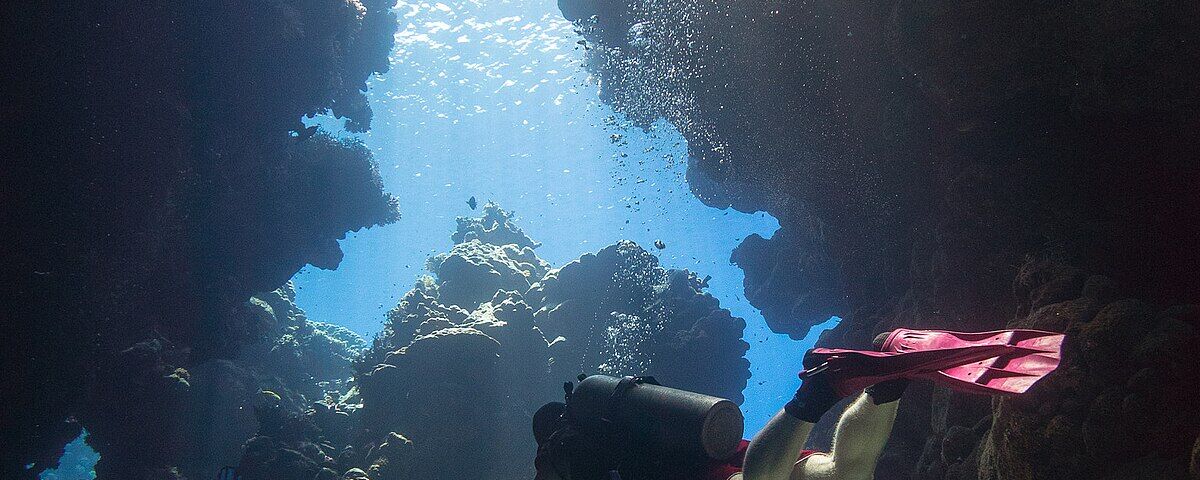
The site is exactly what the name suggests: a submerged seamount rising from the deep ocean floor to a summit at approximately 25 metres below the surface. There's no land above water, no visual reference on the surface. Your boat drops you in open blue water, and you descend 25 metres straight down through nothing before the pinnacle materialises below. For divers accustomed to wall diving where the reef is always within reach, this free descent is a genuine psychological challenge.
The pinnacle top is a coral-covered plateau that drops away on all sides to depths well beyond recreational limits. The surrounding ocean floor is estimated at over 400 metres deep. This position in open water, combined with moderate to strong current, creates conditions that concentrate pelagic species around the pinnacle. Schools of jacks, trevally, and barracuda are the standard fare, with reef sharks and the occasional hammerhead reported during the right conditions.
Current is the defining factor. On calm days, Sunken Island is a manageable advanced dive with excellent marine life. On strong current days, holding position on the pinnacle top requires reef hooks and considerable effort. Guides monitor conditions carefully and cancel when the current exceeds safe limits.
Sunken Island is a special trip from Moalboal, requiring a 15 to 20-minute banca ride into open water. The site commands a premium over standard dive pricing. Weather and current conditions determine availability.
The limitation is clear: this is a demanding dive. The depth (25 metres minimum at the summit, with easy temptation to go deeper), the current, and the blue water descent combine to produce a dive that genuinely requires advanced skills.
The blue water descent deserves honest discussion. For many divers, this is their first experience dropping through open water with no visual reference except their buddy and the dive computer. The pinnacle appears gradually from the blue below, and until it materialises, the descent feels exposed and disorienting. Vertigo is real for some divers, particularly those who are used to wall diving with a solid reef always visible to one side.
The pinnacle itself is not large. The summit plateau is perhaps 30 metres across at its widest, which means a group of divers can explore the entire top surface in a single dive. The limited size concentrates the marine life, making the experience feel more intense than a sprawling reef of equivalent depth.
Marine Life at Sunken Island
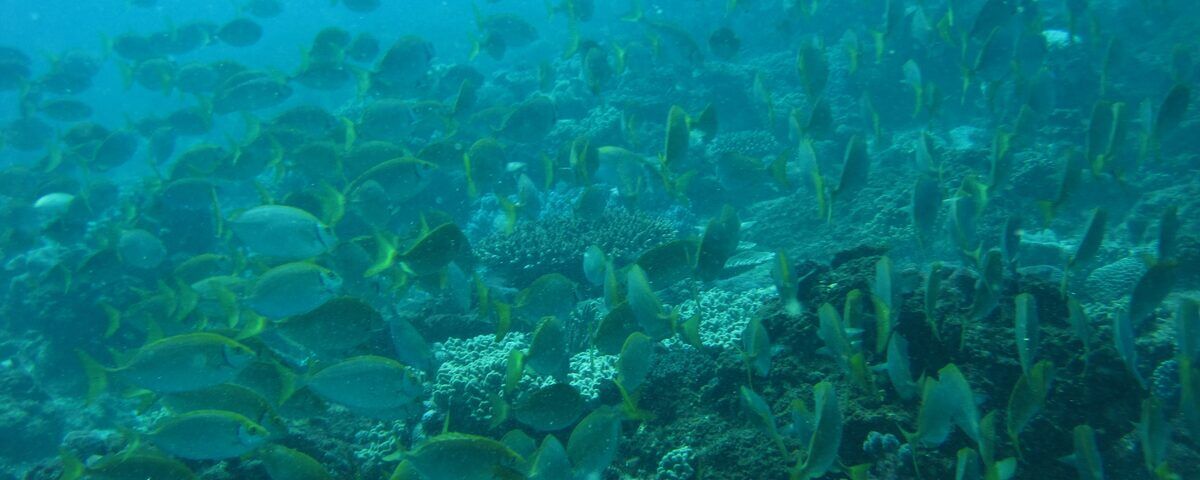
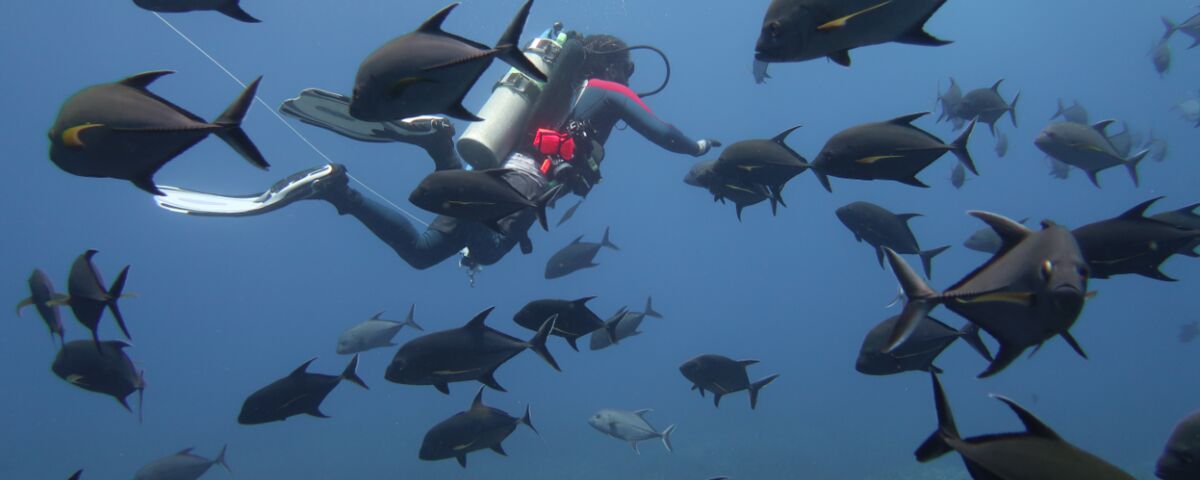
The pinnacle top hosts schooling jacks in large formations, often hundreds of fish circling the summit in a living tornado. Trevally hunt through the schools, and the predator-prey dynamics create explosive moments of scattering fish.
Barracuda form schools in the blue water off the pinnacle edge. Great barracuda appear as solitary hunters, while chevron barracuda school in groups of 20 to 50. Reef sharks (white-tip and grey reef) patrol the pinnacle's edges. Hammerhead sharks have been reported, though sightings are rare and seasonal.
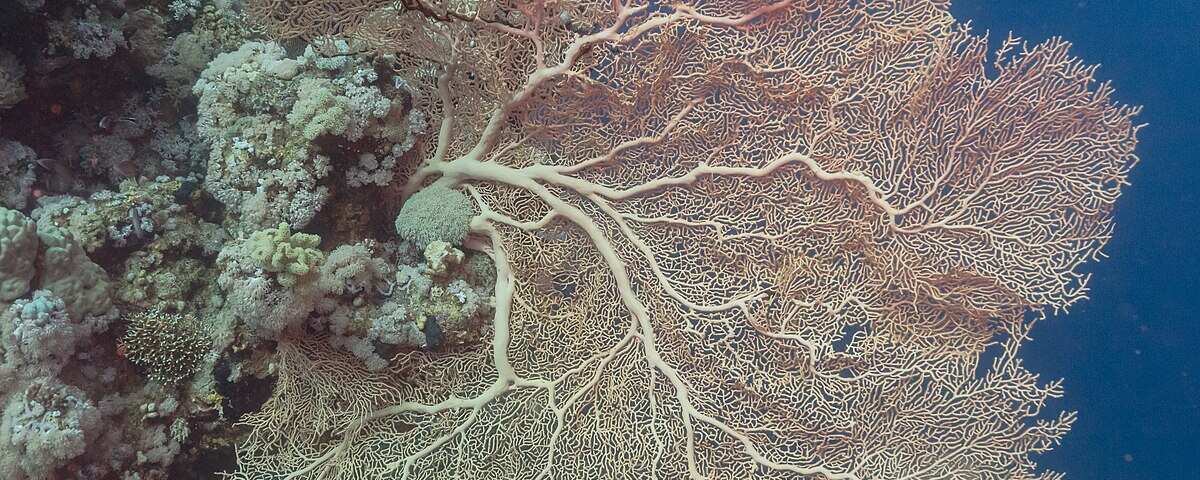
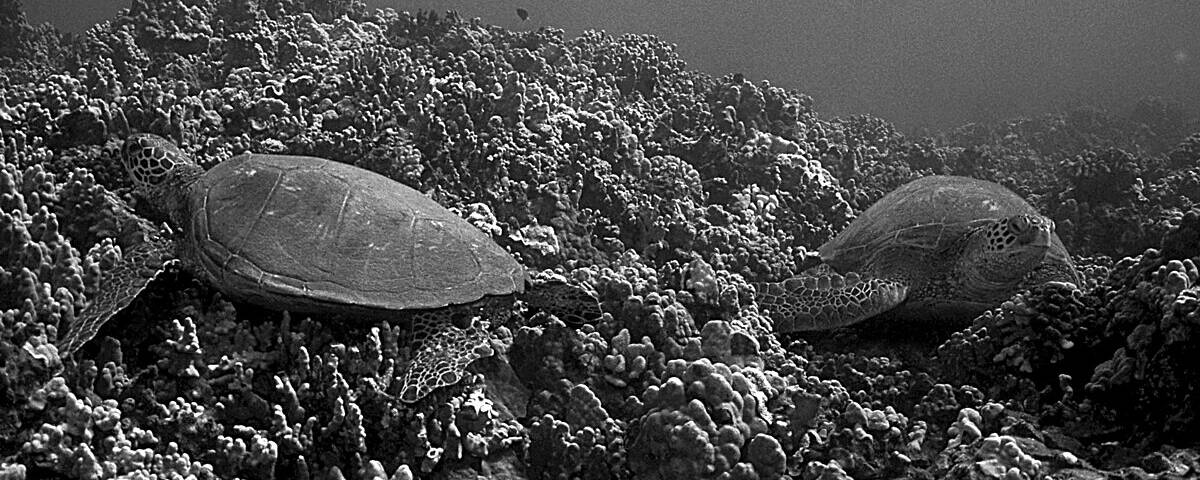
The pinnacle's coral coverage is healthy but dominated by robust species: encrusting corals, low-profile hard corals, and gorgonian fans that bend in the flow. Soft corals extend from the rock on current-sheltered faces.
Tuna pass through regularly, drawn by baitfish concentrations. Eagle rays are occasional visitors, typically seen ascending from the deep along the pinnacle's flanks. The descending walls host anthias clouds in the upper sections, thinning as depth increases.
The baitball events that occasionally occur at Sunken Island are among the most dramatic wildlife spectacles in the Moalboal area. When sardines or other small fish aggregate over the pinnacle, the predators respond en masse: trevally attack from below, barracuda circle from the sides, and the occasional pelagic hunter (tuna or wahoo) streaks through at speed. These events are unpredictable but happen often enough to be a genuine possibility on any given dive.
During the cooler months (January to March), thermocline conditions can bring unusual species to the summit. The colder water from the deep carries nutrients that change the plankton community, which in turn alters the fish assemblages. Hammerhead sightings, though rare, are concentrated in this cooler period.
The pinnacle's summit supports a small but healthy hard coral community that clings to the rock despite the current. These resilient colonies attract the herbivorous fish that graze on the algae around them, and the herbivores in turn attract the predators. The entire food web plays out on a platform smaller than a tennis court, compressed by the seamount's isolation into an unusually dense ecosystem.
Sea snakes are occasional visitors to the summit, typically banded sea kraits hunting small fish among the coral. Their presence adds another predator to the already busy food web, and their graceful swimming between the surface and the summit creates interesting photographic opportunities against the blue water backdrop.
Dive Conditions
Current ranges from moderate to strong and can change during a dive. The exposed position means the pinnacle catches the full force of tidal flow.
Visibility ranges from 10 to 30 metres, with better clarity during the dry season. Plankton blooms can reduce visibility but often correspond with increased pelagic activity.
Water temperature is 25 to 29 degrees, with occasional thermoclines bringing cooler water from the deep. A 3mm wetsuit is minimum; 5mm recommended during cooler months.
The dive starts with a blue water descent to 25 metres (the summit), then explores the pinnacle top and upper walls. SMB essential for the blue water safety stop. Reef hooks useful for stabilising in current.
Advanced Open Water certification with deep dive experience is the genuine minimum.
The remoteness of the site means that rescue and hyperbaric facilities are not immediately accessible. The nearest chamber is in Cebu City, several hours away. Dive conservatively, carry adequate safety equipment, and ensure your operator has emergency oxygen and a clear evacuation plan. This is not a site for pushing limits.
⚓ Divemaster Notes
Sunken Island is the dive I use to gauge whether someone is genuinely an advanced diver or just holds the certification card. The blue water descent to 25 metres with no reference point tells me everything I need to know about their comfort level.
I time the dive for slack water or the beginning of a tidal change, when current is building but not yet overwhelming. The worst scenario is dropping in during peak flow and watching the pinnacle slide past as the current carries the group away from the site.
The jacks are the reliable show. They circle the summit like a living curtain, and positioning yourself in the middle of the school is one of the most immersive fish experiences in Moalboal. But you need to be still. Chasing them scatters the school and ruins it for everyone.
I carry two SMBs on this dive. If the primary fails to inflate properly in current, the backup is the difference between the boat finding you and a very bad day. Every diver in the group deploys their own SMB as well.
Bottom time management is critical. At 25 metres, you get about 25 minutes on air before no-deco limits compress. Nitrox extends this to roughly 35 minutes. The temptation to drop below the summit to 30 or 35 metres for the sharks will eat your time budget fast.
For photographers, the challenge at Sunken Island is the current. Getting a stable position for composition is difficult when the flow is pushing you across the summit. I advise wide-angle shooters to hook onto a rock (dead substrate only) and use the stability to frame the schooling fish. Without stabilisation, the images will be motion-blurred and frustrating.
The ascent from Sunken Island is the most exposed safety stop in the Moalboal area. You're hanging in blue water at 5 metres with nothing around you, so the SMB line becomes your anchor. I deploy mine at 10 metres to give the boat plenty of time to track my position before I reach the surface.
How to Get to Sunken Island
Sunken Island sits approximately 2 kilometres offshore from Moalboal, 15 to 20 minutes by banca from Panagsama Beach. The trip is weather-dependent. Moalboal is 3 hours from Cebu City by road, with flights arriving at Cebu-Mactan International Airport.
Gear Recommendations
3mm to 5mm wetsuit depending on season. SMB essential (carry a backup). Reef hook for stabilising in current. Wide-angle lens for the pelagic schools and pinnacle profiles. Nitrox strongly recommended. Dive computer with conservative settings. Adequate surface signalling devices for open water.
A backup mask is worth carrying on this dive. Losing a mask in the blue water descent with no reef to anchor on creates a serious problem. Similarly, a spare torch is useful if your primary fails during the deeper sections of the pinnacle exploration.
Recommended Dive Operators
Savedra Dive Center has the longest history of guiding Sunken Island and the best read on current conditions. Neptune Diving Adventure runs experienced trips with conservative safety protocols. Blue Abyss Dive Shop offers the trip for qualified divers with good guide-to-diver ratios.
Liveaboard Options
Sunken Island is a day-trip dive from Moalboal. No liveaboards serve this site specifically. Land-based operations from Panagsama Beach are the standard approach.