Buoyancy World Dive Site
Koh Tao (Gulf of Thailand), Thailand · Near Koh Tao
Overview
Buoyancy World is Koh Tao's purpose-built underwater training ground, sitting on a sandy slope just north of the Twins pinnacles off Koh Nang Yuan's west coast. Created as an island-wide community project in partnership with Save Koh Tao, the site was designed to spread diver traffic away from the natural reefs that were taking a hammering from thousands of student dives each month. What started as a handful of concrete structures on a bare sand bottom has grown into something genuinely interesting: a colony of hand-sculpted marine animal statues, skill platforms, and training frames scattered across a gentle slope between 8 and 16 metres.
The concept behind Buoyancy World is simple and, honestly, pretty clever. Rather than running every Open Water student through the same overused coral patches at Twins or Japanese Gardens, dive schools now have a dedicated area where fin pivots, mask clears, and hovering drills happen on sand and concrete instead of living reef. The artificial structures give students something to navigate around and reference their depth against, while the natural reef stays a fin kick away for the scenic part of the dive once skills are complete.
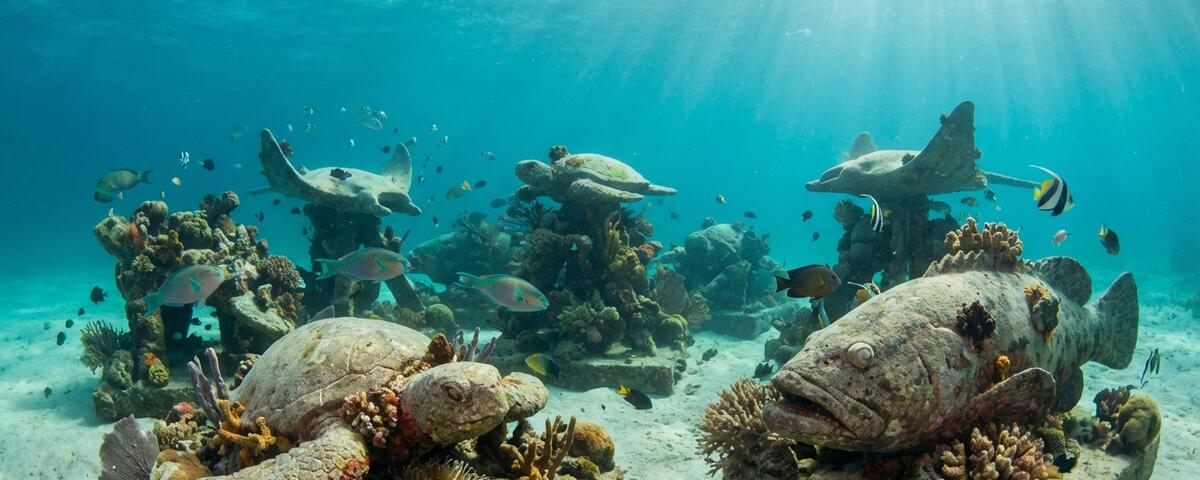
Concrete sculptures of sharks, octopuses, sea turtles, lizards, and various fish sit arranged across the sandy bottom. Some are life-sized. Others are deliberately oversized, built more for visual impact and photo opportunities than biological accuracy. Over the years since installation, these structures have begun doing exactly what artificial reefs are supposed to do. Coral larvae have settled on the rough concrete surfaces, algae coats the upper faces, and the crevices between sculptures shelter juvenile fish, nudibranchs, and the occasional moray eel who has decided a concrete octopus makes a perfectly good home.
The site works for more than just training. Certified divers visit to practise their buoyancy control in a consequence-free environment (no coral to damage if you sink), photographers use the sculptures as creative subjects, and the growing marine colonisation gives conservation-minded divers a real-time case study in how artificial reefs develop. It is not the most dramatic dive on Koh Tao. Nobody is pretending otherwise. But it fills a role that no natural site on the island can, and it does it well.
Marine Life at Buoyancy World
The marine life at Buoyancy World reflects a reef in its early-to-middle stages of development, which makes it more interesting from a biological perspective than most people expect from an artificial site.
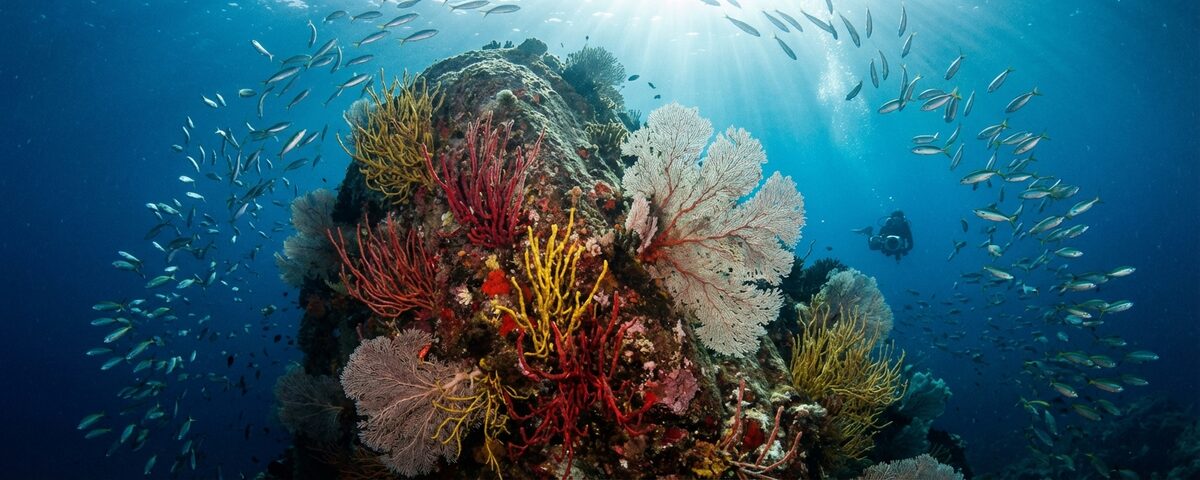
Coral colonisation is the headline story. Hard coral recruits, primarily Porites and encrusting Montipora species, have attached to the upper and current-facing surfaces of the concrete structures. Growth rates vary depending on light exposure and water flow, but several of the older installations show coverage that is genuinely impressive for structures that have been submerged for only a few years. Soft corals appear in patches, particularly on the deeper structures where reduced light favours them over their hard coral competitors.
Algae coats most horizontal surfaces, which in turn supports a small but consistent grazing community. Parrotfish visit to scrape the concrete. Surgeonfish and rabbitfish browse the algal film. Damselfish have claimed territories around the larger sculptures and defend them with the absurd aggression that damselfish are famous for.
The gaps between and underneath the concrete structures create sheltered microhabitats. Juvenile sweetlips huddle in small groups beneath overhangs. Cardinalfish hover in clouds around the shaded sides of larger sculptures. Scorpionfish sit on sandy patches between installations, their camouflage working just as effectively against bare substrate as it does against natural reef. Banded coral shrimp and cleaner shrimp occupy crevices, sometimes setting up cleaning stations that attract passing wrasse and butterflyfish.
Blue-spotted stingrays are regular visitors to the sandy areas between structures. They rest on the bottom during the day and flush out when divers approach too closely. Pufferfish patrol the area at a characteristically unhurried pace. Moray eels have moved into several of the hollow structures, their heads visible from the entrance holes that were either designed for this purpose or have been conveniently adopted.
At night, the site transforms in the same way most Gulf of Thailand sites do. Crabs emerge from inside the sculptures. Hermit crabs drag themselves across the sand between structures. Shrimp eyes reflect torch beams from every crevice. The concrete surfaces that look plain in daylight reveal a coating of feeding organisms after dark, tiny tube worms, hydroids, and bryozoans that retract during the day and extend their feeding apparatus at night.
Dive Conditions
Buoyancy World benefits from the same sheltered position that makes the Twins and Japanese Gardens area so reliable for training dives. Sitting in the lee of Koh Nang Yuan on the western side, it catches minimal swell from either the northeast or southwest monsoon directions. Surface conditions are calm on most days, and the sandy bottom means there is no surge to speak of even when seas are rougher elsewhere around the island.
Currents are typically absent or so mild they barely register. On the rare occasions when tidal flow picks up through the channel between Koh Tao and Koh Nang Yuan, the current at Buoyancy World stays manageable for even the most inexperienced divers. This predictability is the whole point. You cannot run buoyancy training courses if your students are fighting current instead of practising hovering.
Visibility follows the usual Gulf of Thailand patterns. Good days deliver 15 to 20 metres with blue-green water that photographs well. Average days sit around 8 to 12 metres, perfectly adequate for training and enjoyable for fun dives. Poor visibility days, typically after storms or during strong tidal shifts, drop to 5 metres or below. The sandy bottom can reduce visibility further if a group of students is kicking up sediment during skills practice, though experienced instructors position their groups to avoid this.
Water temperature holds steady between 27 and 30 degrees Celsius year-round. There are no thermoclines at this depth range. A 3mm wetsuit is more than sufficient, and many divers train in rashguards during the hotter months without any discomfort.
The best conditions run from March through September, matching the broader Koh Tao dive season. The site operates year-round, though, and cancellations due to weather are exceptionally rare given how protected the location is. Depth ranges from about 5 metres on the shallowest structures to 16 metres on the deeper sand where some installations have been placed, making it accessible for Open Water students on their first qualifying dives right through to Advanced students working on deeper skill sets.
⚓ Divemaster Notes
Buoyancy World does not get the respect it deserves from experienced divers, and I understand why. On paper, concrete sculptures on sand sounds about as exciting as watching paint dry. But there is more going on here than the brief description suggests, and how you use the site makes the difference between a forgettable dive and a surprisingly good one.
For training dives, the key is positioning your students relative to the current, however slight it may be. Face them into whatever flow exists so they drift back onto sand rather than into structures if they lose control. The sculptures are spaced far enough apart that a student who suddenly drops or surges forward is hitting sand, not concrete. That spacing is intentional and it works. I set up skills practice on the sandy flats between the two main sculpture clusters, then reward completed skills with a tour of the structures themselves.
The photography potential here is underrated. Concrete marine animals covered in real coral growth, with actual fish swimming around them, creates genuinely surreal compositions. Wide-angle shots of a diver hovering next to a concrete shark that has been colonised by soft corals tell a story about reef conservation that is worth more than another barracuda silhouette. Bring a wide-angle or fisheye and get creative with the angles.
For certified fun divers, I combine Buoyancy World with Twins on a single dive. Drop at Twins, work the natural pinnacles at 12 to 16 metres, then swim north to Buoyancy World for the second half of the dive at 8 to 12 metres. This gives you the natural reef experience and the artificial reef comparison in one profile, with the shallower section at the end serving as a natural safety stop zone. Air management works out perfectly.
Night dives here are a genuine surprise for divers who have already done the standard White Rock or Sairee night dives. The concrete structures create defined habitats that concentrate nocturnal life in predictable locations. You know where the morays are, you know which sculptures the crabs prefer, and you can plan a route that hits all the interesting spots without swimming in circles on a featureless sand flat.
One practical note: the site is popular with multiple schools simultaneously, particularly during morning sessions. If you are running a training group, arrive early or choose an afternoon slot. The difference in crowding is significant, and your students will have better focus without three other groups doing mask clears ten metres away.
How to Get to Buoyancy World
Reaching Buoyancy World follows the same logistics as any Koh Tao dive site: get to the island first, then take a short boat ride.
From Bangkok, the standard route is an overnight train or VIP bus to Chumphon (8 to 10 hours), then a high-speed catamaran with Lomprayah or Songserm to Koh Tao (1.5 to 2 hours). Combined tickets cost around 1,000 to 1,500 THB and are sold through travel agencies on Khao San Road and online. Flights from Bangkok to Chumphon Airport or Surat Thani Airport cut mainland travel to about an hour, but you still need the ferry connection.
From Koh Samui, the catamaran crossing takes roughly 2 hours and costs 600 to 800 THB. From Koh Phangan, it is about 1 hour. Ferry frequency drops during monsoon months but rarely stops entirely.
Once on Koh Tao, the boat ride to Buoyancy World takes 10 to 15 minutes from Mae Haad pier or Sairee Beach. The site sits just north of the Twins pinnacles, off the western shore of Koh Nang Yuan. Most dive boats visiting Twins, Japanese Gardens, or Koh Nang Yuan pass directly over it. Dive operators typically combine Buoyancy World with a second dive at one of the adjacent natural sites, making it part of a half-day morning or afternoon trip.
Accommodation on Koh Tao ranges from 300 THB backpacker rooms to 3,000 THB air-conditioned bungalows. Sairee Beach has the most dive shops and nightlife. Mae Haad near the ferry pier is convenient. Chalok Bay in the south is quieter. The island has ATMs, pharmacies, a small hospital, and a recompression chamber run by the SSS Network.
Gear Recommendations
A 3mm wetsuit handles everything Buoyancy World throws at you. Water temperature stays between 27 and 30 degrees, and the shallow depth profile means you spend the entire dive in the warmest layer. Shorties and rashguards work fine in the hotter months, though a full suit offers scratch protection if you are working close to the concrete structures.
Dive computer is recommended even at these modest depths. The multi-level nature of swimming between structures at different depths, then potentially continuing to Twins on the same dive, is exactly where a computer outperforms tables. Every dive shop on Koh Tao rents them if you do not have your own.
A torch adds value even on daytime dives. The undersides and interiors of the concrete sculptures shelter marine life that you simply will not see without directed light. Moray eels inside hollow structures, shrimp in crevices, nudibranchs on shaded surfaces. For night dives, primary torch plus backup is the minimum standard.
Photography gear is worth bringing. Wide-angle captures the full sculptures with divers for scale, which creates the best compositions at this site. Macro works for the growing number of small organisms colonising the concrete surfaces, though dedicated macro photographers will find more variety at natural reef sites nearby. If forced to choose one setup, go wide. The sculpted marine animals with real coral growth are the unique selling point here.
Surface marker buoy is good practice to carry. The area sees regular boat traffic between Koh Tao and Koh Nang Yuan, and surfacing with visible marker is standard precaution. Most operators on the island require certified divers to carry SMBs on all boat dives.
Recommended Dive Operators
New Heaven Dive School operates from Chalok Bay with a strong conservation focus and was directly involved in the creation and maintenance of Buoyancy World through its partnership with Save Koh Tao. Their instructors understand the site's ecological development better than anyone on the island and can explain what the colonisation patterns mean in real time. They run smaller groups and spend genuine time on the artificial reef rather than treating it as a brief stop before moving to adjacent sites. Crystal Dive is one of the largest PADI operations on Koh Tao and uses Buoyancy World regularly for their Open Water and Advanced courses. Their scale means reliable scheduling and a broad instructor team, with boats running to the Twins and Nang Yuan area almost daily. They handle the logistics well and their training standards are consistent across a large team. Big Blue Diving from Sairee Beach includes Buoyancy World in their course rotation and fun dive schedules. Their more experienced divemasters tend to find the macro life that casual visitors miss, particularly the nudibranchs and juvenile fish that have colonised the structures. They also run specialty courses in buoyancy control that use the site as their primary classroom. Ban's Diving Resort combines accommodation with dive packages that include regular visits to the Nang Yuan area sites. Their house reef at Sairee gives students extra practice between boat trips, and their instructors use Buoyancy World effectively for skills that need a forgiving environment.
Liveaboard Options
Koh Tao is a shore-based destination, and no liveaboard operation features Buoyancy World as a scheduled stop. The site is designed for day boats and training dives rather than the kind of destination diving that liveaboard itineraries are built around.
Occasional Gulf of Thailand liveaboard routes that run between Chumphon and the Ang Thong archipelago include Koh Tao stops. MV Nautica and similar vessels combine Southwest Pinnacles, Chumphon Pinnacles, Sail Rock, and a Koh Tao reef dive into 3 to 4-night trips between March and October. These routes might include a dive in the Twins and Nang Yuan area, which would put you within swimming distance of Buoyancy World, but it would not be the primary attraction.
For most divers, staying on Koh Tao and visiting Buoyancy World on a day boat from any pier on the island is the practical and cost-effective approach. The boat ride is under 15 minutes, the site rarely closes due to weather, and a week of shore-based diving on Koh Tao costs less than a single night on most liveaboards operating in Thai waters.