HTMS Sattakut (Wreck) Dive Site
Koh Tao (Gulf of Thailand), Thailand · Near Koh Tao
Overview
The HTMS Sattakut is a Second World War landing craft sitting upright on the seabed off Sairee Beach, Koh Tao, and it is comfortably the best wreck dive in the Gulf of Thailand. Originally built as USS LCI(L)-739 at the Commercial Iron Works in Portland, Oregon, the vessel was launched on 27 February 1944 and went straight into the Pacific theatre. She earned three battle stars across campaigns at Palau, Iwo Jima, and Okinawa before being reclassified twice during the war, first as a gunboat and then as a mortar craft.
After the war, she was commissioned into the Royal Thai Navy in 1946 as HTMS Sattakut 742, where she served for over sixty years. The navy decommissioned her in 2007, and on 18 June 2011, Thailand's Department of Marine and Coastal Resources deliberately sank her off Koh Tao as an artificial reef project. The initial sinking went sideways (literally), with the vessel landing on her starboard side in the sand rather than settling upright. A salvage team returned in August 2011 to right the wreck and reposition her roughly 40 metres south of the Hin Pee Wee pinnacle, where she sits today.
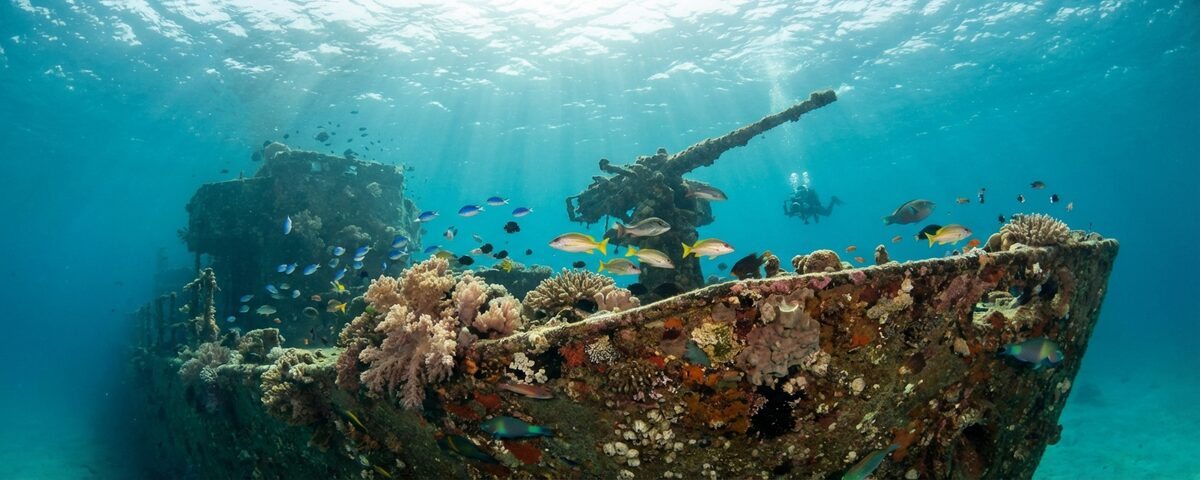
The ship is 48 metres long with a 7-metre beam, which makes her compact enough to explore thoroughly in a single dive but large enough to feel like a proper wreck. She sits upright with her bow pointing northwest, the keel at 27 to 30 metres and the wheelhouse topping out at around 18 to 19 metres. Two anti-aircraft guns remain mounted at bow and stern, Bofors 40mm cannons that are now completely encrusted in coral but still unmistakably military hardware. They are the most photographed features on the wreck and the first thing most divers swim towards.
What makes the Sattakut genuinely interesting, beyond the novelty of swimming around a warship, is how quickly the Gulf of Thailand colonised her. Barely fifteen years after sinking, the hull is blanketed in soft corals, sponges, and encrusting organisms. Hard coral colonies have established on the horizontal surfaces. The wreck functions as a living reef now, concentrating marine life in water that would otherwise be open sandy seabed. She went from military asset to marine habitat faster than anyone expected.
The boat ride from Sairee Beach or Mae Haad pier takes 15 to 20 minutes. Most operators run the Sattakut as a morning dive, often pairing it with a shallower second dive at Hin Pee Wee or White Rock nearby.
Marine Life at HTMS Sattakut (Wreck)
The exterior of the wreck is where most divers spend their time, and it delivers consistently. Giant groupers have claimed the Sattakut as home territory, with several large individuals (a metre or more in length) holding station under overhangs along the hull. They sit with that heavy, territorial stillness that groupers do, barely acknowledging divers unless you get close enough to make them uncomfortable. Yellowtail barracuda school above the wreck in loose formations, their silver bodies catching whatever light penetrates to depth.
Batfish are the wreck's unofficial welcoming committee. Longfin batfish drift alongside dive groups from the moment you reach the deck, maintaining a close but unhurried distance that borders on companionable. They are one of the most reliably photogenic encounters on any Koh Tao dive, and the wreck's structure gives them a backdrop that the open-water pinnacle sites cannot match.
The guns at bow and stern attract their own communities. The forward Bofors cannon is coated in a fur of hydroids and soft coral, and the space beneath it shelters Jenkins' whipray, a species that has become closely associated with this wreck. The stern gun sits deeper, around 28 to 30 metres, and lionfish favour the overhangs in this section. Red and brown lionfish spread their pectoral fins in the crevices between the gun mounting and the hull, their venomous spines displayed with what appears to be complete indifference.
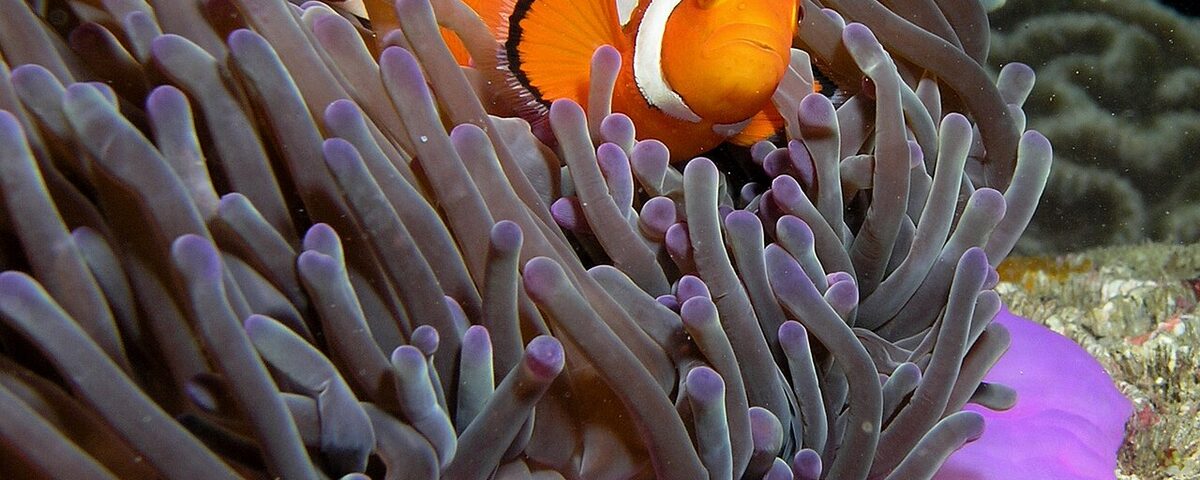
Along the hull, sea anemones have established in clusters, each hosting resident anemonefish. These are smaller colonies than the carpets you find on the Koh Tao pinnacle sites, but they stand out vividly against the dark metal of the hull. Nudibranchs populate the wreck's surfaces in good variety, including several Chromodoris species and the occasional Spanish dancer on night dives.
Banded sea kraits pass through regularly. They are venomous but docile, and encounters happen often enough that guides barely remark on them anymore. The snakes weave through the superstructure hunting small fish in crevices, and they are utterly unbothered by divers.
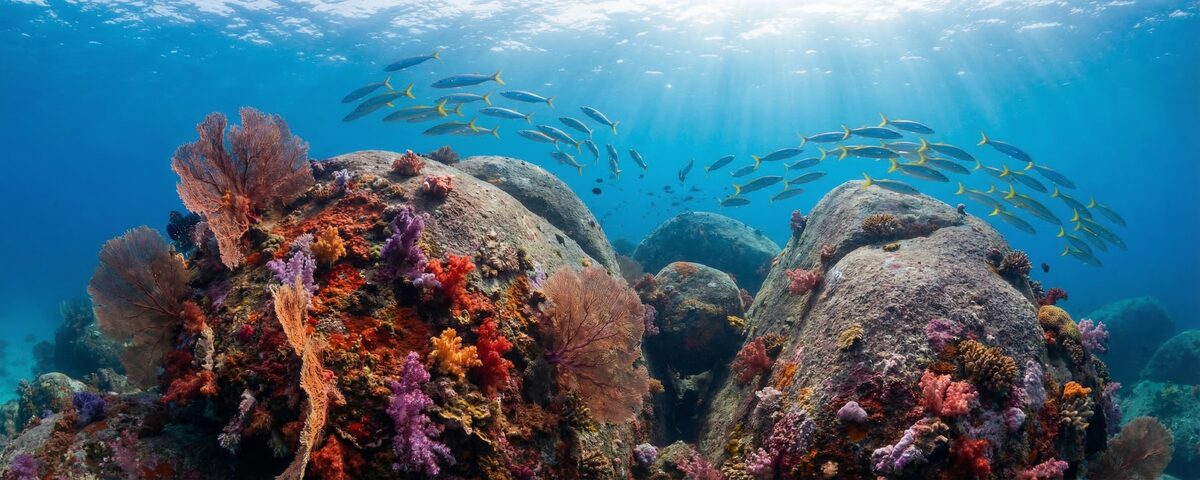
Schooling fusiliers and snapper mass above the wreck, particularly on current days when nutrient-rich water brings feeding activity. The wreck acts as an aggregation point in otherwise featureless seabed, which means the density of fish life here outperforms the surrounding area by a significant margin. On good days, the cloud of fish above the ship is thick enough to filter the light coming down from the surface.
Dive Conditions
Depth is the primary consideration. The wheelhouse at 18 to 19 metres is accessible to Advanced Open Water divers, but the main deck sits at 24 to 26 metres and the keel at 27 to 30 metres. Any meaningful exploration of the wreck puts you below 20 metres for the majority of the dive, which means air consumption runs higher than at Koh Tao's shallower sites and bottom time is noticeably shorter. A typical non-decompression dive on the Sattakut lasts 35 to 45 minutes depending on depth profile and breathing rate.
Visibility is the variable that makes or breaks the experience. The Gulf of Thailand is not renowned for crystal water, and the Sattakut sits on a sandy seabed that silts up when disturbed. On good days, visibility reaches 15 to 25 metres and the wreck reveals itself from a distance as you descend, which is the moment that makes the dive. On poor days, visibility drops to 5 metres or less, and you are navigating by feel as much as sight. The wreck is still interesting in low viz, but photographically it is a different proposition entirely.
Current at the site ranges from negligible to moderate. The wreck's position close to shore and relatively sheltered by the island means it rarely experiences the stronger currents that affect offshore sites like Southwest Pinnacles. When current does run, it typically moves north to south along the coast, and the wreck itself provides shelter on the lee side. Moderate current actually improves the dive by bringing clearer water and more fish activity.
Water temperature is a comfortable 27 to 30 degrees Celsius year-round. The Gulf does not produce the dramatic thermoclines that surprise divers on the Andaman side, so what you feel on the surface is what you get at depth. A 3mm wetsuit handles all conditions. Some divers go with a shorty, though full coverage is advisable given the wreck's metal surfaces and the tendency to brush against structures during penetration or close-quarters photography.
The best months run from March to September when the Gulf's western coast enjoys calmer seas and better visibility. The northeast monsoon from October to December can reduce visibility significantly and occasionally make the short boat crossing uncomfortable, though the site is close enough to shore that cancellations are rare. January and February are transitional.
Entry is by giant stride from the dive boat, with descent on a free line or following the mooring line to the wreck. Most operators have fixed moorings near the site.
⚓ Divemaster Notes
Route planning on the Sattakut depends entirely on the group's certification level and what they want from the dive. For Advanced Open Water groups on their first wreck dive, I keep things simple: descend to the main deck at 24 metres, swim the length of the ship from bow to stern along one side, cross over, and return along the other side before ascending to the wheelhouse for the final portion of the dive. This gives a complete tour of the exterior in 35 to 40 minutes without anyone needing to go below 26 metres.
For experienced wreck divers, the swim-throughs are the draw. The Sattakut has several entry points along the deck that lead into internal corridors. The main penetration route enters through a hatch near the stern, follows a corridor forward past several compartments, and exits through an opening amidships. The corridors are narrow (the ship was only 7 metres wide) and silt accumulation on the floor is real. I brief strict buoyancy and frog kicks before any penetration attempt. One diver dragging fins through the silt can reduce corridor visibility to zero in seconds.
The bow gun at around 22 metres is where I position groups for the classic photograph. Approach from slightly below and in front, shoot upward with the gun silhouetted against the surface light. The soft coral growth on the barrel adds colour that metal alone would lack. The stern gun at 28 to 30 metres is better for marine life encounters (the lionfish and whiprays tend to be concentrated here) but the depth limits time.
I always brief the Hin Pee Wee option. This small pinnacle sits about 40 metres north of the wreck and tops out at 10 to 12 metres. When the group has used half their air on the wreck, swimming to Hin Pee Wee for the safety stop and final portion of the dive is far more interesting than hanging on a line in blue water. The pinnacle has its own coral growth and fish life, and the contrast with the wreck makes it feel like a second dive.
Air management needs active attention here. The depth, the excitement, and the physical effort of finning around a three-dimensional structure all push consumption higher than divers expect. I brief for 200 bar starts, 80 bar turn-around signals, and I carry a pony bottle on every Sattakut dive. The combination of depth and potential penetration makes an independent air source more than just good practice.
Night dives on the Sattakut are outstanding and underrated. The wreck comes alive after dark, with lionfish actively hunting, crabs and shrimps emerging from every crevice, and the torchlight against the metal structure creating an atmosphere that reef dives simply cannot replicate.
How to Get to HTMS Sattakut (Wreck)
Koh Tao sits in the western Gulf of Thailand, part of Surat Thani province. The island is reached by ferry from the mainland or neighbouring islands.
From Bangkok, the most practical route is a combined bus or train ticket to Chumphon (8 to 10 hours overnight) followed by a Lomprayah or Songserm catamaran to Koh Tao (1.5 to 2 hours). The combined ticket costs roughly 1,000 to 1,500 THB. Flights from Bangkok to Chumphon or Surat Thani airports cut the land journey to a couple of hours, though you still need the ferry leg from the mainland.
From Koh Samui, the catamaran takes about 2 hours and runs 600 to 800 THB. From Koh Phangan, it is roughly 1 hour. Multiple daily departures run during high season, with reduced frequency during the monsoon months.
Once on Koh Tao, the HTMS Sattakut is accessed by dive boat from Mae Haad pier or Sairee Beach. The boat ride takes only 15 to 20 minutes heading west from Sairee, making this one of the most accessible wreck dives anywhere in the region. You can be on the wreck within half an hour of leaving your accommodation.
Sairee Beach on the west coast has the highest concentration of dive operators and is the most convenient base for diving the Sattakut. Mae Haad, where the ferries arrive, is equally functional and within walking distance of multiple shops.
Accommodation ranges from backpacker hostels at 300 to 500 THB per night through to comfortable mid-range bungalows at 1,000 to 3,000 THB. The island has ATMs, a small hospital, pharmacies, and a recompression chamber operated by the SSS Network.
Gear Recommendations
A dive computer is not optional on this dive. The multi-level profile (deck at 24 to 26 metres, wheelhouse at 18 metres, Hin Pee Wee at 10 to 12 metres) is exactly the kind of dive where a computer earns its keep by tracking your actual nitrogen loading rather than forcing you to plan for maximum depth. A 3mm full wetsuit provides both warmth and protection against the metal surfaces; brushing against corroding steel in a rashguard is asking for cuts.
Torch is essential, not optional. The interior compartments are dark regardless of surface conditions, and even on the exterior, a torch reveals colours in the coral and marine growth that are lost to blue shift at 25 metres. A primary torch with a backup is sensible if you intend any penetration.
Surface marker buoy (SMB) is standard kit for any Koh Tao boat dive but particularly important here. If current carries you during ascent, the boat needs to find you, and the site's proximity to other boat traffic means visibility on the surface matters.
For photography, wide-angle is the obvious choice for the exterior and the classic gun shots. A fisheye dome setup gives the dramatic wreck perspective that these images demand. But do not overlook macro: the wreck's surfaces are covered in small life that rewards close inspection. If forced to choose one lens, go wide. The architecture is the subject here.
Gloves are not permitted at Thai dive sites. Wreck gloves would be useful on the Sattakut, but the regulation exists to discourage grabbing coral, so work on your buoyancy instead. Reef hook is unnecessary at this depth and current level.
Recommended Dive Operators
Crystal Dive Koh Tao runs regular trips to the Sattakut with experienced wreck guides who know every entry point and photogenic angle on the ship. Their operation is large enough to maintain consistent scheduling and their guides manage mixed-ability groups well on deeper dives. Big Blue Diving has been operating on Koh Tao for decades and their guide team treats the Sattakut as a signature dive, with briefings that cover the wreck's history as well as the diving. Ban's Diving Resort maintains reliable scheduling for the Sattakut with a boat fleet that handles the short crossing comfortably, and they offer the PADI Wreck Diver speciality using this site as the primary training wreck. Roctopus Dive caters to the more experienced end of the market and runs small-group trips to the Sattakut that allow for slower, more detailed exploration. Their technical diving programme uses the wreck extensively for advanced wreck penetration courses. DPM Diving offers well-organised Sattakut trips with guides who focus on marine life identification alongside wreck orientation, which suits divers interested in the biology as much as the structure.
Liveaboard Options
Koh Tao is overwhelmingly a shore-based dive destination, and no liveaboards operate exclusively in the area. However, occasional Gulf of Thailand liveaboard itineraries include Koh Tao as a stop, combining the Sattakut with Chumphon Pinnacles, Sail Rock, and Ang Thong Marine Park over 3 to 4-night trips. These trips run seasonally and are less common than the Andaman Sea liveaboard market. MV Nautica and similar vessels offer these routes when demand warrants.
For the vast majority of divers, staying on Koh Tao and diving from day boats is the standard approach. The Sattakut is only 15 to 20 minutes from shore, which makes a liveaboard unnecessary for accessing this site specifically. Budget accommodation on the island combined with per-dive pricing from local operators works out significantly cheaper than any liveaboard option.