Samran Pinnacle Dive Site
Koh Tao, Thailand · Near Koh Tao
Overview
Samran Pinnacle sits roughly halfway between Sail Rock and Koh Tao, a submerged granite formation that most divers never hear about because the two famous neighbours either side of it steal all the attention. That obscurity is precisely what makes it worth visiting. The pinnacle rises from a sandy bottom at around 28 metres to a peak at 9 metres below the surface, and on a good day with clean water and manageable current, it delivers one of the best pelagic encounters in the Gulf of Thailand.
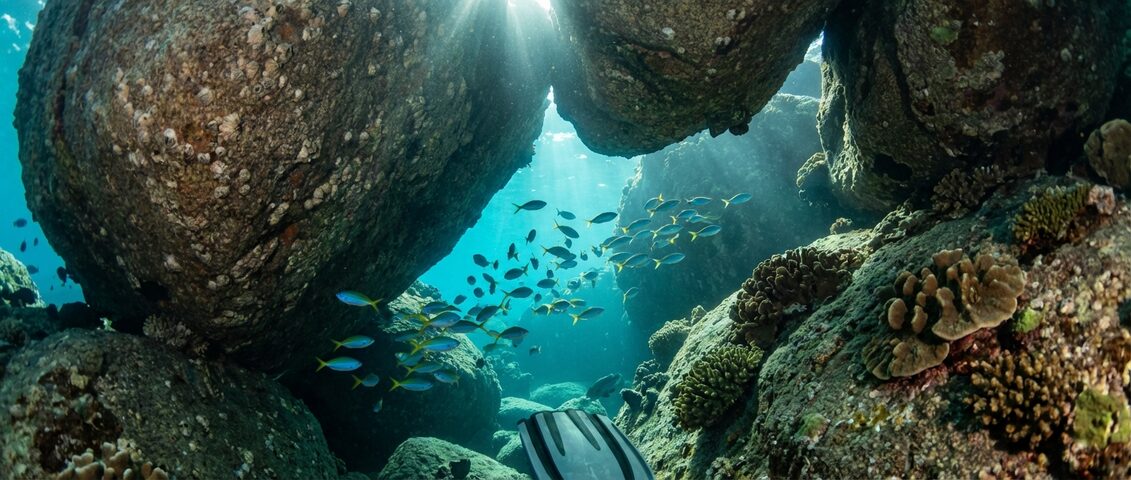
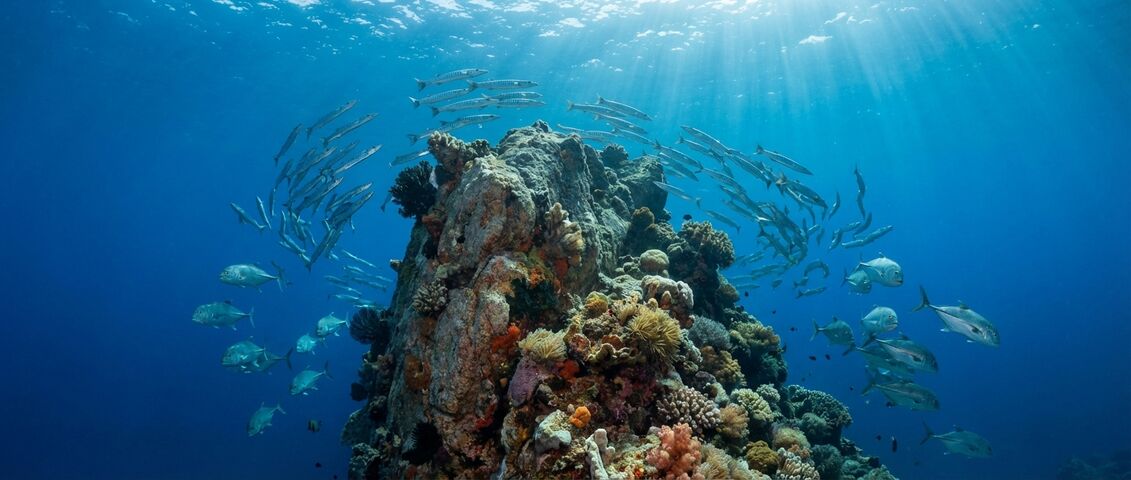
The site is compact. You can circumnavigate the main rock formation comfortably in a single dive, spending time at depth on the deeper flanks before spiralling upward through the fish schools that gather along the pinnacle's upper reaches. The granite structure itself is covered in anemones, hard corals, and barrel sponges that have colonised every available surface, but the real draw is what swims around it rather than what grows on it.
Barracuda are the headline act. Schools of great barracuda circle the pinnacle in slow, deliberate formations, sometimes hundreds strong, and they are remarkably unbothered by divers who approach calmly. Giant trevally patrol the edges, picking off smaller fish from the fusilier schools that stream past in current. On the deeper sand, blue-spotted stingrays shuffle between coral patches, and white-eye moray eels peer from crevices in the granite.
The site's position in open water means it catches the Gulf's tidal currents, which can run from negligible to quite punchy depending on the moon phase and time of day. That current is a double-edged sword: it brings the nutrients and plankton that attract the baitfish that attract the predators, but it also means you need to be comfortable managing drift and maintaining position at depth. This is not a beginner site, and dive centres rightly restrict it to advanced certified divers.
Samran Pinnacle is also one of Koh Tao's whale shark sites. Sightings are seasonal and unpredictable, concentrated around March to May and September to October when plankton levels peak in the Gulf. Nobody can guarantee a whale shark, but the pinnacle's position in the open channel between Koh Phangan and Koh Tao puts it directly on the migration path. More than a few divers have been circling the rock watching barracuda when a whale shark materialised out of the blue behind them.
Marine Life at Samran Pinnacle
Great barracuda dominate the scene here. Schools of 50 to 200 fish orbit the pinnacle at mid-depth, their silvery bodies forming tight cylindrical formations that rotate slowly in the current. They tend to hold station on the pinnacle's lee side, so which face of the rock they favour shifts with the tide. Individual fish reach well over a metre in length, and they tolerate close approach if you move slowly and avoid sudden gestures.
Giant trevally work the pinnacle independently and in loose groups of 3 to 8 fish. They hunt aggressively through the fusilier schools, their bursts of speed generating visible pressure waves in the water. Yellowtail barracuda sometimes form a second, smaller school distinct from the main great barracuda formation.
The granite surfaces host pink anemonefish in their host anemones, a common sight but always photogenic against the dark rock. Hermit crabs are surprisingly abundant in the crevices. White-eye moray eels occupy holes throughout the structure, and the occasional giant moray shows itself on deeper sections.
Blue-spotted stingrays rest on the sandy bottom at the pinnacle's base. Porcupinefish and boxfish shelter in the overhangs. Scorpionfish blend into the rock at various depths, a reminder to watch your hand placement. Nudibranchs are present for the macro enthusiasts willing to look closely between pelagic passes.
During whale shark season (roughly March to May, September to October), sightings at Samran Pinnacle are possible though never guaranteed. The sharks pass through in the water column above the pinnacle, sometimes descending to investigate the structure. Whale shark encounters here tend to be brief but spectacular: the fish appear from the blue, make a pass, and continue their journey through the Gulf.
Dive Conditions
The pinnacle's summit sits at 9 metres, with the main body of the rock between 12 and 22 metres where most of the interesting marine life concentrates. The base meets sand at approximately 28 metres, and scattered boulders extend slightly deeper for those with the gas and certification to explore them.
Current is the defining factor at Samran Pinnacle. On slack tide, the site is straightforward and calm. When the current runs, it can be moderate to strong, and holding position at depth requires effort. Most operators time their visits to coincide with slack or light current windows, but conditions can change during a dive as the tide turns. Carrying a reef hook is advisable for days when the current picks up mid-dive.
Visibility ranges from 10 to 25 metres depending on season and recent weather. The clearest conditions typically fall between March and May. During and after the monsoon season (November to January), visibility can drop to 10 metres or less, though the nutrient-rich water often coincides with the best fish action.
Water temperature holds between 27 and 30 degrees year-round. A 3mm shorty is sufficient for most divers, though a full 3mm wetsuit is more comfortable on repetitive dives or if you run cold at depth.
The boat ride from Koh Tao takes approximately 25 minutes. From Koh Phangan, it is roughly 30 to 40 minutes depending on sea state. Some operators combine Samran Pinnacle with Sail Rock on a multi-dive day trip, which is an excellent pairing if you have the surface interval time.
⚓ Divemaster Notes
I schedule Samran Pinnacle based on the tide tables, not the calendar. The difference between slack water and full tidal flow here is the difference between a relaxed dive watching barracuda at arm's length and a workout where you spend half your air fighting to stay in one spot. I check the charts the evening before and pick the window that gives us the calmest conditions at depth.
The descent is direct, down the mooring line to the pinnacle top at 9 metres. I take the group deeper first, dropping to 20 to 24 metres on the current-exposed side to check for trevally and the larger barracuda formations. The fish tend to stack at mid-depth on the upcurrent face, so reading the current direction before descending tells me which side to head for.
The circumnavigation works best anti-clockwise in a southerly current, clockwise in a northerly one. Going with the current on the first half of the circuit means you can relax and observe, then the sheltered lee side gives you a calm second half to ascend gradually.
I tell my divers three things before every Samran Pinnacle dive. First, keep your buoyancy tight because the current will push you off the rock if you are not neutral. Second, bring a reef hook and do not be embarrassed to use it. Third, check behind you every few minutes. The best sighting I ever had here, a 4-metre whale shark in April, came from behind the group while everyone was photographing barracuda. My buddy tapped my tank and pointed over my shoulder, and there it was, cruising past like it owned the ocean. It did.
For underwater photographers, the barracuda schools respond best to slow, patient approaches from below. Position yourself at 18 to 20 metres and let the school come to you rather than chasing them across the pinnacle. Wide-angle is essential. A dome port and 10 to 17mm lens covers both the barracuda formations and any whale shark surprises.
One safety note: the open water position means there is nowhere to shelter if conditions deteriorate. If the current exceeds your comfort level during the dive, ascending to shallower water where the pinnacle provides more shelter is always the right call. Pride has no place at 25 metres in a ripping current.
How to Get to Samran Pinnacle
Samran Pinnacle is accessed by dive boat from either Koh Tao or Koh Phangan. From Koh Tao, the journey takes about 25 minutes heading south towards Sail Rock. From Koh Phangan, it is 30 to 40 minutes heading north.
Koh Tao itself is reached by ferry from Chumphon (1.5 to 2 hours by catamaran) or from Koh Samui and Koh Phangan via inter-island ferries operated by Lomprayah and Seatran Discovery. Bangkok to Chumphon is roughly 8 hours by train or 1 hour by flight to Chumphon or Surat Thani airports.
Most dive operators on Koh Tao run Samran Pinnacle as part of a deep or advanced dive trip rather than as a standalone destination. The best approach is to book a 3-dive day trip that combines Samran Pinnacle with Sail Rock and Shark Island, covering three distinct environments in a single day. These trips typically depart early morning and return by mid-afternoon.
Koh Phangan-based operators also visit the site, with Blue Horizon Diving among those offering regular trips. The pinnacle's position between the two islands makes it accessible from either base.
Gear Recommendations
3mm full wetsuit or shorty depending on personal cold tolerance. Reef hook recommended, particularly during spring tides when current can be unpredictable. SMB and reel are mandatory for safety stops in open water with current. Wide-angle camera setup for the barracuda schools and potential pelagic encounters. Nitrox recommended to extend bottom time in the 20 to 24 metre range where the best fish action concentrates. Torch useful for illuminating crevices and moray eel dens on the granite walls.
Recommended Dive Operators
Crystal Dive on Koh Tao is one of the larger operations with experienced guides who know the pinnacle's current patterns well. They run regular advanced day trips that include Samran Pinnacle alongside Sail Rock. Black Turtle Dive specifically recommends the Sail Rock, Samran Pinnacle, and Shark Island three-dive combination as one of the best day trips available from Koh Tao. DivePoint Koh Tao offers the site as part of their advanced programme. From Koh Phangan, Blue Horizon Diving runs trips to the pinnacle with knowledgeable guides familiar with conditions in the channel between the islands.
Liveaboard Options
Samran Pinnacle is not typically a liveaboard destination, as Koh Tao's dive sites are all accessible by day boat. However, liveaboards transiting between the Gulf of Thailand islands occasionally stop here. The site is more commonly dived as part of a multi-site day trip from Koh Tao or Koh Phangan. For liveaboard experiences in the Gulf of Thailand, operators based in Chumphon and Koh Samui run seasonal trips that may include Samran Pinnacle alongside Chumphon Pinnacles, Sail Rock, and Southwest Pinnacles.